
 Buy gold bars
 Buy gold coins
 Series
 Buy silver coins
 Buy silver bars
 Series
 Buy silver collectible coins
 Silver collectible coin series
 Buy gold collectible series
 Gold collectible coin series
 Author:
  Date: 27 December 2024
Gold price forecast 2026: scenarios, opportunities and analysis
 Rolf van Zanten
11 December 2025
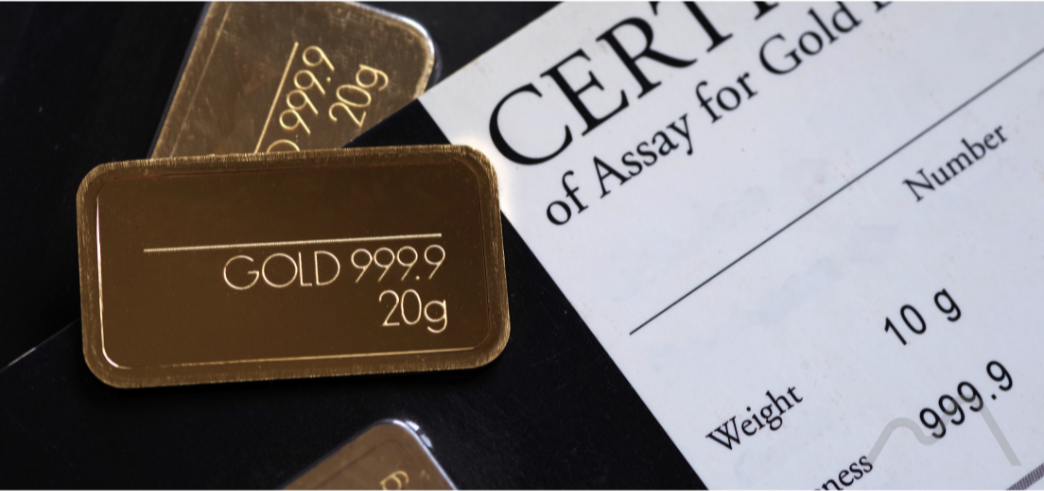
A gold certificate is a document or packaging that records the authenticity, purity and weight of a gold piece. It is issued by the refinery that produced the gold, often a refinery listed on the Good Delivery List of the London Bullion Market Association (LBMA), and typically contains a unique serial number that matches the number on the gold bar itself. Such a certificate of authenticity makes gold easier to verify and more tradable.
In this article you will read what a gold certificate is, what information is on it, how to check its authenticity and why certificated gold is accepted more readily worldwide. We also explain the difference between a certificate of authenticity and a gold certificate as an exchange product, because those are two very different things.
A gold certificate is proof of authenticity that belongs to a specific gold item and records its main characteristics. On the certificate, also called an assay card, you will typically find the purity (for example 999.9/1000), the weight, the name of the refinery and a unique serial number. With gold bars this certificate is almost always present; with gold coins it depends on the type of coin.
The certificate itself has no value. Value only arises in combination with the associated gold item: the certificate proves that the bar or coin is genuine and meets the specifications listed. Separate from the gold, a certificate is therefore nothing more than a document.
The term gold certificate is used for two completely different things, and that distinction is important to understand before you buy gold.
The first and most common meaning is the certificate of authenticity: a physical document or sealed packaging that accompanies your gold bar or coin and confirms its authenticity. This is what this article primarily deals with.
The second meaning is the gold certificate as an exchange product: a financial instrument that allows you to trade the value of gold without owning the physical metal yourself. The gold is then stored elsewhere and you hold a claim or interest.
On the market this usually refers to products such as Exchange Traded Funds (ETFs) or Exchange Traded Commodities (ETCs). Because you do not have the gold in your own hands, you are dependent on a third party. You can read more about that distinction in our article on digital gold versus physical gold.
A certificate of authenticity lists the key details used to identify and verify a gold item. In practice, these are the following components:
Not every certificate contains the exact same combination; the precise format varies by producer and product series. For some refineries the certificate is a separate document, while for others it is integrated into the packaging itself.
The gold bars from Umicore and C. Hafner, for example, are delivered in a sealed blister pack that also functions as a certificate of authenticity. This certificate is often called an assay card, a term that refers to the role of the assayer in determining the purity.
No, not every gold item is supplied with a certificate, and that's not always a problem. Whether a certificate is provided mainly depends on the type of gold.
Gold bars are almost always delivered with a certificate of authenticity or in a certified blister pack. Common gold bullion coins, such as the Krugerrand or the Maple Leaf, are usually sold without a separate certificate and are often supplied in tubes rather than individually packaged: their authenticity can be determined from the coin itself, which is struck by an official mint and is recognizable worldwide.
Gold collector coins, on the other hand, often do come with a certificate and a presentation box, because the mintage is limited and the numismatic value plays a role.
With pre-owned gold bars, the original packaging may also be missing or damaged. That does not automatically make the bar inauthentic, but it does mean that the producer, the weight and any test results play a larger role in the assessment. The absence of a certificate therefore does not mean that the gold is less reliable; the recognizability of the coin or additional checks then serve a similar function.
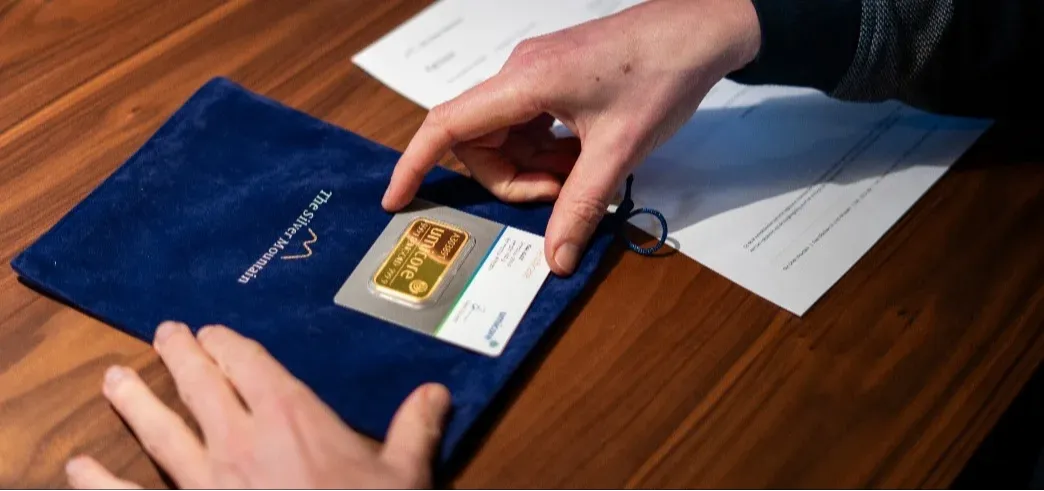
A gold certificate records the authenticity, purity, weight and often a serial number of a gold bar or gold coin.
You verify a gold certificate's authenticity by comparing the serial number on the certificate with the number on the gold bar and by checking the security features. A certificate itself can also be forged, so it's worth checking a few things:
Always assess these signs together. One single feature, such as only a hologram or only a serial number, is not decisive on its own. What a certificate does not do is prove the authenticity of the gold itself with absolute certainty.
If in doubt about the bar or coin itself, a physical check, such as a density test or an XRF analysis, remains the most reliable method. Read more about the role of gold markings in our article on LBMA and Good Delivery.
A lost certificate does not make your gold fake. The bar or coin itself remains unchanged, with the same purity, the same weight and, for a bar, the same engraved serial number. That serial number in the metal is and remains the primary feature; the loose document is a supplement, not a replacement.
If you store gold for a long time, the associated certificate may sometimes become separated from the bar, for example during a move or when clearing out old documents. In that case you can often contact the producer: some refineries will issue a duplicate or replacement certificate on request, usually upon presentation of the original purchase invoice. In that case, first contact the party you bought the gold from.
Take a photo or scan of your certificate and store it digitally, separate from the physical storage location of the gold itself. That way you still have the details at hand if the original document becomes damaged, is lost, or if certificate and gold would both be lost in theft or fire.
Gold with a certificate is generally easier and quicker to sell than gold without. For a buyer or dealer, an authenticity certificate removes some of the uncertainty: purity, weight and origin are documented.
| Characteristic | Gold with certificate | Gold without certificate |
|---|---|---|
| Proving authenticity | Easy, via document and serial number | Requires additional checks (test/analysis) |
| Marketability | Easily accepted worldwide | May be harder or slower to sell |
| Valuation | Clearly substantiated | Possibly lower offers due to uncertainty |
| Risk of dispute | Limited | Greater |
This does not mean that gold without a certificate is worthless. A common investment coin without a separate certificate remains easily marketable because of its recognizability. But for bars and less well-known products, a certificate provides a clear advantage when selling.
At The Silver Mountain you can always offer your gold again via our sister company Inkoop Edelmetaal, where a complete certificate simplifies the process
Always keep the certificate together with your purchase invoice; those two documents together form the provenance file for your gold. That file is relevant not only when selling, but also in other situations. For the annual tax return you need the value of your gold for the Box 3 reference value, and clear records make substantiation easier.
If you ever consider gifting gold, that same documentation is a good starting point to determine the value at the time of the gift.
You can read more about this in our articles on the annual reference value of investment gold for the tax return and on tax-efficient gifting of precious metals.
The main assurance does not come from the certificate alone, but from the reliability of the dealer you buy from. A recognized dealer supplies gold from producers with a recognizable reputation, provided with the correct documentation, and guarantees the authenticity of what you buy.
The Silver Mountain has specialized in physical precious metals since 2008 and is listed in the AFM register under license number 12048860 for offering investment objects. We supply gold from recognized producers, including refineries that are on the LBMA Good Delivery List. This is one of the strictest quality standards in the international gold market.
Orders are delivered insured via our own delivery service, or you can pick them up by appointment at our offices in Baarn and The Hague.
Want to purchase gold and start investing in precious metals? You will find the full range on our page buy gold or read more in our knowledge center on gold.
A certificate provides reassurance, but it is no substitute for trust in the dealer. With a common investment coin the coin itself is already the proof; with a bar a certificate is standard. The most important thing is that you buy from a party that vouches for authenticity and origin, so you can buy and sell without worry.
Rolf van Zanten - founder The Silver MountainA gold certificate is a valuable tool that records the authenticity, purity and origin of a gold piece and increases its marketability. Such a certificate of authenticity almost always accompanies gold bars; for common investment coins the coin itself is the proof.
Note the distinction with a gold certificate as an exchange product, where you do not own physical gold. Always check multiple signals together, such as the serial number, the producer and the packaging, and buy from a recognized dealer; that ultimately gives the most certainty.
The Silver Mountain does not provide investment advice and this article should therefore not be considered as such. Past results do not guarantee future performance.
A gold certificate is a document or sealed packaging that records the authenticity, purity, weight and often a serial number of a gold piece. It is issued by the refinery and makes the gold easier to verify and trade. Separate from the associated gold piece it has no independent value.
No. Gold bars are almost always delivered with a certificate of authenticity or in certified blister packaging. Common investment coins usually are not, because the coin itself is already recognizable and verifiable. Collectible coins do come with a certificate, due to their limited mintage and numismatic value.
First compare the serial number on the certificate with the number on the gold bar; they must match exactly. Also check whether the certificate comes from a recognized refinery and look for security features such as holograms and watermarks. If in doubt you can contact the producer.
Not necessarily. A common investment coin without a separate certificate remains easily tradable because of its recognizability. With bars and lesser-known products, the absence of a certificate can complicate the sale and lead to a lower offer, because authenticity is then harder to prove.
A certificate of authenticity belongs to a physical gold piece that you own yourself. A gold certificate as an exchange product, such as an ETF or ETC, is a financial instrument with which you trade the gold price without owning the metal itself. In that case you are dependent on a third party.
No, a certificate is a strong aid but not an absolute guarantee, because certificates can also be forged. The greatest certainty arises by assessing multiple signals together and by buying from a recognized, reliable dealer. If there is doubt about the gold itself, a physical check, such as a density test or XRF analysis, remains the most reliable method.
Not automatically. Damaged or missing packaging does not automatically make a gold bar counterfeit, but it can mean a dealer will inspect or test the product more thoroughly before accepting it. Therefore keep the packaging intact if possible so the authenticity remains easy to verify.
Rolf van Zanten is the founder and owner of The Silver Mountain, a specialist in physical precious metals since 2008. With nearly twenty years of experience in the precious metals trade, Rolf shares his expertise on investing in gold, silver, and platinum in an accessible and reliable way. His knowledge of the international gold and silver markets helps investors make well-informed decisions. In his role as an expert, he strives to ensure that transparency, security, and trust are at the heart of every purchase.

Be the first to discover the latest products and the latest news about precious metals.


 Daan Wesdorp
 Nederlands