
 Buy gold bars
 Buy gold coins
 Series
 Buy silver coins
 Buy silver bars
 Series
 Buy silver collectible coins
 Silver collectible coin series
 Buy gold collectible series
 Gold collectible coin series


- Discount
- Pre-owned


- Pre-owned
- Bestseller


- Discount
- Pre-owned


- Pre-owned


Discover which products suit your preference and budget. Enter your preferences and receive an instant tailored recommendation.

What is Dutch silver coinage?
Dutch silver coinage (Nederlands zilvergeld) is the collective term for historical Dutch circulating coins minted in silver alloy, predominantly the one-guilder coin, the rijksdaalder, and commemorative ten-guilder coins. The vast majority contain 72% pure silver (720/1000 fineness), alloyed with 28% copper for added hardness and durability against circulation wear. Until 1967, silver guilders and rijksdaalders were used in daily transactions throughout the Netherlands.
Today, they are no longer legal tender currency, meaning their value is derived almost entirely from their intrinsic silver content. For this reason, you purchase them at The Silver Mountain by net fine silver weight rather than by individual coin piece.
Why investors choose Dutch silver coins
Dutch silver coinage offers a cost-effective way to own physical silver, especially for those who buy silver by weight.
Low premium over the silver value
When buying Dutch silver coinage, you typically pay a lower premium over the intrinsic silver value than with newly minted bullion coins. Because these coins have been around for decades, there are no longer any mint production costs. Consequently, you often get more pure silver for the exact same amount.
Sorting by price per gram allows you to compare the products on this page at a glance.
No 21% VAT on the full purchase price
Dutch silver coinage is pre-owned and therefore falls under the VAT margin scheme. Under this scheme, you only pay VAT on the dealer's profit margin rather than on the entire product. This VAT is incorporated directly into the price and is not itemized separately on your invoice.
Newly minted coins and silver bars, by contrast, are subject to 21% VAT on the total purchase price. You can read more about this distinction on our page about buying pre-owned versus new silver coins.
Recognizable and easy to sell
Dutch bullion dealers immediately recognize silver guilders and rijksdaalders, as well as their specific silver purity. The portraits of Queen Wilhelmina and Queen Juliana make the coins simple to identify.
Looking to sell later? At The Silver Mountain, you have guaranteed buyback security through our sister company Inkoop Edelmetaal.
Net vs. gross weight: how to make a fair price comparison
At The Silver Mountain, you purchase Dutch coinage based on net weight: 1 kilo means 1 kilo of pure silver. Not every dealer calculates pricing this way. Some dealers sell per gross kilo of coins, which for coins made of 72% silver, contains only 720 grams of fine silver. If you only compare the price per "kilo", you are comparing two completely different products.
| 1 kilo net (The Silver Mountain) | 1 kilo gross | |
|---|---|---|
| Weight of the coins | approx. 1,389 grams* | 1,000 grams |
| Quantity of pure silver | 1,000 grams | 720 grams |
*For coins with 72% silver content.
Therefore, always calculate back to the price per gram of fine silver. Divide the total price, including any delivery fees, by the number of grams of pure silver. That way, you can see at a glance which offer is the most competitive.
What is inside a bag of Dutch silver coinage?
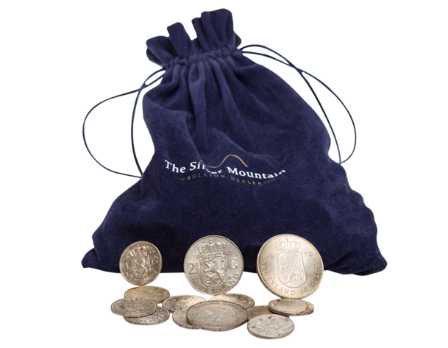
A bag of Dutch silver coinage contains an unsorted mix of silver guilders, rijksdaalders, and ten-guilder pieces from various mintage years. We fill each bag until the agreed fine silver weight is reached.
As a result, the ratio between the coins varies per bag and cannot be chosen in advance. You are paying for the quantity of pure silver, so the specific composition has no bearing on the value of your purchase.
Because the coins come from circulation, they may show signs of wear. For the intrinsic silver value, this makes no difference at all.
Available quantities
You can purchase Dutch silver coinage in four weights of pure silver:
- 500 grams pure silver Dutch coinage
- 1 kilo pure silver Dutch coinage
- 2 kilos pure silver Dutch coinage
- 5 kilos pure silver Dutch coinage
500 grams offers an accessible entry point. For larger quantities, the price per gram is typically more competitive.
Prefer a single coin type?
If you are looking for a fixed composition, explore our bundles containing a single type of coin. The silver 50-guilder coins are struck in 92.5% silver and are available in lots of 25, 50, or 100 pieces.
In addition, we offer a bundle of 100 silver ten-guilder coins from 1995 through 1999, containing a combined 1.2 kilos of pure silver. Here, too, compare based on the total weight of pure silver, as the historical nominal value in guilders does not reflect this.
Overview: Years, weights, and silver purities
This table shows the Dutch silver coins from our selection, detailing the pure silver content per coin.
| Coin | Period | Gross weight | Silver fineness | Pure silver per coin |
|---|---|---|---|---|
| Guilder (Juliana) | 1954 to 1967 | 6.5 g | 72% | 4.68 g |
| Guilder (Wilhelmina) | 1922 to 1945 | 10 g | 72% | 7.2 g |
| Rijksdaalder (Juliana) | 1959 to 1966 | 15 g | 72% | 10.8 g |
| Rijksdaalder (Wilhelmina) | various years between 1929 and 1943 | 25 g | 72% | 18 g |
| 10 guilders (Juliana) | 1970 and 1973 | 25 g | 72% | 18 g |
| 10 guilders (Beatrix, Benelux) | 1994 | 15 g | 72% | 10.8 g |
| 10 guilders (Beatrix) | 1995, 1996, 1997, and 1999 | 15 g | 80% | 12 g |
| 50 guilders (Beatrix) | various issues between 1982 and 1998 | 25 g | 92.5% | 23.1 g |
The gross weight indicates original minting specifications; slight fractional variations may occur due to circulation wear. Older guilders and rijksdaalders struck prior to 1922 and 1929 respectively possessed a higher historical silver content of 94.5%. Starting in 1967, circulating guilders were minted in nickel, followed by rijksdaalders in 1969. These nickel issues contain zero silver.
How to recognize a silver guilder
The mintage year provides the fastest indicator. Guilders struck up to and including 1966 are made of silver. For the year 1967, both silver and nickel versions exist. The silver guilder weighs 6.5 grams, whereas the nickel version weighs 6 grams. If you are uncertain, test the coin with a strong magnet: nickel is ferromagnetic and adheres firmly to a magnet, whereas silver is non-magnetic and will not attract. The magnet test exclusively distinguishes nickel from silver and does not verify the authenticity of a coin on its own.
Do you have old coins lying around? You can sell your silver guilders through Inkoop Edelmetaal.
From circulating currency to investment asset
The Netherlands conducted commerce using silver currency for centuries, which explains why large quantities of silver guilders and rijksdaalders still reside in Dutch households, drawers, and private safes. Dutch provincial mints produced silver trade coinage as early as the Dutch Republic, such as the famous Lion Dollar (leeuwendaalder) first struck in 1575. This monetary tradition continued unbroken until 1967, when rising international silver prices made the metal far too valuable for everyday coinage, prompting the Dutch government to transition to nickel.
Curious to explore more numismatic history? Our knowledge center covers the complete history of Dutch silver coinage in detail.

Our expert talking:
A bag of Dutch history
Anyone opening a bag of Dutch silver currency holds a tangible piece of our monetary heritage. Wilhelmina, Juliana, occasional commemorative tens from the 1990s: generations of Dutch citizens bought their groceries with these exact coins. In 1967, silver became too valuable for pocket change and vanished from circulation. But the silver never disappeared. It remains right there, gram for gram.
Rolf van Zanten - founder of The Silver MountainSourcing and quality control via Inkoop Edelmetaal
The historical Dutch silver coins we sell are primarily sourced through our sister enterprise, Inkoop Edelmetaal, with a significant portion purchased directly from private individuals.
Upon receipt, our bullion specialists test every lot for authenticity, exact weight, and metallurgical silver content. Only coins meeting our standards are repacked for sale. Our prices track the live silver spot market continuously and update automatically.
Secure and personal delivery
Your order is delivered fully insured via our personal courier service, within an agreed two-hour time window. We pack all orders under continuous video surveillance at Dutch Value Logistics, located on the premises of the Royal Dutch Mint. Your purchase is fully insured right up to the moment of physical handover. Prefer to pick up your order yourself? Collection is available by appointment at our office in Baarn or The Hague.
The Silver Mountain has been active in physical precious metals since 2008. The Silver Mountain B.V. holds an AFM licence (12048860) as an authorized provider of investment objects. Customers rate our service 4.8/5 on Trustpilot based on 4.641 reviews.
Prefer not to store your silver at home? You can opt for insured vault storage with Edelmetaal Beheer Nederland, allocated directly in your legal name.
Exploring broader options, such as silver bars? On our page about buying physical silver, you can compare all available alternatives side by side. Unsure which quantity best suits your needs? Feel free to call us at +31 (0)35 203 1380. We are happy to think along with you.
Our experts explain silver Dutch coins.
Frequently asked questions about buying Dutch silver coinage
1. How much pure silver is in a Dutch silver guilder?
This depends on the mintage year. A Queen Juliana guilder struck between 1954 and 1967 weighs 6.5 grams with a 72% silver fineness, containing 4.68 grams of pure silver. A Queen Wilhelmina guilder minted between 1922 and 1945 is heavier: 10.0 grams gross weight at 72% purity, containing 7.20 grams of fine silver. Guilders minted prior to 1922 contain a higher historical fineness of 94.5%.
2. What is a silver guilder worth?
The value of a silver guilder directly reflects the prevailing live spot price of silver. Because most years were struck in massive circulation volumes, numismatic collector premiums rarely play a role. You calculate its intrinsic value by multiplying its fine silver weight (4.68 grams for Juliana, 7.2 grams for Wilhelmina) by the live silver price per gram. Rare, uncirculated key dates should be evaluated separately by a numismatic specialist.
3. Does a coin with a higher silver purity always contain more pure silver?
Not necessarily. The total weight of the coin is equally decisive. For example, a 25-gram Juliana 10-guilder coin struck in 72% silver contains 18.0 grams of fine silver, whereas a 15-gram Beatrix 10-guilder coin struck in 80% silver contains only 12.0 grams. The coin with the lower percentage purity actually contains more absolute silver. Always evaluate coins by their net weight in fine silver.
4. How can I verify whether my guilder is silver?
Start by checking the mintage date. Guilders struck up to and including 1966 are silver; later dates are nickel. Both varieties exist for the transitional year 1967: the silver coin weighs 6.5 grams, whereas the nickel version weighs 6.0 grams. A magnet also assists: nickel is strongly attracted to a magnet, while silver will not react. Note: magnet testing only distinguishes nickel from silver and does not verify authenticity.
5. Until what year were Dutch guilders minted in silver?
Until 1967. In that year, rising international bullion prices prompted the Dutch government to replace silver with nickel for circulating guilders. The last regular circulating silver rijksdaalders (2.5 guilders) were struck in 1966. Subsequent silver issues, such as the 10-guilder and 50-guilder coins, were produced exclusively as commemorative coins.
6. Is Dutch silver coinage exempt from VAT?
Not completely, but it is highly tax-advantaged. Because Dutch circulation coins are pre-owned items, they fall under the EU VAT margin scheme (margeregeling). Under this scheme, VAT (21%) is levied only on the dealer’s gross profit margin, not on the total value of the silver. The VAT is incorporated directly into the retail price and not invoiced separately. In contrast, newly minted silver bars and conventional silver bullion coins carry 21% VAT on the entire purchase value.
7. Can I choose which specific coins are placed in my bag?
No. Each bag is assembled as an unsorted lot of guilders, rijksdaalders, and ten-guilder pieces across various mintage years until the specified net fine silver weight is reached. Consequently, the denomination count and coin distribution vary per bag. This does not affect your investment value, as you are purchasing net fine silver content. If you prefer a single denomination, choose our dedicated bundles of 50-guilder or 10-guilder pieces.
8. Is Dutch silver coinage easy to sell?
Yes. Dutch silver currency is exceptionally liquid within the Netherlands, where precious metal merchants instantly recognize the denominations, weights, and silver alloys. Clients of The Silver Mountain benefit from guaranteed buyback execution through our sister business, Inkoop Edelmetaal, which purchases coins based transparently on live market rates posted publicly on their website.
9. Dutch silver coins or modern silver bullion coins: which suits me best?
It depends on your investment objective. Dutch silver coinage typically carries a lower premium per gram of pure silver, making it ideal for investors focused on maximizing physical silver accumulation per invested euro. Modern 1-ounce bullion coins (such as the Canadian Silver Maple Leaf) boast .9999 purity, standardized fine ounce weights, and instant global liquidity. If you anticipate liquidating your holdings outside the Netherlands, internationally recognized silver bullion coins are generally the more practical choice.



 Nederlands