
 Buy gold bars
 Buy gold coins
 Series
 Buy silver coins
 Buy silver bars
 Series
 Buy silver collectible coins
 Silver collectible coin series
 Buy gold collectible series
 Gold collectible coin series
 Author:
  Date: 29 June 2026
Dutch Gold Tientje: history, years of issue, and numismatic value
 Rolf van Zanten
27 May 2026
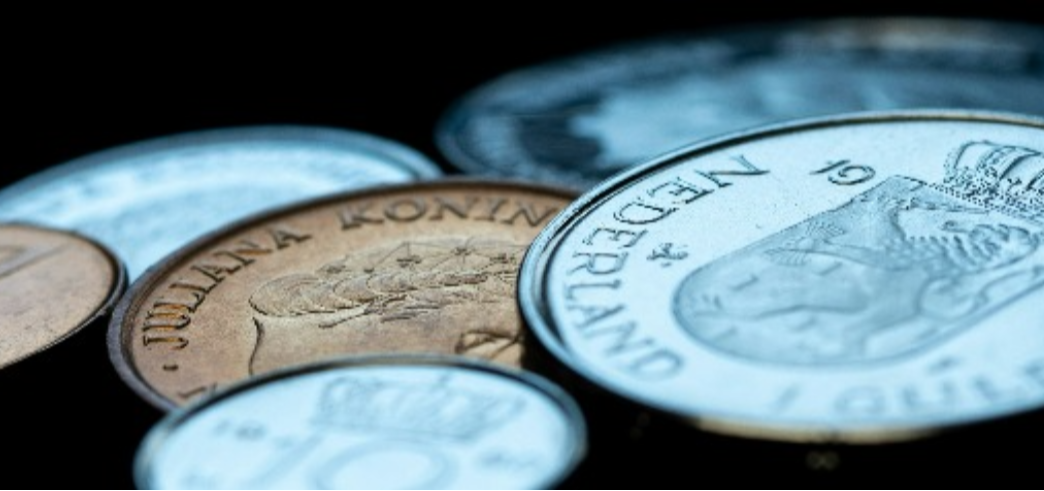
Dutch silver coinage has a history of almost five centuries. From the silver trade coins of the Republic to the last silver guldens and rijksdaalders that made way for nickel in 1967: silver coins formed the backbone of Dutch transactions for centuries.
In this knowledge center article you will read how silver coinage originated, which coins existed, how the silver content changed over the centuries and why these coins are still sought after today.
Silver was for centuries an ideal material for coinage. The metal is durable, resistant to corrosion and carries intrinsic value. A silver coin was therefore not only a means of payment, but also a tangible amount of precious metal with intrinsic worth.
For a trading nation like the Netherlands, that was hugely important. Money had to inspire confidence, both domestically and in international trade. Whoever received a silver gulden or rijksdaalder received a coin whose value lay in the metal itself, independent of the issuing authority.
If you first want to understand the broader development of the gulden as a currency, including its gold and paper variants, read our full article on the history of the Dutch gulden.
The history of Dutch silver money begins long before the modern gulden. In the Republic of the United Netherlands, silver trade coins were already struck that were accepted far beyond the country's borders.
A well-known example is the leeuwendaalder, which was struck in Holland from 1575 and was specifically intended to facilitate international trade. The silver ducat, in circulation from the mid-seventeenth century, represented the value of the old rijksdaalder: 50 stuivers.
These coins were not only used in the Netherlands but were also accepted as payment in countries such as Germany, Denmark and Sweden. That illustrates how important reliable silver money was for the Dutch trading position.
The name "gulden" goes back to the golden florin (fiorino d'oro), an influential coin struck in Florence from 1252 and imitated throughout Western Europe. Because the first examples were made of gold, it was called a "gulden", which simply means "golden". It is to that golden origin that the gulden also owes the characteristic ƒ sign and the abbreviation fl.
During the course of the sixteenth century, silver took over the leading role from gold because it was more practical for daily trade. An important turning point was the carolusgulden under Emperor Charles V: introduced in 1521 as a gold coin, followed by a silver variant in 1543. The gulden was subdivided into 20 stuivers, a division that remained largely unchanged for almost three centuries.
True standardization came with the founding of the Kingdom of the Netherlands. With the Coin Act of 1816 the gulden became the official national currency, from then on subdivided into 100 cents instead of 20 stuivers.
From 1817 each Dutch monarch had their own gulden, with the portrait on the obverse and the national coat of arms on the reverse. In 1818 the famous edge inscription "God zij met ons" was also introduced, which could be read on the edge of the gulden until the end.
The coins were struck by 's Rijks Munt in Utrecht, the predecessor of the current Koninklijke Nederlandse Munt, and issued under the responsibility of De Nederlandsche Bank.
Dutch silver coinage consisted of several denominations: the half guilder, the guilder, the Rijksdaalder (2½ guilders) and later the silver ten-guilder. Notably, the silver content gradually decreased over the years.
This was a deliberate choice by the government: once the silver value of a coin approached its face value, there was a risk that coins would be hoarded or melted down. Reducing the fineness kept that in check.
| Coin | Period / Monarch | Weight | Silver purity | Fine silver content |
|---|---|---|---|---|
| Guilder (Gulden) | 1840–1849 (William II) et seq. | 10 g | 945/1000 | 9.45 g |
| Guilder (Gulden) | 1922–1945 (Wilhelmina) | 10 g | 720/1000 | 7.2 g |
| Guilder (Gulden) | 1954–1967 (Juliana) | 6.5 g | 720/1000 | 4.68 g |
| Half guilder (Halve gulden) | Up to 1930 (Wilhelmina) | 5 g | 720/1000 | 3.6 g |
| Rijksdaalder | 1840–1898 (William I–III) | 25 g | 945/1000 | ±23.6 g |
| Rijksdaalder | From 1929 (Wilhelmina) | 25 g | 720/1000 | 18 g |
| Rijksdaalder | 1959–1966 (Juliana) | 15 g | 720/1000 | 10.8 g |
Specifications vary by year of issue; the table shows the most common regular issues. The earliest guilders (William I, before 1840) had a different weight and fineness. The silver ten-guilder and the later jubilee coins of Beatrix had their own specifications, often 925/1000.
On the obverse the portrait of the reigning monarch always appeared, and on the reverse the Dutch coat of arms with the denomination. That made the coins small works of art that reflected the national identity.
Alongside the guilder, the rijksdaalder played a leading role in Dutch coinage. A rijksdaalder had a face value of 2½ guilders and was popularly called a "knaak". Because of its larger size and higher value it was a conspicuous, heavy coin.
For anyone who wants to understand the history of silver coinage, the rijksdaalder is particularly interesting: in this single coin type five monarchs, multiple weights and different silver contents come together. The early rijksdaalders from William I through William III had, with 94.5% silver, the highest content of all rijksdaalders ever minted. Under Wilhelmina this fell from 1929 to 72%, and under Juliana the coin became both smaller and lighter.
The silver guilder remained a familiar beacon even in turbulent times. During World War II, Dutch silver and copper coinage was confiscated by the occupier and replaced with zinc coins. To secure the money supply, the Dutch government had silver guilders and rijksdaalders minted in the United States.
The issues from 1944 and 1945 hardly entered circulation and are therefore rare today and sought after by collectors. After the war silver coinage returned and became, in part, a symbol of reconstruction.
In the 1960s the price of silver rose so sharply worldwide that the value of the silver in a coin began to approach its face value. It simply became too expensive to continue striking guilders and rijksdaalders in silver. Therefore the government decided in 1967 to nickel-plate all circulating coinage.
This still causes confusion today: there are both silver and nickel guilders dated 1967. The difference is easy to determine with a magnet. Silver is, after all, not magnetic, nickel is.
The silver guilders and rijksdaalders of Queen Juliana were definitively withdrawn from circulation as of 1 January 1973. This ended more than four centuries of silver Dutch circulating coinage. The guilder itself remained the currency until the introduction of the euro.
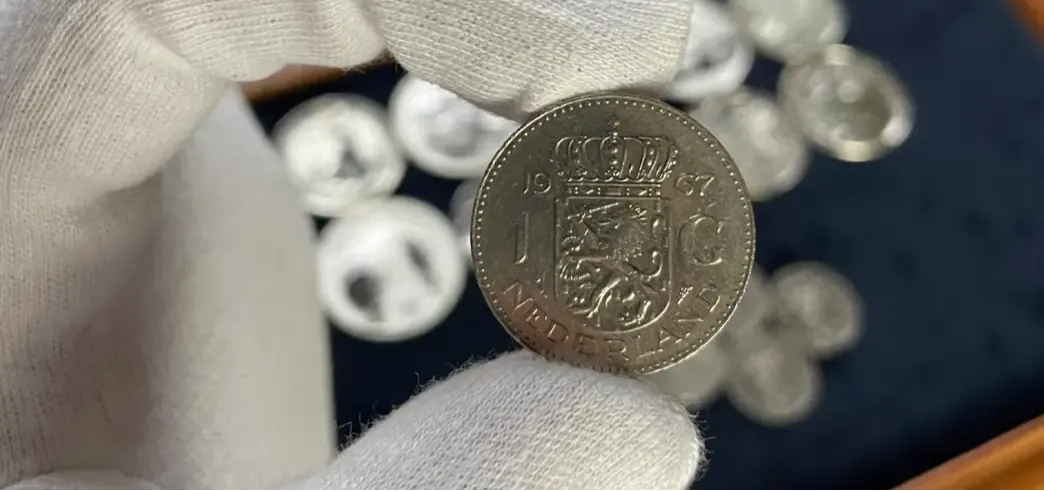
The Netherlands used silver coinage for nearly five centuries, from the leeuwendaalder (from 1575) to the last silver guilders and rijksdaalders in 1967.
On 1 January 2002 the euro was introduced and on 28 January 2002 the guilder definitively lost its status as legal tender. The fixed conversion rate was set at 1 euro = 2.20371 guilders. Guilder coins can no longer be exchanged at De Nederlandsche Bank since 2007; most guilder banknotes can still be exchanged until 1 January 2032.
For silver coins the old nominal value has thereby become completely meaningless. Their current value consists solely of the amount of physical silver contained in them, combined with any specific collector value.
With old Dutch silver coinage it is important to strictly separate two types of value:
A common Juliana guilder is in practice almost always traded close to the pure silver value. A scarce nineteenth-century guilder or a specific wartime year in absolute top condition, by contrast, can yield a multiple of the intrinsic material value.
For most people who find old coins in the attic, the silver value is the real and practical starting point. For numismatists and collectors, the detailed research into year, mintmark and the exact condition of the coin only begins after that.
Not every old Dutch coin is made of silver and not every silver-coloured coin actually contains precious metal. You can recognise silver coins by a fixed combination of factors:
Always store silver coins in a dry environment and protect them immediately from scratches, preferably in a special coin capsule or an acid-free coin holder. Handle coins only by the edge or wear cotton gloves, as skin oils can permanently damage the delicate surface.
Preferably never polish old coins. Many historical coins naturally develop a unique patina that offers protection. For rare collector coins, intensive polishing can even cause permanent damage and a substantial loss in value. Read more in this knowledge-base article about cleaning silver coins without risk of damage.
Silver guilders and rijksdaalders connect economic history with personal memories, such as savings in an old tin or coins from an inheritance. At the same time they still represent a material value that moves directly with the global silver market.
For that reason, historical coinage is also extremely interesting for those who want to own physical silver in a cost-efficient way. The Silver Mountain offers this silver coinage, among other formats, in bags with mixed Dutch silver coins. These mixes combine guilders, rijksdaalders and silver ten-guilder coins, where the transaction price is determined entirely by the exact net weight of pure silver.
Old silver coinage often represents more value than people think. When the silver guilder went out of circulation in the 1960s, its nominal value was roughly equal to about 45 euro cents. The silver content of that same guilder has since become worth a multiple of that amount.
Someone who had saved their guilders at that time instead of spending them would have achieved a nominal return of more than 1,000% on the silver alone. That precisely shows how an apparently vanished means of payment preserved its purchasing power by moving from fiat money to tangible precious metal.
Dutch silver coinage tells the story of almost five centuries of trade, trust and economic change. From the leeuwendaalder to the last silver guilders and rijksdaalders these coins were once everyday means of payment.
Today they no longer derive their value from their face value, but from their silver content, their collector value and their historical significance. In this way old Dutch silver money remains a recognizable piece of history and a tangible form of physical silver.
The Silver Mountain does not provide investment advice and this article should therefore not be regarded as such. Past results offer no guarantee for the future.
Guilders from before 1967 often contained silver, but the fineness varies by period. Nineteenth-century guilders had a high fineness (945/1000), while the guilders of Wilhelmina (from 1922) and Juliana (1954–1967) contained 720/1000. From 1967 guilders were made of nickel, which does not represent a precious metal value.
That depends on the year. A Wilhelmina guilder (1922–1945) weighs 10 grams and contains 7.2 grams of pure silver. A Juliana guilder (1954–1967) is lighter, 6.5 grams, and contains 4.68 grams of pure silver. Older nineteenth-century guilders generally contain significantly more fine silver per coin.
Use a magnet: silver is not magnetic, nickel is. If the magnet sticks, the coin is made of nickel and has no precious metal value. This is especially relevant for guilders from 1967, which exist in both silver and nickel.
The rijksdaalder, colloquially called the 'knaak', was worth 2½ guilders and was larger and heavier. A silver rijksdaalder therefore contains more silver than a guilder: a Wilhelmina rijksdaalder (from 1929) contains 18 grams of pure silver, compared with 7.2 grams in a guilder.
No, since 28 January 2002 the guilder is no longer legal tender. Guilder coins have not been exchangeable at De Nederlandsche Bank since 2007. The value of a silver guilder now consists solely of its silver content and any collector value.
The Netherlands stopped minting silver circulation coins in 1967, because the rising price of silver made silver too expensive for everyday coinage. The last silver guilders and rijksdaalders of Queen Juliana went out of circulation on 1 January 1973.
Rolf van Zanten is the founder and owner of The Silver Mountain, a specialist in physical precious metals since 2008. With nearly twenty years of experience in the precious metals trade, Rolf shares his expertise on investing in gold, silver, and platinum in an accessible and reliable way. His knowledge of the international gold and silver markets helps investors make well-informed decisions. In his role as an expert, he strives to ensure that transparency, security, and trust are at the heart of every purchase.

Be the first to discover the latest products and the latest news about precious metals.



 Nederlands