
 Buy gold bars
 Buy gold coins
 Series
 Buy silver coins
 Buy silver bars
 Series
 Buy silver collectible coins
 Silver collectible coin series
 Buy gold collectible series
 Gold collectible coin series
 Author:
  Date: 21 February 2025
Dutch Gold Tientje: history, years of issue, and numismatic value
 Rolf van Zanten
27 May 2026
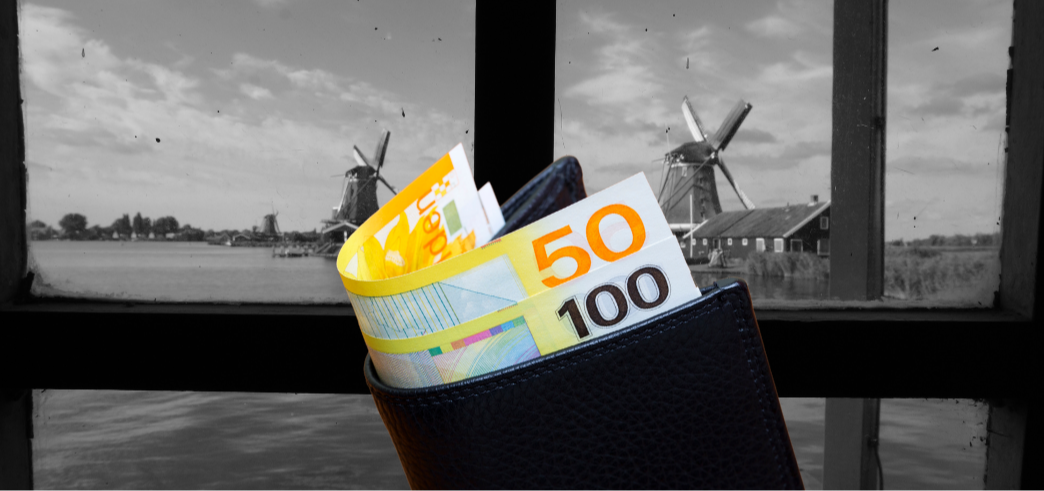
The Dutch guilder has been the currency of the Netherlands for almost five centuries. From the first gold florin that was minted in 1517 under Charles V, to the definitive replacement by the euro in 2002: the guilder tells the story of the Dutch economy, trade, and world history.
In this knowledge center article, you will read all about the origin of the guilder, the role of the florin, the flourishing during the Golden Age, the transition to the euro, and the value that historical guilders still hold today for collectors and investors.
To understand the origin of our national currency, our experts will take you back to 13th-century Italy. In the historical year 1252, the powerful and prosperous city-state of Florence introduced a revolutionary gold coin to the market.
This impressive coin was given the official name fiorino d'oro. This name was a reference to the elegant lily that adorned the famous city coat of arms.
Why did this specific Italian coin become the blueprint for the later Dutch guilder? Within the global precious metals market, this had everything to do with the unwavering technical product specifications. For international trade, the fiorino d'oro offered 3 certainties at the time:
Because of these strong monetary characteristics, the concept of this reliable trade coin spread at a rapid pace across the rest of the European continent. When the coin eventually reached the Low Countries, the population quickly gave it its own twist.
In everyday speech and Middle Dutch, this foreign gold piece was simply called a guilder, which literally translated means golden. With this, the linguistic and also the physical foundation for our later national unit was definitively laid.
The Dutch guilder (abbreviated fl. or ƒ, after the word florin) was the official currency of the Netherlands from 1517 to 2002. One guilder was divided into 100 cents. Well-known denominations were:
The guilder was issued by De Nederlandsche Bank (DNB) and minted by the Royal Mint in Utrecht, the current Royal Dutch Mint.
The terms florin and guilder are historically exactly the same coin under two different names. In the southern provinces, people continued to speak of the florin for a very long time, while in the northern provinces the term guilder was increasingly used.
Once the guilder became the official name of our national currency, the old name disappeared from everyday speech. Yet the historical reference has always been preserved. The famous letter f on price tags and the international abbreviation fl symbolized the Dutch florin until the very last moment.
The question of when our currency was exactly introduced actually has multiple historical answers. Over the centuries, our national minting system has gradually developed from a fragmented regional medium of exchange into a tightly standardized currency.
Our experts will gladly take you along the 4 most important monetary milestones from our history in this brief timeline:
Through this eventful and gradual development, the guilder coin grew over the centuries into one of the most recognizable and reliable coins in the world.
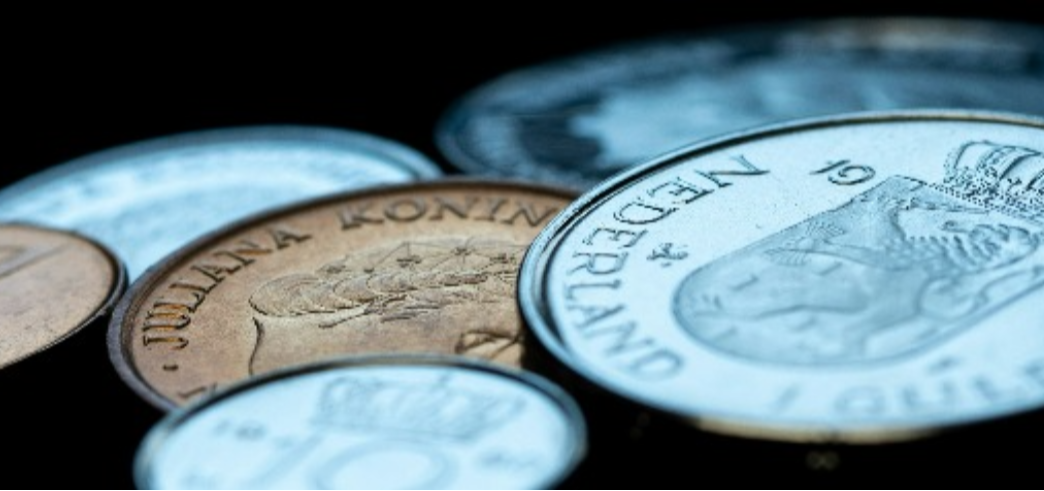
The name guilder descends directly from the gold florin from Florence and means gold-colored.
The legal backing of our money has changed radically over the centuries. Whereas the coin consisted entirely of solid precious metal during the heyday of the Dutch East India Company, this later gradually shifted to a paper promise.
In the table below, you can clearly see how the value and backing of the Dutch currency have developed over the years.
| Year or period | Monetary system | Meaning for the guilder |
|---|---|---|
| The year 1609 | Bank of Amsterdam | A fixed silver value guarantees worldwide and absolute trust |
| 1816 to 1847 | Bimetallism | The national money is legally backed by both physical silver and physical gold |
| 1847 to 1875 | Silver standard | The value is one hundred percent linked to the national silver reserve |
| 1875 to 1936 | Gold standard | A single guilder is legally exactly equal to 0.6048 grams of pure gold |
| The year 1945 | Tientje of Lieftinck | An extremely strict monetary purge restores the economy after the Second World War |
The introduction of the gold standard in the year 1875 was an absolute highlight in our monetary history. Banknotes received the formal legal promise that they were always exchangeable for physical gold. This brought a decades-long period of enormous economic stability for citizens and trade.
During the severe crisis in the 1930s, however, the Netherlands had to definitively let go of this gold link. From that moment on, the value of our money was never again directly backed by a fixed amount of precious metal in the highly secured vaults of De Nederlandsche Bank.
The two world wars had an impact on the Dutch guilder. But what exactly happened during World War I and World War II? We have listed the consequences for you below.
Although the Netherlands remained neutral during the First World War, the conflict had major economic consequences. International trade largely came to a standstill, food shortages led to price increases, and the guilder was temporarily decoupled from the gold standard. After the war, in 1925, the Netherlands returned to the gold standard to restore monetary stability.
During the global economic crisis after 1929, the Netherlands was one of the last countries to hold on to the gold standard. It was not until 1936 that it was definitively abandoned, which led to a devaluation of the guilder and ultimately contributed to economic recovery.
During the German occupation, the guilder was pegged to the Reichsmark at a fixed ratio of 1 guilder = 1.327 Reichsmark. The occupying forces extracted large quantities of gold and silver from the Netherlands, and hyperinflation arose due to money creation.
Immediately after the liberation, Minister of Finance Piet Lieftinck implemented the so-called monetary purge in 1945: all banknotes were exchanged for new ones, and black money was skimmed off as much as possible. This reform is known as "Het Tientje van Lieftinck" (Lieftinck's Ten) and restored confidence in the guilder.
After the Second World War, the Netherlands experienced decades of economic growth. In 1944, under the Bretton Woods system, the guilder was pegged to the American dollar (1 dollar = 3.80 guilders, later 3.62 guilders). After the end of Bretton Woods in 1971, the guilder began to float, but in practice remained closely linked to the German mark via the European Monetary System (EMS) from 1979.
During this period, well-known guilder coins were minted featuring the effigy of Queen Juliana (1948-1980) and later Queen Beatrix (from 1980 onwards).
Until well into the twentieth century, our national coins were mainly minted from solid silver. Because silver is an extremely precious metal, the government decided over the years to gradually lower the percentage of silver in the coins.
This was done because the intrinsic metal value would otherwise become much higher than the nominal value of the coin.
For you as an investor, the exact composition of these historical coins is incredibly important when determining their true value. In the list below, you will find a complete overview of the legal silver content per historical period:
From the year 1967, the government decided to permanently remove silver coins from daily payment circulation. At the time, they were completely replaced by cheaper nickel variants.
However, coins minted before the year 1967 are still traded extensively today as Dutch silver coinage because of their fixed silver value. For private investors, buying up these old silver units is an exceptionally advantageous and tangible way to invest in physical precious metal.
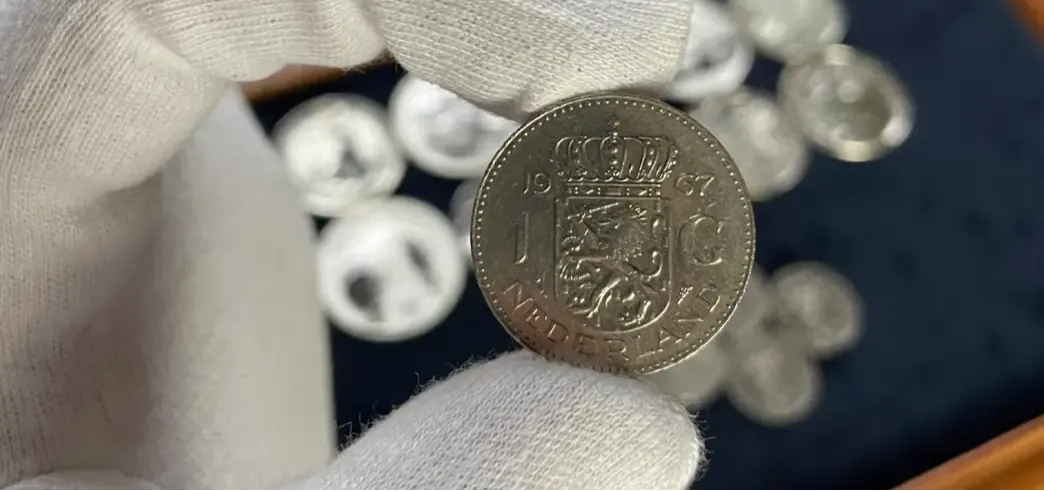 Old Dutch guilders can be worth a lot of money, like Dutch silver coins which are a stable investment.
The transition from the familiar guilder to the completely new euro was one of the most profound monetary events in recent national history. This complex trajectory was the final piece of a decades-long process of far-reaching European economic integration.
With the formation of the Economic and Monetary Union, the European member states wanted to remove mutual trade barriers for good and form a strong financial bloc together on the world market.
To manage this gigantic logistical and economic change properly, a tight and careful timeline was mapped out. We have clearly listed the most important moments of this historical transition for you:
The rapid introduction of the new currency brought about a huge adjustment for the ordinary citizen. For years, many consumers continued to mentally convert prices in the supermarket and on the housing market into their old money to maintain a sense of value.
| Year | Event | Monetary significance |
|---|---|---|
| 1252 | Minting of the fiorino d'oro | The gold florin from Florence lays the foundation for the later European and Dutch monetary system. |
| 1378 | First Dutch guilder | Count Willem V puts the very first guilder coins into circulation within the local northern provinces. |
| 1517 | Introduction of the Carolus guilder | Emperor Charles V ensures a major monetary unification with a coin worth exactly twenty stuivers. |
| 1609 | Foundation of the Bank of Amsterdam | The bank guarantees a fixed silver content, as a result of which the Dutch coin is trusted worldwide. |
| 1680 | Introduction of the silver guilder | The States of Holland switch to physical silver as the dominant base coin for domestic trade. |
| 1816 | Introduction of the Mint Act | King Willem I introduces the decimal system. The national unified currency is divided into a hundred cents. |
| 1875 | Peg to the gold standard | The value of the national currency is legally fixed at 0.6048 grams of pure gold per guilder. |
| 1936 | Abandoning the gold peg | The Netherlands leaves the gold standard as a monetary basis due to the severe global economic crisis. |
| 1945 | Monetary purge Piet Lieftinck | The famous Tientje of Lieftinck restores the national economy and financial trust after the occupation years. |
| 1967 | Abolition of silver coinage | Silver permanently disappears from wallets. The government switches to nickel for guilders and rijksdaalders. |
| 1999 | Digital introduction of the euro | The euro becomes the official scriptural currency. The irrevocable exchange rate is set at 2.20371 guilders. |
| 2002 | Physical introduction of the euro | Euro banknotes and coins flood into ATMs. The guilder definitively loses its status as legal tender. |
| 2007 | End of exchange for guilder coins | The official deadline for handing in physical coins at De Nederlandsche Bank expires irrevocably. |
| 2032 | End of exchange for banknotes | The very last legal deadline for exchanging most paper guilder banknotes at the central bank. |
The banknotes and coins of the past may no longer be legal tender, but many specimens certainly still represent a significant financial value. Do you still have banknotes lying in the attic?
Then you can still exchange specific series at De Nederlandsche Bank until January 1, 2032, at the latest. For all coins, however, this exchange period already ended in the year 2007.
Nevertheless, wise investors absolutely do not throw their old coins away. Because precious metal has risen enormously in price in recent years, the historical gold tientjes and the silver rijksdaalders have become exceptionally valuable.
To determine the exact value of this historical money, our experts always look at 3 factors in practice:
At The Silver Mountain, we see every day how these historical pieces of the Netherlands form a beautiful and stable foundation for investors in physical precious metal.
The Dutch guilder has an impressive monetary history behind it. What began over five centuries ago with its first national introduction ended in 2002 with the definitive arrival of the euro. Yet this trusted currency has never truly disappeared.
Thanks to the high intrinsic metal value of the gold tientje and the silver rijksdaalder, our old money remains as popular as ever. For modern investors, these historical coins form a tangible piece of history and a highly stable investment.
The Silver Mountain does not provide investment advice. This article is for educational purposes only. Past performance is not indicative of future results.
The Dutch guilder was the official national currency of the Netherlands for centuries. Originally, this familiar currency descends from a medieval gold trade coin from Florence, Italy. On the first day of the year 2002, our currency was permanently replaced by the modern euro.
In the historical year 1517, the powerful Emperor Charles V introduced the very first national Carolus guilder. However, the modern variant only emerged much later. Through the introduction of the Mint Act in 1816, our national coin was officially subdivided into exactly one hundred cents for the first time.
During the historical transition to our new European currency, the exchange rate was set once and irrevocably. The exact legal conversion rate was exactly 2.20371 guilders for a single euro. Converted, a guilder was therefore worth about forty-five current euro cents in the new daily payment traffic.
Unfortunately, exchanging physical coins at De Nederlandsche Bank has not been possible since the year 2007. However, do you still have old paper banknotes lying around? You can still officially hand in certain specific series of these banknotes until January 1, 2032, at the latest.
Old coins can certainly still represent a significant financial value. Silver rijksdaalders and classic gold tientjes contain a very high content of precious metal. At precious metal dealers, the value of these specific coins is directly linked to the current international gold or silver price.
Rolf van Zanten is the founder and owner of The Silver Mountain, a specialist in physical precious metals since 2008. With nearly twenty years of experience in the precious metals trade, Rolf shares his expertise on investing in gold, silver, and platinum in an accessible and reliable way. His knowledge of the international gold and silver markets helps investors make well-informed decisions. In his role as an expert, he strives to ensure that transparency, security, and trust are at the heart of every purchase.

Be the first to discover the latest products and the latest news about precious metals.


 Daan Wesdorp
 Nederlands