
 Buy gold bars
 Buy gold coins
 Series
 Buy silver coins
 Buy silver bars
 Series
 Buy silver collectible coins
 Silver collectible coin series
 Buy gold collectible series
 Gold collectible coin series
 Author:
  Date: 21 February 2025
Where is gold extracted?
 Rolf van Zanten
21 February 2025
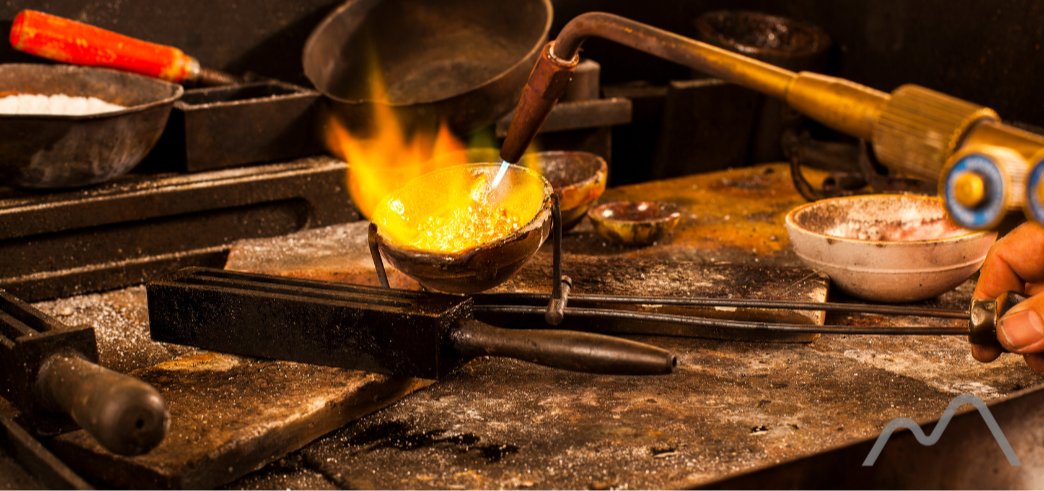
Pure gold melts at 1,064.18 °C. At that temperature the metal goes from solid to liquid, after which it can be cast into a new form, such as a bar, a coin or a piece of jewelry. Melting gold therefore means heating the metal until it becomes liquid, and that is different from refining gold, which is discussed further below.
This article explains the exact melting point of gold, why a lower carat content reduces the melting temperature, and how melting is carried out in practice. It also explains why remelting an existing gold bar can harm its value and when you should leave the melting to a professional.
The melting point of pure gold is 1,064.18 °C. At that temperature the bonds between the gold atoms break just enough to make the metal liquid, without it evaporating. The boiling point is much higher, around 2,800–2,856 °C, which gives gold a wide range in which it remains liquid and can be worked.
Compared with other precious metals, that is a moderate melting point. Silver becomes liquid at a lower temperature, while platinum and palladium require much higher temperatures. The table below compares the melting points of the four precious metals.
| Precious metal | Melting point (pure metal) |
|---|---|
| Silver | 961.78 °C |
| Gold | 1,064.18 °C |
| Palladium | 1,554.9 °C |
| Platinum | 1,768.3 °C |
Source: Royal Society of Chemistry
That relatively accessible melting point is one of the reasons why gold has been worked by people for thousands of years: it can be melted and cast with relatively simple means, and it retains its quality in the process.
Yes, generally the lower the carat content, the lower the melting temperature. Pure 24-carat gold melts at 1,064.18 °C, but once gold is alloyed with metals such as copper and silver, the temperature at which the alloy becomes liquid drops. This explains why jewelry often melts at a lower temperature than pure investment bars.
A gold alloy does not have a sharp melting point like pure gold, but a melting range. Within that range the material becomes gradually liquid and the exact limits depend on the precise composition.
| Gold type | Composition | Melting behavior |
|---|---|---|
| 24 karat (pure) | 99.9% gold | Sharp transition around 1,064.18 °C |
| 22 karat | 91.7% gold | Melting range, depending on the alloy |
| 18 karat | 75% gold | Melting range, generally lower than pure gold |
| 14 karat | 58.5% gold | Broader melting range due to more alloying metals |
Yellow gold, red gold and white gold of the same karat can react differently to heating because of their different compositions. A professional smelter therefore first analyzes the material.
A well-known example is the South African Krugerrand, which is struck in 22 karat and therefore contains 91.7% pure gold. The coin contains exactly one troy ounce of fine gold, but weighs slightly more overall due to the added copper alloy, which also gives the coin its characteristic reddish hue.
Read more about gold purity in our article on karats and the purity of gold.
Melting gold is done by heating the metal evenly in a heat-resistant container to above its melting point. That container is called a melting crucible and is made of graphite or a refractory ceramic composition, materials that withstand the high temperature.
The heat comes from a melting furnace or, in professional settings, from an induction furnace that heats the gold quickly and evenly. In practice, gold is heated slightly above the melting point so that the entire mass is liquid and easily castable.
During heating, flux is often added, a fluxing agent based on borax and sodium carbonate. Flux helps collect certain oxides and impurities into a separate slag layer and causes the molten gold to coalesce better. Once the gold is fully liquid, it is poured with tongs into a preheated mold.
This is often an ingot in a mold, or loose granules if the gold will be further processed later. In the mold, the metal cools below the melting point and solidifies again, taking the shape of the mold.
This melting and casting is a shaping step, not a refining one. It changes the form of the gold, not its fineness. Alloying metals such as copper and silver that are part of the gold do not simply disappear during melting; a separate refining process is required for that.
Melting gold at home is technically possible, but is not recommended and is pointless for investment gold. To reach above 1000 °C you need a suitable furnace, a crucible, flux and heat-resistant protection.
You then work with splashing molten metal, and harmful fumes can be released from unknown alloys or coatings, making good ventilation necessary. A kitchen oven or ordinary gas burner does not provide sufficient temperature control.
Besides, it yields little. Melting a gold piece of jewelry into a new object requires craftsmanship that goes beyond melting alone: after casting, air bubbles and imperfections often appear. And investment-grade gold that you remelt loses the properties for which you bought it. If you want to sell gold or have it processed, you are better off with a professional, accredited party than with a self-melted result.

The melting point of pure gold is 1,064.18 °C, the boiling point much higher, around 2,800 °C.
Melting and refining are often used interchangeably, but they are two different processes. Melting only turns gold into a liquid so it can be cast into another shape. Refining is the chemical or electrolytic process that removes other metals and impurities from the gold, raising its fineness to a tradable standard such as 99.99%.
In short: melting changes the shape, refining changes the purity. During melting some oxides and dirt particles may end up in the slag layer, but the alloying metals themselves are not removed.
The entire path from raw gold to a microscope-pure investment bar, including refining methods, bar casting and coin minting, is described in our article on how gold is refined and produced. For the origin of the raw metal see where gold is mined.
Existing gold can be remelted and reused, which is an important source of supply. Old jewelry, industrial gold residues and outdated products are professionally remelted and refined into new, pure gold without any loss of quality. At the molecular level there is no "new" or "old" gold; after professional processing recycled gold is equivalent to mined gold.
It is different for investment gold, and caution is advised.
A gold bar from an LBMA-recognized producer owes its tradability in part to the serial number, the hallmarks and the accompanying certificate. If you have such a bar remelted those features disappear, along with the easy international tradability.
A self-cast block of gold can have a high gold content, but without analysis and reliable identification it is hard to verify and trade. For an investor it is therefore almost never wise to remelt a certified bar. You give up value instead of adding to it.
I regularly get asked whether someone should have their gold bar remelted. My answer is almost always no. It is precisely the serial number, the hallmark and the certificate that make a bar tradable worldwide. If you melt it down, you lose that certainty and are left only with the bare metal value. If you want to sell gold, sell it as a recognized product and preserve the value you originally paid for.
Rolf van Zanten - founder The Silver MountainIf you own physical gold you never need to melt it yourself to sell or convert it. At The Silver Mountain you can arrange that easily and with peace of mind. Since 2008 we have specialized in physical precious metals and, as an AFM license holder, are used to working carefully and transparently, from your first purchase to a later sale.
Our gold bars come from reputable refineries on the LBMA Good Delivery List, the international benchmark for quality and reliability in the precious metals world. Our gold coins come from recognized mints. That way you can be sure you have a recognizable and globally tradable product in your hands.
If you want to sell later, sister company Inkoop Edelmetaal buys your gold back as a recognized product. That preserves the value and tradability the product had as an original, exactly what would be lost by remelting. Ready to get started? See the full range on the buy gold page.
Gold melts at 1,064.18 °C and that relatively accessible melting point has made the metal workable for thousands of years. A gold alloy has no fixed melting point but a melting range: the lower the karat content, the earlier the alloy becomes liquid. Melting itself is a shaping step that makes gold liquid for casting, but it does not change the purity. That is done during refining.
For the investor one lesson is particularly important: remelting a certified gold bar or coin harms tradability and thus value. If you want gold melted or processed, leave it to a professional and recognized party.
The Silver Mountain does not provide investment advice and this article should not be considered as such. There are serious safety risks associated with melting or chemically treating precious metals yourself. Past results are no guarantee of future performance.
Pure gold melts at 1,064.18 °C under normal atmospheric pressure. At that temperature the metal changes from solid to liquid. Alloyed gold, such as 18- or 14-karat jewelry gold, becomes liquid at a lower temperature because the added metals cause the alloy to melt earlier. The boiling point of gold is much higher, around 2,800 °C.
The boiling point of gold is around 2,800 °C, well above the melting point of 1,064.18 °C. Because of that large difference, gold stays liquid over a wide temperature range and casts well without evaporating. As a result the metal is easy in practice to work into bars, coins or jewelry.
No, 18-carat gold does not have a fixed melting point but a melting range, because a quarter of the alloy consists of other metals. Yellow gold, red gold and white gold can contain varying amounts of copper, silver or palladium. As a result they become liquid within different temperature ranges, depending on the exact composition.
Yes, it is possible, but it is not recommended. You need a suitable furnace, a crucible, flux and heat-resistant protection, and you will be working with splattering molten metal above 1000 °C. Harmful fumes can be released from unknown alloys. For investment gold, melting at home is also pointless because you lose the tradability and value.
Melting gold simply makes the metal liquid so it can be cast into another form. Refining gold is the chemical or electrolytic process by which impurities and other metals are removed to increase the fineness, for example to 99.99%. So melting changes the form, refining changes the purity of the gold.
Yes, it can. A recognized gold bar owes part of its tradability to the serial number, the stamps and the certificate. When remelted those features disappear, making the bar harder to trade internationally and often only tradable for the raw metal value. For an investor, remelting is therefore almost never advisable.
With careful melting the gold itself does not disappear, but the total weight can decrease. Impurities and oxidized alloy metals can be separated, and small residues of material sometimes remain in the crucible or slag. The amount of pure gold largely remains intact; the value ultimately follows from the demonstrable fine weight.
No, pure gold does not burn like wood or paper and does not turn to ash. It first becomes liquid at 1,064.18 °C and only vaporizes at much higher temperatures, around 2,800 °C. However, alloy metals, coatings or impurities in impure gold can oxidize or form harmful fumes when heated.
Rolf van Zanten is the founder and owner of The Silver Mountain, a specialist in physical precious metals since 2008. With nearly twenty years of experience in the precious metals trade, Rolf shares his expertise on investing in gold, silver, and platinum in an accessible and reliable way. His knowledge of the international gold and silver markets helps investors make well-informed decisions. In his role as an expert, he strives to ensure that transparency, security, and trust are at the heart of every purchase.

Be the first to discover the latest products and the latest news about precious metals.


 Daan Wesdorp
 Nederlands