
 Buy gold bars
 Buy gold coins
 Series
 Buy silver coins
 Buy silver bars
 Series
 Buy silver collectible coins
 Silver collectible coin series
 Buy gold collectible series
 Gold collectible coin series
 Author:
  Date: 17 April 2026
 About
About Gold Price Forecast 2030: Which scenarios do experts expect?
 Daan Wesdorp
18 June 2024
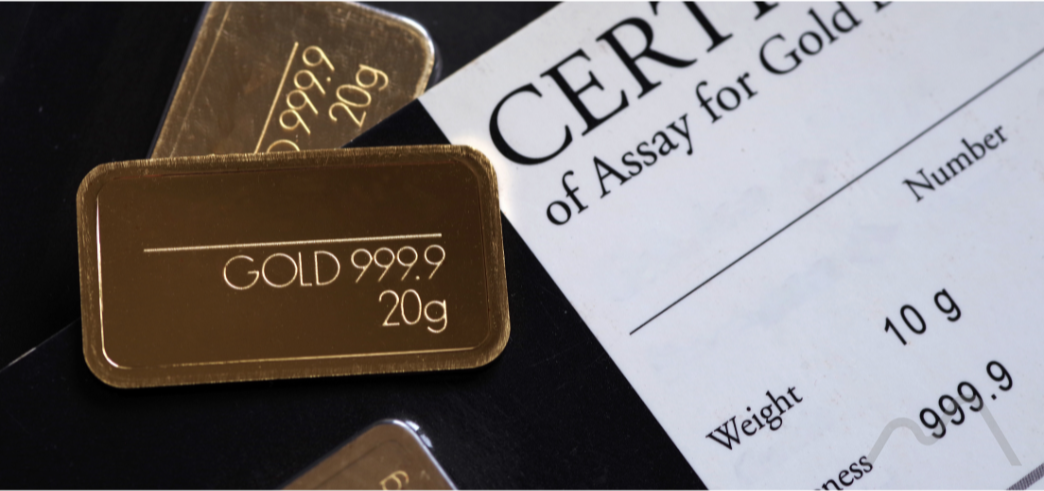
Anyone who buys physical gold invariably encounters the term karat. Whether you invest in a well-known gold coin, a heavy gold bar or a valuable piece of jewelry, this specific number directly determines the value and quality of your asset. Yet the different units in the precious metals market often cause confusion. Sellers interchangeably speak of fineness, percentages and karats.
What exactly is gold karat and how do you calculate the actual purity? In this knowledge center article we give you a clear explanation. You will discover the exact differences between 14, 18, 22 and 24 karat and learn how you can easily recognize the gold purity yourself.
The term karat undoubtedly sounds familiar to you. However, the exact mathematical meaning behind it is less well known to many beginning investors. The word is traditionally derived from the Greek word 'keration', which refers to the seed of the carob tree.
Because these small seeds possessed a remarkably constant weight, they were used by merchants in antiquity as the ultimate and reliable reference weight for weighing precious metals.
Today, a karat is the universal unit of measurement that indicates the purity of gold in a metal alloy. The system works based on a clear division into 24 equal parts. When something consists entirely of pure precious metal, we speak of 24 karat gold.
Mathematically speaking, one karat thus represents exactly a 1/24th part of pure gold. Converted, this equals 4.166 percent of the total weight.
Pure 24 karat gold is naturally a relatively soft and pliable material. This makes it very vulnerable to wear and damage in its purest form. For that reason, gold is often melted together at high temperatures with other, harder metals such as copper, silver, or zinc. We call this specific process making an alloy.
This historical system is still widely applied globally, primarily in the jewelry industry. However, within the professional investment market for gold bars and gold coins, we see that the international fineness scale is more often the standard nowadays.
The number of parts of pure gold within a total alloy of 24 parts ultimately determines the final karat purity. Does a gold ring consist of 18 parts pure gold and 6 parts copper? Then this piece of jewelry qualifies as 18 karat gold.
In the physical precious metals market the terms karat, gold content and fineness are often used interchangeably. Although at their core they refer to exactly the same principle, namely the purity of the metal, the mathematical scaling is fundamentally different.
For you as an investor it is important to be able to distinguish these three designations flawlessly, so you always know exactly what you are buying. We make the following professional distinction:
To make these ratios clear to you, we have summarized the most common purities and their corresponding applications in a clear table.
| Karat | Percentage of gold | Fineness (stamp) | Application |
|---|---|---|---|
| 24 karat | 99.9% to 99.99% | 999.9 | Investment gold (bars and coins) |
| 22 karat | 91.67% | 916.7 | Investment coins (e.g. Krugerrand) |
| 18 karat | 75.0% | 750 | Exclusive jewelry |
| 14 karat | 58.5% | 585 | Most common jewelry in the Netherlands |
| 9 karat | 37.5% | 375 | Affordable jewelry (mainly abroad) |

24 karat gold is the purest form and contains the highest amount of pure gold.
When you invest in precious metals, you quickly discover that the difference between the various karats goes beyond just a mathematical percentage. The chosen alloy has a direct impact on the hardness, color and application of the gold. Where 24 karat gold is the norm for vault storage, a piece of jewelry requires a completely different composition.
Below we explain the exact properties per purity to you, so you always make the right choice for your investment portfolio or jewelry collection.
18 karat gold has a fineness of 750 and consists of exactly 75 percent pure gold. The remaining 25 percent is carefully supplemented with robust metals such as silver, copper or palladium. This specific composition offers you a number of important advantages:
Within the world of investment gold, 22 karat occupies a special and historical position. This purity consists of 91.67 percent pure gold (a fineness of 916.7). It is the undisputed standard for some of the most traded and well known investment coins in the world, such as the South African Krugerrand and the American Eagle.
Mints consciously choose 22 karat to give the coins a slight degree of robustness. The addition of copper, which gives the Krugerrand its famous orange glow, makes the coin resistant to damage and wear during trading.
24 karat is the highest achievable purity within the precious metals market. This purity stands for 99.9 to 99.99 percent pure gold, often indicated in the market with the stamp 999.9 Fine Gold. Because no other metals are added, 24 karat gold is naturally extremely soft and pliable.
You will only find this highest purity in specific investment products:
Because of the extreme softness of the pure metal we advise you to always store 24 karat coins and bars in their original, protective capsule or packaging. This prevents depreciation due to unnecessary scratches or dents.
A common misconception is that a 22 karat coin of 1 troy ounce contains less gold than a 24 karat coin. This is incorrect. A 22 karat Krugerrand contains exactly 1 troy ounce (31.103 grams) of pure gold.
To achieve this, the coin itself is simply made slightly heavier. The gross weight of a Krugerrand is therefore 33.93 grams. When purchasing, you therefore pay exclusively for the amount of pure gold and not for the extra copper.
When you hold a physical gold bar or a solid gold coin in your hands for the first time, you will immediately notice how surprisingly heavy this feels. Gold has an extremely high density. It belongs to the heaviest precious metals on earth.
To give you a practical idea: a compact block of pure gold the size of a standard pack of butter easily weighs more than a kilogram. This unique physical property directly explains why relatively small investment products still represent a significant financial value and can be stored efficiently in a vault.
Within the professional precious metals market, however, we rarely measure the weight of gold exclusively in regular grams or kilos. The international and undisputed standard measurement for trading in precious metals is the troy ounce.
When you look at the current gold price, you always see the price per troy ounce listed. One troy ounce is mathematically equal to exactly 31.1034768 grams.
For you as an investor, it is important to carefully distinguish between the following two concepts when considering your purchase:
As explained earlier, the gross weight and the fine gold weight of a 24 karat coin are exactly the same. However, if you choose a 22 karat coin, the gross weight on the scale is always slightly higher to ensure that you still own exactly one troy ounce of pure gold.

A 22 karat investment coin of 1 troy ounce contains exactly the same amount of pure gold as a 24 karat one.
Around the term karat, there are some persistent misunderstandings that regularly cause confusion for new investors and buyers of jewelry. We list the two most common mistakes for you, so that you always enter the precious metals market well informed.
We regularly see and hear that people search for the term 'karat silver'. Technically speaking, however, this wording is completely incorrect. The historical karat system is exclusively reserved worldwide for indicating the purity of gold.
When we speak about the purity of silver, we exclusively use the percentage method or the international fineness scale in parts per thousand in the precious metals industry. The two best known and most common forms of silver are:
Another common confusion arises when gold jewelry is combined with gemstones. The word carat (internationally often abbreviated as 'ct') is also widely used in the diamond trade, but the meaning there is fundamentally different.
Where karat for gold always indicates the purity and pureness of the metal, for diamonds and other gemstones it is exclusively a hard unit for weight. One carat for a diamond is mathematically equal to exactly 0.2 grams.
So when you buy an 18 karat gold ring with a 1 carat diamond, two completely different properties are being described. You then know that the ring itself consists of 75 percent pure gold, while the inlaid diamond weighs exactly 0.2 grams.
Determining the exact gold purity is of great importance for you as an owner or potential buyer to determine the actual value of an object. Fortunately, you do not always have to visit a laboratory immediately for this.
In the Netherlands, the trade in precious metals is strictly regulated via the Guarantee Act. As a result, almost all gold objects are provided with official hallmarks that you can recognize with the naked eye, or with the help of a magnifying glass.
Manufacturers and goldsmiths place these stamps in strategic, inconspicuous places. With a gold ring, you will almost always find the hallmark on the inside of the band. With necklaces and bracelets, you must look closely at the clasp or the end link of the jewelry. With pendants, the stamp is often placed on the back or on the suspension eye.
These hallmarks usually consist of three numbers that indicate the fineness of the gold. The numbers correspond directly to the percentage of pure gold in the object. For example, do you see the number 585? Then you know immediately that the object consists of 58.5 percent pure gold, which equals 14 karat.
With investment gold, such as bars and coins, the purity is often explicitly stated as a fineness of 999.9.
In the table below you will find the most common stamps and the corresponding karats. This overview helps you to immediately determine the purity of your gold.
| Stamp (Fineness) | Karat gold | Percentage pure gold |
|---|---|---|
| 999 | 24 karat | 99.9% (Pure gold) |
| 916 | 22 karat | 91.6% |
| 750 | 18 karat | 75.0% |
| 585 | 14 karat | 58.5% |
| 375 | 9 karat | 37.5% (Legally no gold in NL) |
| 333 | 8 karat | 33.3% (Legally no gold in NL) |
Knowledge about the different gold purities enables you to select the right precious metals with complete confidence. You now know exactly that 24 karat guarantees the very highest purity, while 22 karat coins offer extra robustness while retaining exactly the same amount of gold. Your ideal choice depends entirely on your personal investment strategy.
Are you ready to structurally protect your wealth against a loss of purchasing power? At The Silver Mountain you can buy pure gold safely and discreetly. We exclusively offer globally recognized bars and coins, so you are always assured of the very highest quality and optimal tradability.
The Silver Mountain does not provide investment advice. This article is for educational purposes only. Past performance is not indicative of future results.
A karat is the traditional unit of measurement that indicates how pure your gold is. The scale has a maximum of 24 parts. At 24 karat the object consists entirely of gold. At 18 karat, 18 parts consist of pure gold and the rest of other added metals.
In practice, 24 karat stands for 99.9 percent to even 99.99 percent pure gold. Producers often indicate this on bars and modern coins with the stamp 999.9 fineness. This is the purest form of gold commercially available to you.
18 karat gold is an excellent choice for luxurious jewelry. The gold content is 75 percent, while the added alloy makes the metal strong enough for your daily use. For pure investing, however, the absolute preference is almost always for 22 or 24 karat.
Gold investment coins are generally minted in 22 or 24 karat. Modern coins such as the Maple Leaf contain 24 karat gold. Classic coins such as the Krugerrand and American Eagle are 22 karat. These possess an added alloy, making the coin much more resistant to damage.
Both terms indicate the purity of your gold, but use a different mathematical scale. Karat divides gold into 24 units. Fineness accurately expresses purity in parts per thousand. For instance, 18 karat is exactly equal to 750 fineness and 24 karat to 999.9 fineness.
No, the term karat silver is technically incorrect. The precious metals market uses the karat system exclusively for the assessment of gold. When you want to determine the purity of silver, you only look at percentages or the international fineness scale, such as the well known 925 stamp for sterling silver.
No, 24 karat is the absolute maximum value within this global system. It stands for gold that is virtually completely free of impurities. Although some specialized refineries produce gold of 99.999 percent, this precious metal technically simply remains under the highest denominator of 24 karat.
Rolf van Zanten is the founder and owner of The Silver Mountain, a specialist in physical precious metals since 2008. With nearly twenty years of experience in the precious metals trade, Rolf shares his expertise on investing in gold, silver, and platinum in an accessible and reliable way. His knowledge of the international gold and silver markets helps investors make well-informed decisions. In his role as an expert, he strives to ensure that transparency, security, and trust are at the heart of every purchase.

Be the first to discover the latest products and the latest news about precious metals.



 Nederlands