
 Buy gold bars
 Buy gold coins
 Series
 Buy silver coins
 Buy silver bars
 Series
 Buy silver collectible coins
 Silver collectible coin series
 Buy gold collectible series
 Gold collectible coin series
 Author:
 Date: 4 November 2026
 About
Recognize a reliable gold dealer: use our checklist
 Daan Wesdorp
23 September 2026

After selling your company, assets that were tied up for years in a single business suddenly sit in an account. Often in your holding company, sometimes privately, and sometimes partly still with the buyer. The first step is to determine what you actually have. Which amount has already been received, which taxes and obligations still follow, and what will you need in the coming years? Only then do you divide the assets across destinations, each with its own function.
In this knowledge article you will read how to take those steps, what role physical precious metals can play in that, and what practical matters are involved.
After selling a company, what mainly changes is the way your assets work: from a single business over which you had direct influence, to assets that are spread across different destinations.
As an entrepreneur you personally managed customers, costs and investments. With investments you determine the allocation, the costs and the duration, but the market determines a large part of the outcome. At the same time your assets may need to cover part of the income that previously came from your business.
It also supports personal plans, such as retiring earlier, starting a business again or keeping your partner financially independent. Those plans determine how much money you need and when.
Founder Rolf van Zanten of The Silver Mountain notes in conversations after an exit that entrepreneurs mainly ask about diversification and preserving what they have built, and less about a rising gold price. Ownership, storage and marketability frequently come up.
Available means the part of the proceeds you have already received and that is not needed for taxes, obligations or expenses that are already committed. That amount is often lower than the sale price in the contract.
Work with your accountant or acquisition advisor to identify:
In many transactions, part of the purchase price follows later. An earn-out is a part of the purchase price that depends on future performance or conditions; it may turn out lower or be cancelled.
With a seller loan you finance part of the acquisition: the buyer owes you money and pays interest and repayment, as long as its financial position permits. Both are not a bank deposit, but uncertain future receipts. They also keep you economically tied to your former company.
Which tax you pay depends on the transaction. When selling a sole proprietorship or partnership, cessation profit (stakingswinst) may arise. This is the profit when ending the business that counts as income. If a BV sells its business via an asset-liability transaction, the profit falls under corporate income tax.
If your holding has sold the shares of the operating company, the proceeds remain in the holding and the participation exemption (deelnemingsvrijstelling) may apply under conditions. That is a scheme whereby profit on shares in a subsidiary remains tax-free. If the holding later distributes to you personally, tax will then still be due.
Making a plan takes time. ABN AMRO advises entrepreneurs, for example, to temporarily place the proceeds in a savings account and let the sale settle. Pay attention to the deposit guarantee: it protects up to € 100,000 per account holder per bank, and accounts under different brand names of one bank are counted together.
A BV is considered a separate account holder. The temporarily increased protection up to € 500,000 applies only in situations described by DNB and only to natural persons, not to a BV. A business sale therefore does not automatically provide extra protection.
A practical way to divide the proceeds is to give each part a purpose: immediately available, income, growth or diversification. Money set aside for a tax bill in a few months calls for different choices than capital you can do without for years. Paying off debts can also be a destination. That saves interest, but the money is no longer available afterwards.
The table below compares six purposes for your new assets.
| Category | Possible function | Income | Availability | Key risks |
|---|---|---|---|---|
| Bank balances and deposits | Buffer and planned expenses | Interest | Immediate; a term deposit after maturity | Loss of purchasing power, bank risk above the coverage |
| Bonds | Income and stability | Interest | Varies per bond | Interest rate risk, issuer default |
| Investment funds | Depends on the composition | Depends on the composition | Depends on the exit rules | Risk of the underlying investments, costs |
| Private equity | Growth | Uncertain | Often locked up for years | Business risk, costs, capital calls |
| Real estate | Income and value appreciation | Rent after expenses | Selling takes time | Vacancy, maintenance, financing |
| Physical gold | Diversification and direct ownership | None | Tradable worldwide | Price risk, costs, theft with self-custody |
An investment fund is a form, not a category: an equity fund behaves very differently from a bond fund. With private equity, a commitment can also mean that you must contribute more later, so you cannot lock that money up elsewhere.
After an exit your wealth is no longer tied to a single company. Physical gold can provide a counterbalance: an asset that is not dependent on a company’s results or on repayment by a bank or other party.
Gold does not pay interest or dividends. Returns come only from the price, which is quoted in dollars. That price can also disappoint for extended periods: after the peak of January 1980 it took almost three decades in dollar terms before that price was reached again. In the initial panic phase of a crisis gold sometimes falls as well, because investors free up cash. You can read more about this in our article on gold during a financial crisis.
In addition, when buying you pay a premium and when storing you pay a custody fee; how that pricing structure works is explained in our article on why physical gold is more expensive than the spot price.
Therefore gold is less suitable for money you will soon need as a fixed amount in euros, or for a need for regular income.
There is no percentage of gold or silver that is right for every entrepreneur after an exit. The size follows from your wealth plan, and percentages (often 10%) that you encounter online are starting points used by others.
The Silver Mountain does not provide personal recommendations on this. The following considerations come first:
Whether the gold price is now "too high" no one can reliably predict; you only recognize a bottom or ideal entry point in hindsight. Buying all at once or in phases is therefore mainly an implementation choice. With a large one-off purchase your price is fixed at a single moment. By buying in phases you spread the purchase over multiple moments, so that a single unfavorable moment weighs less heavily.
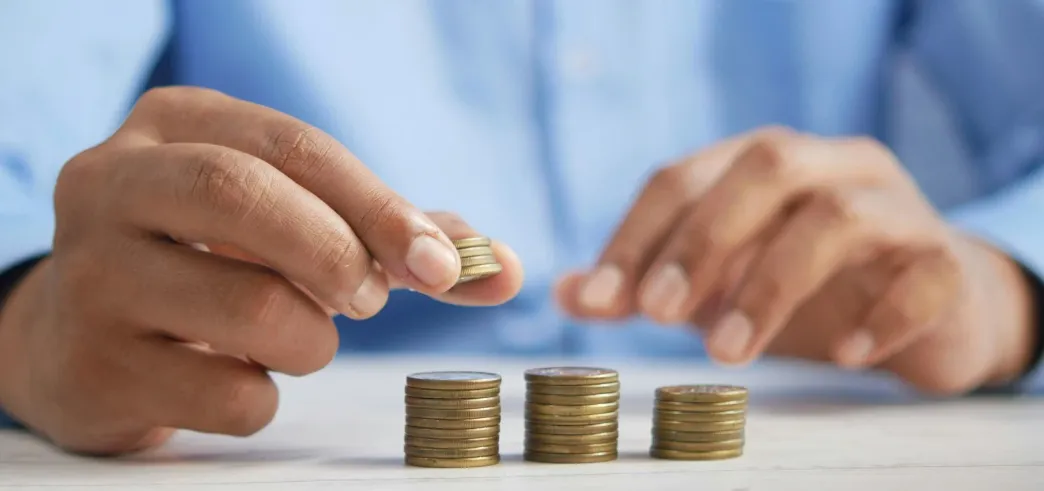
Physical precious metals provide tangible ownership without a counterparty and can help you better diversify your wealth.
Whether you buy from your holding company or personally is primarily a fiscal and legal choice that is independent of the product. It helps to separate three matters.
If you buy through your holding company, the results on the precious metals fall under corporate income tax. The participation exemption that may have applied to the capital gain on your operating company does not apply to later results on gold. If the holding later distributes to you personally, dividend tax and box 2, the tax on income from a substantial interest, will apply. The withheld dividend tax is generally creditable against your income tax.
If you buy personally, precious metals fall into box 3, under other assets. In 2026 the Tax Authority calculates on investments and other assets using an assumed return of 6.00%, above a tax-free allowance of € 59.357 per person, at a rate of 36%. If your actual return was lower, you can report that under the current rules.
Also bear in mind that the new box 3 system the cabinet envisages from 2028, including a different treatment of physical precious metals, is not yet final. You can read the status in our article on goud in box 3.
Gold is considered investment gold when it concerns bars with a purity of at least 995/1,000 and a weight accepted by the gold market, or gold coins with a purity of at least 900/1,000 that were minted after 1800 and meet the further conditions of the Tax Authority.
Not every gold product therefore falls under the VAT exemption. You can find more explanation in our article on what investment gold is.
| Product or structure | VAT on purchase | Considerations |
|---|---|---|
| Investment gold that meets the conditions | Exempt | An exemption is not a 0% rate: no VAT is calculated, so there is nothing to deduct |
| Silver bars, regularly delivered in the Netherlands | Typically 21% | Deductible only for a VAT entrepreneur who uses the purchase for taxable activities; in a holding that only manages assets this is often not the case |
| Silver coins under the margin scheme | The VAT is included in the seller's margin | No separate VAT amount on the invoice, so nothing to deduct |
| Silver in the customs warehouse in Zurich | No VAT as long as the silver remains in the structure | Sale within the structure without VAT; upon import into the Netherlands in principle 21% import VAT; there is a storage fee |
A customs warehouse is storage under customs supervision, where goods can be held without import duties being due. Edelmetaal Beheer Nederland stores the silver there with Loomis International in Zurich. That no VAT is charged follows from the customs status of the silver, not just from its location in Switzerland. On import into the Netherlands, transport and insurance costs may also be included in the base for import VAT. You can read more on our page about VAT-free silver.
Also note the following points:
With physical precious metals, weight, ownership, custody and sales terms together determine how flexible and controllable your holdings are.
Large bars usually have a lower premium per gram than coins, but a kilo bar is sold in a single transaction. Smaller units cost more per gram and allow you to sell part of your holding flexibly later.
The bid price on resale also varies by product type; the current percentages we offer are on the website of Inkoop Edelmetaal.
Keeping it yourself gives you a tangible possession, but you must arrange security and insurance yourself. Check whether your policy covers precious metals and what limits apply, including for holdings of your BV. With professional storage, a specialised party stores the metal on your behalf for a storage fee. Access is then via a request for delivery or sale. And insurance covers theft or damage, not a falling metal price.
Allocated means that specific bars or coins are assigned to you; segregated means your metal is kept separate from that of others. When stored via Edelmetaal Beheer Nederland the precious metal is allocated and kept in your name, legally separated from the assets of Edelmetaal Beheer Nederland and The Silver Mountain, in vault locations in the Netherlands or, in the customs warehouses, at Loomis in Zürich.
Keep your invoice in the name of the buyer and the storage agreement with weight, type and, where applicable, serial number. Also have recorded who may give instructions; for a BV that is the question of who can sign on behalf of the company.
Thanks to the sale certainty through our sister company Inkoop Edelmetaal, you can easily sell your precious metals back. Under the purchase terms we always buy, regardless of how the price moves. After inspection, payment is made exclusively by bank transfer and within 24 hours.
For storage you place the order from your account, and silver in the depot is sold without the silver leaving the depot. You receive the price at that moment; a fixed return in euros is not guaranteed.
More information can be found on our page about selling to us.
Would you like to invest part of your sale proceeds in precious metals and are you curious about the options? We can advise you during an introductory meeting.
In an introductory meeting you discuss with a precious metals specialist from The Silver Mountain how a purchase of physical precious metals proceeds in practice, from product choice to storage and sale.
The meeting is intended for purchases from € 10.000, lasts about 45 minutes and takes place by appointment at our experience-center in The Hague or Villa Elias in Baarn.
Would you like to discuss your situation at your leisure? Then schedule an introductory meeting in The Hague or Baarn.
The Silver Mountain has specialised in physical precious metals since 2008 and is listed in the AFM register with licence number 12048860 for offering investment products. Our gold bars come from refineries on the LBMA Good Delivery List and our coins from recognised mints.
The Silver Mountain is a specialist in physical precious metals and does not provide individual investment, tax or legal advice. This article is intended solely as general information. Have your personal situation assessed by your tax advisor, accountant or wealth planner.
First map out what you have actually received, which taxes and obligations still follow and what you will need in the coming years. Distinguish between money in your holding company and private funds, and regard an earn-out or vendor loan as an uncertain future receipt. In the meantime you can temporarily place the proceeds in a savings or deposit account, within the limits of the deposit guarantee.
There is no standard percentage for that. The amount depends on your goals, your horizon, your other assets and liabilities, the liquidity you need and the price drops you can bear. Percentages mentioned online are starting points from others. Discuss the allocation of your total assets with a wealth planner who knows your full situation.
Yes, a holding company can buy and hold physical gold. The invoice will then be in the name of the BV, and the business account is verified in advance as required by anti-money laundering legislation. Investment gold is also exempt from VAT for a BV. Returns on the gold fall under corporate income tax, even if the sale profit on your company fell under the participation exemption.
Not automatically. VAT deduction is only possible if your holding company is a VAT-registered business and the purchase is used for VAT-taxable activities; a holding that only manages assets after the exit often does not meet that requirement. For silver coins under the margin scheme there is no deductible VAT on the invoice. Silver in the Swiss customs warehouse is bought without VAT as long as it remains there.
No one can predict that reliably. Whether a price was high or low only becomes clear in hindsight, and a recent rise or fall does not predict the next movement. More important is whether gold fits your objective, horizon and ability to withstand price declines. Those who want the timing of entry to weigh less can buy in phases, although that does not guarantee a lower average price.
Allocated stored precious metal is legally yours and should in principle not be part of the bankruptcy estate of the storage provider or the dealer. Settlement via a bankruptcy trustee can take time, and you must be able to demonstrate your ownership with your invoice and custody agreement. If you have paid but the metal has not yet been delivered or allocated, then you have a claim and not ownership.
Via Inkoop Edelmetaal you can sell under the buy-back terms, regardless of how the price moves. After inspection of the precious metal, payment is made by bank transfer within 24 hours, provided the minimum amount for a sales order is met. For storage you place the order from your account. You receive the price at that moment, and it is usually below the price at which you bought.
Rolf van Zanten is the founder and owner of The Silver Mountain, a specialist in physical precious metals since 2008. With nearly twenty years of experience in the precious metals trade, Rolf shares his expertise on investing in gold, silver, and platinum in an accessible and reliable way. His knowledge of the international gold and silver markets helps investors make well-informed decisions. In his role as an expert, he strives to ensure that transparency, security, and trust are at the heart of every purchase.

Be the first to discover the latest products and the latest news about precious metals.


 Nederlands