
 Buy gold bars
 Buy gold coins
 Series
 Buy silver coins
 Buy silver bars
 Series
 Buy silver collectible coins
 Silver collectible coin series
 Buy gold collectible series
 Gold collectible coin series
 Author:
  Date: 21 February 2025
 About
About Everything about the gold guilder
 Daan Wesdorp
6 June 2024
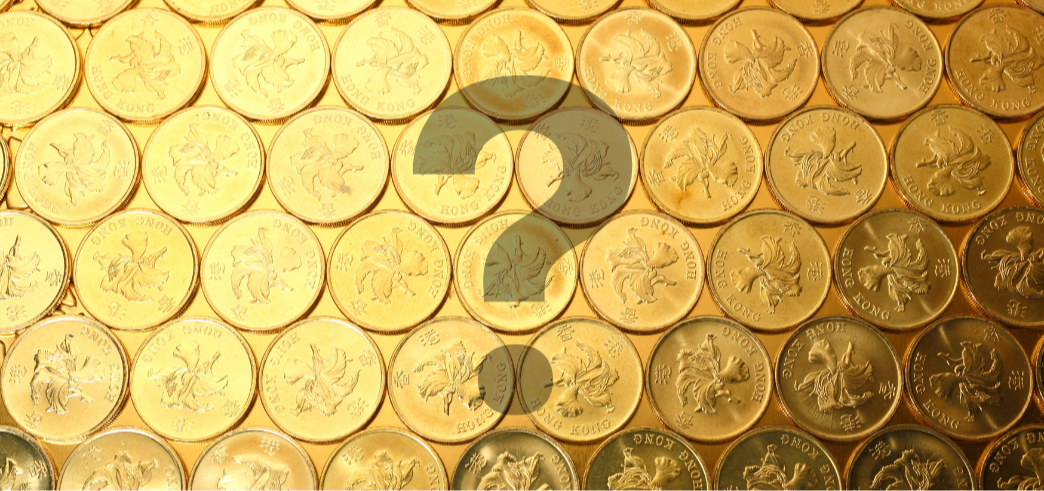
Which gold coins you should buy depends on four factors: your goal (investing or collecting), your budget, the desired tradability and the price per gram. For most beginning investors, globally recognized 1 troy ounce investment coins, such as the Maple Leaf, Krugerrand or Philharmoniker, are the logical first choice: they are pure, easy to trade and carry a relatively low premium above the spot price of gold.
This guide helps you make that choice step by step. You will learn which factors really matter, how the best-known investment coins compare to each other, and how you can use a simple decision model to determine which coin suits your situation. That way you choose not by feeling, but based on the characteristics that are important to you.

A good coin choice starts with your purpose, not with the coin you find the most beautiful. Most gold bullion coins contain exactly the same amount of pure gold (usually 1 troy ounce), which makes their intrinsic value virtually identical. The difference lies in the premium, tradability, denomination size and whether a coin is intended purely as an investment or also as a collectible.
Understanding that distinction prevents the most common beginner’s mistake: paying too much for a coin with a high collector’s premium when the real goal is wealth protection. In the following sections we go through the four decision factors, after which you can use the step-by-step plan to make your own assessment.
Four factors together determine which gold coin suits you: your purpose, purity, weight and tradability. Below you’ll find for each factor what to look for and why it matters.
Your purpose determines which type of coin suits you. If you buy gold to protect and diversify your wealth, regular investment coins (bullion) are the logical choice: you then pay as little as possible above the gold value. If you are looking for rarity, a special design or historical value, gold collector coins come into play.
The practical distinction: with an investment coin you mainly pay for the gold; with a collector coin you also pay for rarity and finish. You can recoup that collector’s premium when selling, but only if there is a collector willing to pay for it; an investment coin’s value simply follows the gold price. For most beginners, an investment coin is therefore the most predictable.
The purity of a gold coin says less about quality than many beginners think. Modern investment coins such as the Maple Leaf, Philharmonic and Britannia have a purity of 99.99% (24 carat). The Krugerrand and the American Eagle are less pure at 91.67% (22 carat), but they do contain exactly 1 troy ounce of pure gold; some copper is simply added for hardness, which makes the coin heavier and more scratch-resistant.
For tradability and value that difference in purity makes no difference: a Krugerrand is just as easy to sell worldwide as a Maple Leaf. It does explain a concept that is often confusing for beginners: the difference between fine weight and gross weight.
The fine weight is the amount of pure gold in the coin; the gross weight is the total weight including any alloy. A 1 troy ounce Krugerrand contains a full troy ounce of pure gold (the fine weight), but it weighs slightly more overall because of the added copper (the gross weight). Only the fine weight counts for the gold value; purity by itself does not say anything about that.
In our knowledge article you can read more about carat and gold content.
The weight of a coin determines both your entry amount and the premium per gram. Most investment coins weigh 1 troy ounce (31.103 grams), but there are smaller fractions. The rule of thumb: the smaller the coin, the higher the production costs per gram, and therefore the higher the premium.
A large coin is cheaper per gram, but less flexible when selling: you always sell the entire weight at once. Smaller denominations cost relatively more, but allow you to buy gradually or later sell only part of your holding. Whether cost or flexibility weighs heavier for you depends on your budget and plans.
Tradability determines how easily you can sell the coin later. Globally recognized investment coins from reputable mints are recognizable everywhere and therefore very liquid. That usually keeps the spread, the difference between buy and sell price, low. Less well-known or purely national coins can be harder to sell or sell at a lower price.
For those who buy gold as wealth protection this is often the decisive factor: a coin you can sell quickly and at a fair price is in practice more valuable than a slightly cheaper coin that is less marketable.
If you want to know how current prices compare, you can find them on the page with the current gold price.
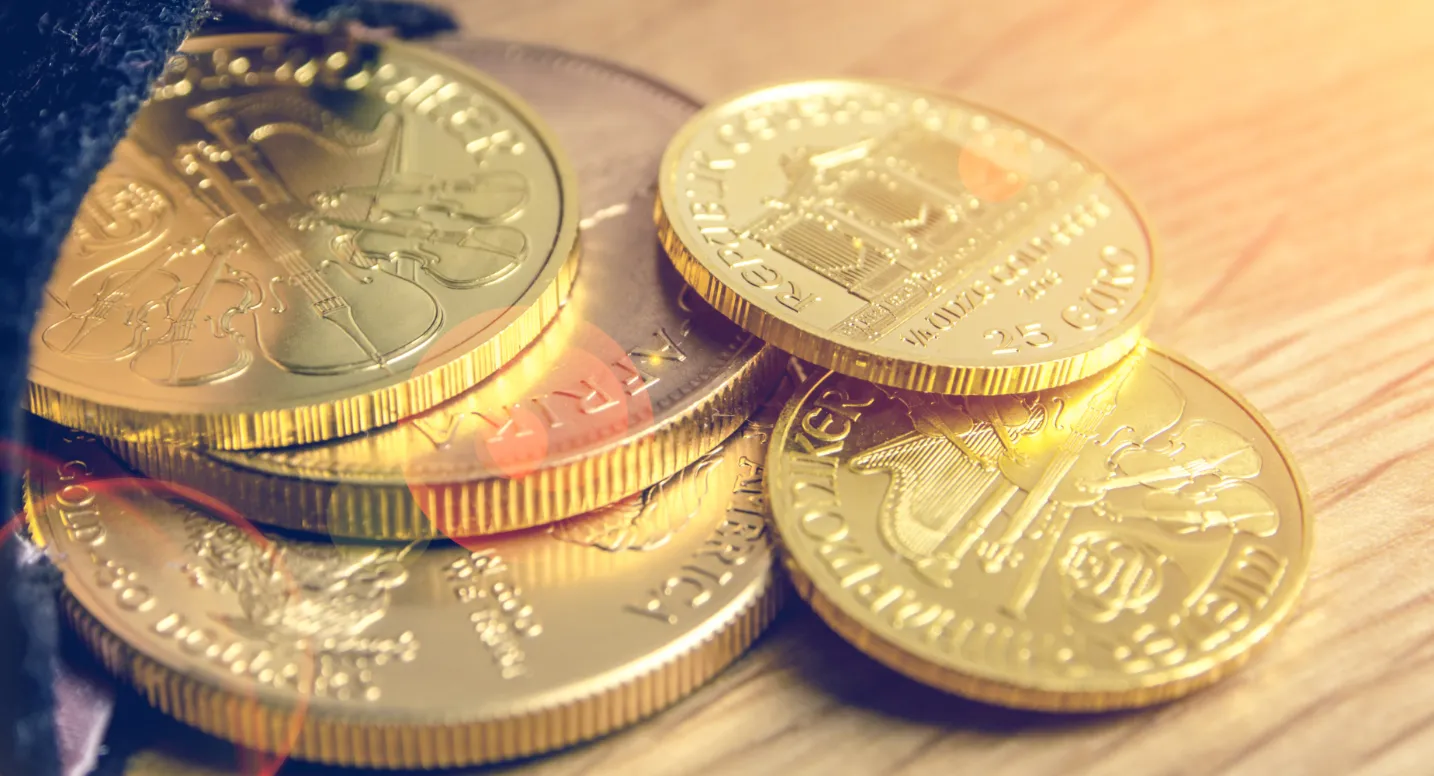
Globally recognized 1 troy ounce bullion coins are usually the most practical for beginners.
When comparing coins you inevitably come across two terms. The premium is the amount you pay above the bare gold value, covering production, distribution and margin. The spread is the difference between the price at which you buy and the price at which you can sell at that same moment.
Together these two determine whether a coin is cost-effective, more than the purchase price alone. A coin with a slightly higher purchase price but a higher buyback price can ultimately be more advantageous than a cheaper coin with a lower buyback price. Therefore compare not only what you pay, but also what you get back.
The best-known gold investment coins appear very similar at first glance: they are almost all 1 troy ounce coins recognized worldwide. The difference lies in purity, country of origin and the character of the coin. The table below sets the fixed features side by side.
We deliberately leave out prices here, because they continuously move with the gold price; you can find current prices and spreads on the product pages themselves.
| Coin | Country / mint | Purity | Standard weight |
|---|---|---|---|
| Maple Leaf | Canada (Royal Canadian Mint) | 99.99% (24 carat) | 1 troy ounce (+ fractions) |
| Krugerrand | South Africa (South African Mint) | 91.67% (22 carat) | 1 troy ounce (+ fractions) |
| Philharmoniker | Austria (Münze Österreich) | 99.99% (24 carat) | 1 troy ounce (+ fractions) |
| Britannia | United Kingdom (Royal Mint) | 99.99% (24 carat) | 1 troy ounce (+ fractions) |
| Kangaroo | Australia (Perth Mint) | 99.99% (24 carat) | 1 troy ounce (+ fractions) |
| American Eagle | United States (US Mint) | 91.67% (22 carat) | 1 troy ounce (+ fractions) |
Features may vary slightly by year.
The choice between these coins rarely revolves around the gold content, because with the same denomination it is virtually identical. It's more a matter of preference: the Maple Leaf and Britannia are known for their high purity and modern security features, while the Krugerrand and American Eagle are harder and more scratch-resistant due to their copper alloy.
All the mentioned coins are globally recognized investment coins and meet the EU requirements for VAT-exempt investment gold.
Besides modern investment coins, there are historical coins with a lower entry point and their own character. The best-known example is the golden tientje, with a fineness of 90% and a small size. The gold ducat (98.3%) is also popular.
These coins generally have a lower price per piece than a 1 troy ounce coin, making them an accessible way to start with physical gold.
Historical coins combine a gold value with a certain collectible value. They are easy to trade in the Netherlands, but internationally less common than a Maple Leaf or Krugerrand. For those who mainly buy and sell in the Netherlands and want to start small, they can be a pleasant choice.
In addition to the type of coin, you can choose between newly minted and pre-owned (second-hand) coins. A pre-owned investment coin has previously been owned and was afterwards checked by the dealer for weight, dimensions and purity. For a regular investment coin, an older year contains exactly the same amount of pure gold as the new issue.
For those who mainly care about gold value and costs, a certified pre-owned coin is therefore often attractive: the same amount of gold, but usually at a lower premium. A newly minted coin is more interesting when you are looking for a specific year, intend the coin as a gift, or value an immaculate condition.
A light sign of use is less decisive for an investment coin than for a collector's coin, where the condition directly affects the collectible value.
With the four factors laid out you can now make an informed choice. The step-by-step plan below brings purpose, budget, costs and tradability together in 5 clear steps, so you can move from orientation to a concrete coin choice.
There is no coin that is best for everyone, but based on what you value most, a clear preference emerges. The table below translates the four decision factors into concrete profiles, so you can see at a glance which type of coin matches your needs.
| What matters most to you | Consider |
|---|---|
| Lowest price per gram and maximum tradability | A 1 troy ounce investment coin, such as the Maple Leaf, Krugerrand or Philharmonic |
| Start small with a limited budget | A fractional coin of 1/10 or 1/4 troy ounce, or a gold ten-guilder coin |
| Ability to sell in parts later | Multiple smaller denominations instead of one large coin |
| Scratch resistance and durability | A 22-karat coin, such as the Krugerrand or American Eagle |
| As pure gold as possible | A 24-karat coin, such as the Maple Leaf, Britannia, Philharmonic or Kangaroo |
| Gold with Dutch history or collecting appeal | A gold ten-guilder coin, a gold ducat or a collector series |
If you identify with multiple rows, that's not a problem: most beginners end up with a globally recognized 1 troy ounce investment coin, because it scores well on almost every point.
New investors often ask me what 'the best' gold coin is, but that question has no general answer. The best coin is the one that fits your goal and budget. For most people who want to protect their wealth, a globally recognized 1 troy ounce investment coin with a low premium is the wisest foundation. Start there, and build slowly from that.
Rolf van Zanten - bullion expert The Silver MountainYou buy gold coins safely from a recognized, specialized dealer who guarantees authenticity, provenance and a transparent price structure. Pay attention to a number of points:
The Silver Mountain has been specialized in physical precious metals since 2008 and is listed in the AFM register under license number 12048860 for offering investment objects. Our coins come from recognized mints. You can have them delivered insured via our own delivery service or pick them up by appointment in Baarn and The Hague.
Thanks to the buyback guarantee via our sister company Inkoop Edelmetaal, you can easily sell them back to us later. If you're ready to make a concrete choice, you can find the full range on the buy physical gold page.
The best gold coin to buy is the coin that matches your goal, budget and preferences regarding tradability. For most beginner investors who want to protect their wealth, a globally recognized 1 troy ounce investment coin is the most practical and cost-effective choice. Think of the Maple Leaf, Krugerrand or Philharmoniker.
If you want to start small, fractional denominations or a small "gold ten" offer an accessible alternative. First determine your goal and budget, weigh costs against flexibility, and only then make your choice.
The Silver Mountain does not provide investment advice and this article should therefore not be considered as such. Past performance does not guarantee future results.
For beginners, a globally recognized 1 troy ounce investment coin, such as the Maple Leaf, Krugerrand or Philharmoniker, is usually the best choice. These coins are pure or contain exactly 1 troy ounce of gold, have a low premium and are easy to trade worldwide, which makes them predictable and accessible.
Generally, a 1 troy ounce investment coin has the lowest premium per gram, because production costs are spread over more gold. Which specific coin is the most advantageous at a given time varies by day and by year. Therefore always compare the current price per coin before you buy.
Not necessarily. A 24-carat coin (99.99%) and a 22-carat coin (91.67%) like the Krugerrand both contain 1 troy ounce of pure gold. The less pure coin is harder and more scratch-resistant. Purity makes no difference for value and tradability; it is mainly a matter of preference.
That depends on your priority. One large coin (1 troy ounce) is cheaper per gram, but you always sell the full weight at once. Multiple small denominations carry a relatively higher premium, but offer flexibility: you can buy in installments and later sell part of them.
Collector coins can be valuable, but are less predictable than investment coins. You pay a higher premium for rarity and finish, which you only recoup if a collector is willing to pay for it. Those who buy purely for wealth protection are generally better off with regular investment coins.
Yes, pre-owned investment coins can be an efficient choice for investors. They contain the same gold weight as comparable new coins, but are often offered at a lower premium. Do check whether the dealer has inspected the coin for weight, dimensions and fineness, and what buyback conditions apply.
Globally recognized investment coins such as the Maple Leaf, Krugerrand and Philharmoniker are the easiest to sell, because they are internationally recognizable and highly liquid. That keeps the spread low. Historical and purely national coins are easily tradable in the Netherlands, but less common internationally.
Rolf van Zanten is the founder and owner of The Silver Mountain, a specialist in physical precious metals since 2008. With nearly twenty years of experience in the precious metals trade, Rolf shares his expertise on investing in gold, silver, and platinum in an accessible and reliable way. His knowledge of the international gold and silver markets helps investors make well-informed decisions. In his role as an expert, he strives to ensure that transparency, security, and trust are at the heart of every purchase.

Be the first to discover the latest products and the latest news about precious metals.



 Nederlands