
 Buy gold bars
 Buy gold coins
 Series
 Buy silver coins
 Buy silver bars
 Series
 Buy silver collectible coins
 Silver collectible coin series
 Buy gold collectible series
 Gold collectible coin series
 Author:
 Date: 23 November 2026
Top 10 Countries with the Largest Gold Reserves: Gold Holdings, Production and Natural Resources
 Rolf van Zanten
27 February 2025
Due to volatile precious metal prices and high demand, prices in your cart are temporarily locked for 10 instead of 15 minutes.
Due to price volatility, cart prices are temporarily locked for 10 minutes.

The more than 612 tonnes of gold that De Nederlandsche Bank manages is owned by DNB itself and not by the state. That is stated in the report Focus on the gold reserve, which the Court of Audit presented to the House of Representatives on 11 November 2026. The reserve was worth €72.2 billion at the end of 2025. The Court of Audit also notes that the Minister of Finance requests little information about the oversight of the gold. In addition, DNB and the minister have no arrangements on using the gold in a crisis.
The Court of Audit examined how the Minister of Finance deals with the state's interest in the gold reserve. The minister is the sole shareholder of DNB on behalf of the state, but has no control over the gold. Between March and August 2026 DNB moved approximately 86 tonnes of gold from New York and Ottawa to London; the ministry was informed about that plan on 8 December 2025. The report maps out the facts and contains no judgments or recommendations.
De Nederlandsche Bank is a public limited company. The gold is on its balance sheet and is therefore the property of DNB. That is also how DNB and the Ministry of Finance view it. The minister is the sole shareholder on behalf of the state, but cannot use that shareholding to exercise the rights that an owner would have.
That view differs from what DNB used to communicate itself. In a 2010 brochure the bank wrote that the gold belonged to the state and called it "our national rainy-day fund". On DNB's website it has only stated since May 2025 that DNB owns the gold as part of its reserves.
In 2010 the gold stock was worth €10 billion. At the end of 2025 it was €72.2 billion, more than seven times as much. Offset against that value on DNB's balance sheet was a revaluation reserve of €71.1 billion. In that reserve DNB records how much the gold it holds has increased in value. If the gold price falls, that reserve absorbs the decline.
As long as DNB holds the gold, none of that appreciation goes to the treasury, because the reserve is not distributed as a dividend. On the other hand, the state also does not have to step in if the gold price falls sharply. If DNB itself decides to sell gold, the realized profit can be paid out to the state. The minister cannot force such a sale.
DNB itself checks whether the gold is present. DNB makes an inspection memorandum of each vault check, for the vault in Zeist and for the foreign vaults. In 2014 the minister wrote in response to parliamentary questions that DNB physically checks the stock in the Netherlands every year. In addition, DNB visits one of the foreign custodians each year, on a rotating basis. According to that response, no differences were found during those checks.
DNB's annual accounts are audited by accountant KPMG, who was appointed by the minister. What KPMG could establish itself differs by location:
| Custody location | What KPMG did for the 2025 annual accounts |
|---|---|
| DNB Cashcentrum in Zeist | Was present at DNB's year-end inventory |
| New York, Ottawa and London | Did not accompany the physical inspections; received an external confirmation, which according to DNB comes from the custodial central banks themselves |
The ministry bases itself on the annual reports and the audit by the accountant. It never asked for the inspection memoranda because it does not consider that fitting with the role of shareholder and DNB's independence. DNB could also not share their contents with the Court of Audit. Requesting them would have been permitted, however. There is no legal prohibition on asking how the checks are carried out. According to the Court of Audit, requesting information is not the same as influencing decisions.
The Public Accounts Act excludes investigation by the Court of Audit into DNB's monetary tasks. The holding and management of gold fall under that. The Court of Audit could therefore only look at the role of the minister.
In other euro area countries the arrangements are different. In Germany the external auditors of the Bundesbank are appointed in consultation with the Bundesrechnungshof. The Austrian Court of Audit published a report on the gold reserves of the Oesterreichische Nationalbank.
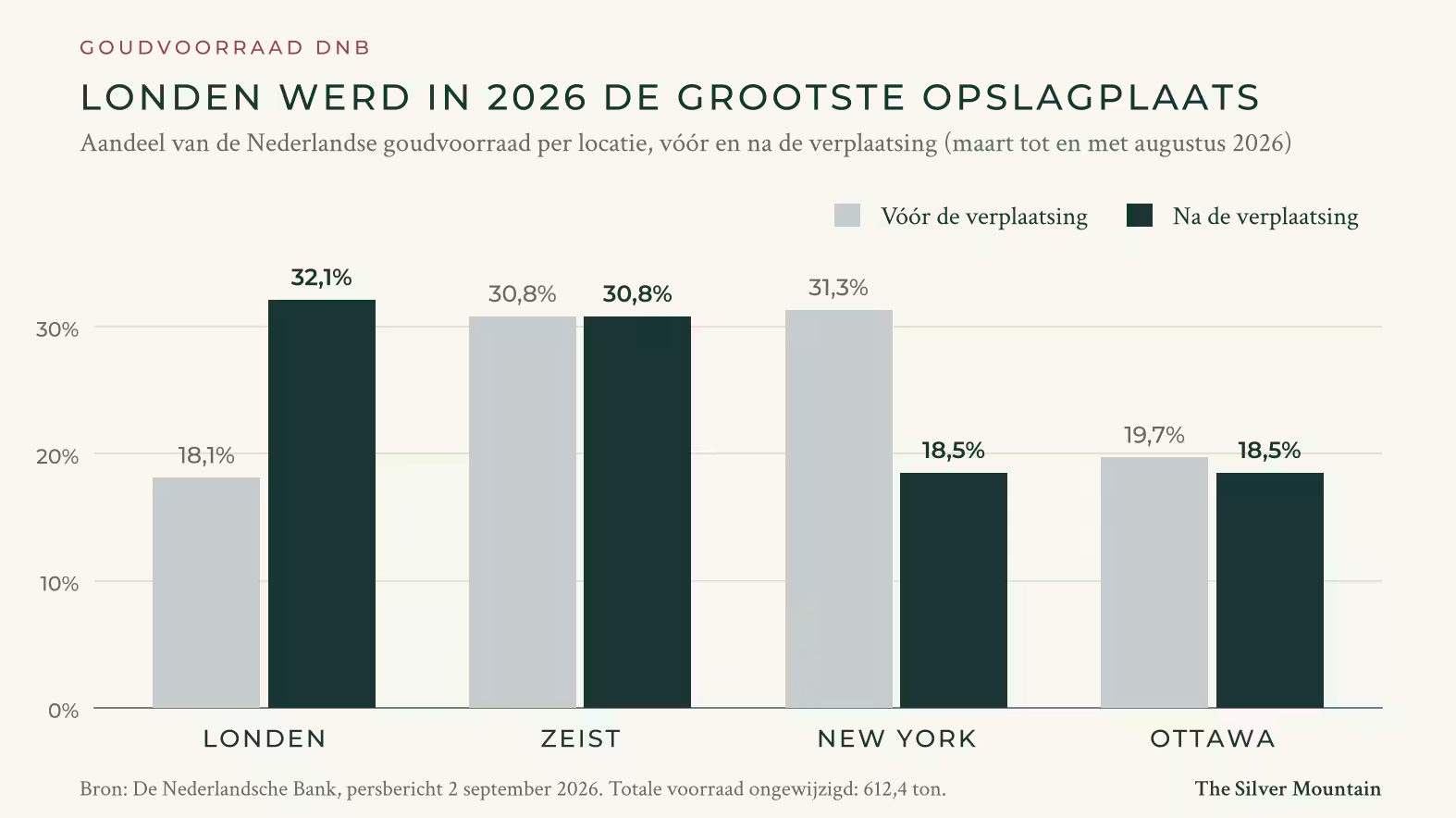
Between March and August 2026 DNB moved about 86 tonnes of gold from New York and Ottawa to London. Previously almost 313 tonnes were located in those two countries. DNB announced the operation on 2 September 2026. The total size of the holdings remained unchanged.
DNB gives two reasons, which the bank says fit with strengthening its crisis preparedness in a period of increasing geopolitical unrest:
DNB president Olaf Sleijpen said at the announcement that the bank assumes it will never need to deploy the gold, but does want to strengthen its readiness.
DNB sold nearly 59 tonnes of gold in New York and repurchased gold in London that meets the international standard. In addition, more than 27 tonnes physically moved from the United States and Canada to Zeist. An equal amount of gold from Zeist, which already met the market standard, went to London. That way, no gold bars had to be remelted.
| Storage location | Share before | Share after | Value before | Value after |
|---|---|---|---|---|
| London | 18.1% | 32.1% | €13 bn | €23 bn |
| Zeist | 30.8% | 30.8% | €22 bn | €22 bn |
| New York | 31.3% | 18.5% | €23 bn | €13 bn |
| Ottawa | 19.7% | 18.5% | €14 bn | €13 bn |
Source: DNB (percentages), Court of Audit (amounts based on the gold price of 1 October 2026). Due to rounding, the columns do not add up exactly.
In March 2025 DNB mentioned in a meeting with officials from Finance that it might reconsider the storage locations. On 8 December 2025 DNB informed the ministry of the concrete intention to relocate gold. On 16 December the DNB president discussed it with the minister during a lunch meeting.
The Court of Audit was already conducting its investigation. At the minister's request it paused the investigation on 18 December. The Court of Audit made that decision itself, because of the country's major interests and the safety of those involved. On 3 September 2026, a day after DNB announced the relocation, the investigation resumed.
In an earlier relocation, in 2014 from New York to the Netherlands, the ministry could no longer determine whether the minister had been informed in advance. No documents about that were found in the archives.
DNB describes the gold on its website as a rainy-day fund for emergencies, such as a financial crisis, serious political instability or war. In its internal guidelines it states why DNB holds the gold: situations in which confidence in fiat money is no longer self-evident. Fiat money is money without intrinsic value, such as the euro. The gold is managed passively.
According to DNB, the gold remains DNB's even in such situations. The state cannot deploy it. DNB itself has two options. It can retain the gold as a strategic reserve, as an anchor of confidence; for that it does not need to be sold. It can also sell it and pay the proceeds to the state. That decision rests with DNB, and the minister may not give instructions about it.
No agreements have been made between DNB and the minister and no scenarios have been developed for deploying the gold in a crisis. Minister Eelco Heinen writes in his response to the report that there is little reason for that in normal times, reports NOS. He points out that the gold is managed passively according to the guidelines, that he attends DNB's annual meeting and that he receives information both solicited and unsolicited. According to the minister, DNB's management of the gold contributes to the resilience of the Dutch economy.
Central banks in the eurozone are independent in their monetary tasks. That is laid down in the Treaty on the Functioning of the European Union (TFEU). Governments may not influence those tasks, and the management of the gold reserves is part of that. The minister therefore has no authority over how much gold the Netherlands holds, how it is managed and where it is located.
According to the Court of Audit, independence does not mean that information cannot be exchanged. The European Monetary Institute, the predecessor of the ECB, already wrote in 1996 that the prohibition on influence does not exclude a dialogue with governments.
The Bank Act 1998 regulates that exchange of information:
Information the minister receives in this way is subject to the same confidentiality obligation as at DNB.
In practice that authority has been little used. In the brief reports of the periodic consultations between the minister and the DNB president, the Court of Audit found no mention of the gold reserves up to the end of 2025. From December 2025 onwards the gold reserves and the relocation were discussed.
DNB writes that its guidelines have been deliberately drawn up at a high level of abstraction. As a result, according to the Court of Audit, they do not say how DNB determines where the gold is safely located. They also do not say how presence is checked and how availability in a crisis is ensured.
In September 2026 the minister wrote to the House of Representatives that the management of the gold reserves is part of the state's vital interests. He considers that his limited requests for information fit his role as shareholder and the independence of DNB.
Until the late 1930s almost all Dutch gold was held in the Netherlands. In the run-up to the war DNB placed a large portion in vaults in New York, London and later Ottawa. Most of the gold that remained in the Netherlands was taken away by the German occupiers. After the war the Netherlands received back about half of that.
At its peak DNB had 1,753 tonnes of gold. In 1992 DNB secretly sold 400 tonnes, and in 1996 another 300 tonnes followed. In the Gold Agreement of 1999 fifteen European central banks agreed to sell only gradually. The Netherlands then continued to reduce its holdings until 2008. Since then the stock has been stable at 612.45 tonnes.
More about the size of that stock is in the article about how much gold the Netherlands has. A comparison with other countries is in the overview of countries with the largest gold reserves. How 612 tonnes compares to all the gold that has ever been mined is explained in a separate article.
The Court of Audit bases this overview on the annual report In Gold We Trust by Incrementum. Germany repatriated the largest amount between 2013 and 2017: equivalent to nearly €80 billion at the gold price of 1 October 2026. France follows with just over €40 billion, spread over 2013-2016 and 2025-2026.
India, Turkey, Poland, Hungary and Austria also moved gold. Not all relocations are made public.
For the Netherlands the next benchmark is set in DNB's policy. The bank fully evaluates the gold policy, including the distribution across storage locations, every five years. In addition it assesses annually whether an interim evaluation is needed. According to DNB, the 2026 relocation resulted from such an evaluation.
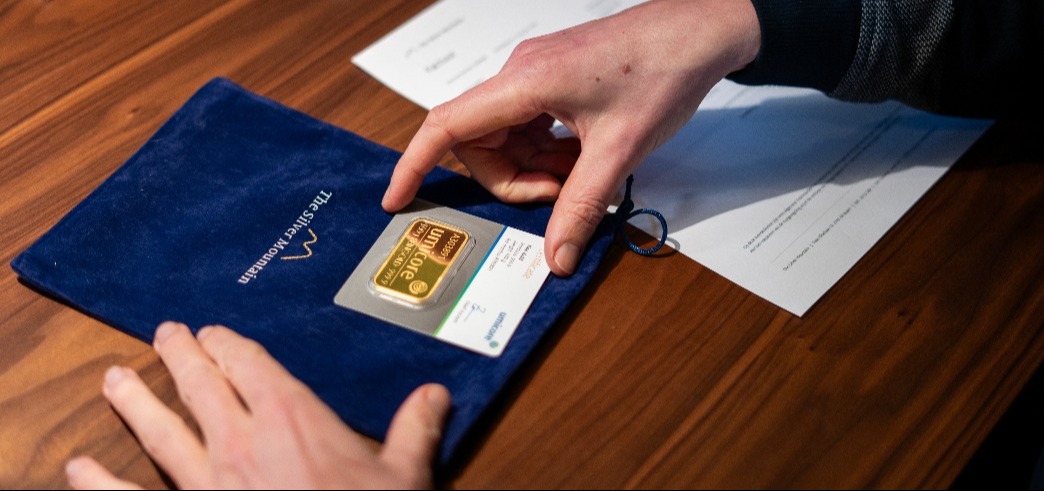
A gold bar that you buy from The Silver Mountain is your own physical property.
For the investigation the Court of Audit posed a series of practical questions to the ministry:
For those who own gold personally, those same questions concern ownership and saleability.
Those who follow the news about the state’s gold often ask the same question about their own gold: is it really mine, and can I access it when I need it? For gold you buy from The Silver Mountain, the answer is clear. It is yours. You decide where it is stored and when you sell it.
If you prefer to keep your gold yourself, we deliver it using our own personal delivery service. Insured, and in a time slot you receive by e-mail the evening before. If you choose storage, Edelmetaal Beheer Nederland keeps your gold allocated and in your name, in Switzerland or the Netherlands. Those are your own bars and coins, not a share in a pooled stock. From your account at Edelmetaal Beheer Nederland you can also sell them back directly.
DNB moved gold to London because gold that meets the international standard is the most quickly tradable there. That principle is also reflected in our range. The Silver Mountain sells gold bars from refiners on the LBMA Good Delivery List and gold coins from recognised mints, and guarantees the authenticity of every product.
If you want to sell later, sister company Inkoop Edelmetaal arranges that with sale assurance. Under its purchase terms Inkoop Edelmetaal always buys, regardless of the exchange rate. After inspection the amount appears in your account within 24 hours. The entire chain, from purchase to resale, is thus with one organisation that has been doing this since 2008.
See the gold bars and gold coins in our gold range. Buying gold for the first time and want to talk it over? Call us at 035 203 1380, we are happy to discuss it with you.
When gold arrives with us via Inkoop Edelmetaal, specialists first check what we have on hand. A central bank looks at something else as well: how quickly a bar is tradable where it is located. That question is just as relevant for a private individual. Those who buy gold prefer to know in advance how they will store it and later sell it.
Rolf van Zanten - Founder The Silver MountainThis article contains general information and is not personal investment advice. Sources: Court of Audit, Focus on the gold reserves (11 November 2026); DNB, press release of 2 September 2026.
The gold is the property of De Nederlandsche Bank itself. DNB is a public limited company and the gold is on its balance sheet. The state is the sole shareholder via the Minister of Finance, but cannot exercise ownership rights over the gold. The Court of Audit established this in November 2026. Since May 2025 DNB states on its website that it owns the gold.
Not directly. As long as DNB holds the gold, the bank records the increase in value in a revaluation reserve, which amounted to €71.1 billion at the end of 2025. That reserve is not paid out as dividends. Conversely, the state does not have to step in if the gold price falls sharply. Only when DNB itself decides to sell gold can the realised profit be distributed to the state.
DNB cites two reasons. Gold held at the Bank of England meets international trading standards and is therefore considered the most tradable gold in the world, so DNB can deploy it fastest in a crisis. In addition, DNB wanted to distribute the stock more evenly across North America, the United Kingdom and the Netherlands. Between March and August 2026 about 86 tonnes went to London.
Mostly via sale and repurchase. DNB sold almost 59 tonnes of gold in New York and bought back gold in London that meets international trading standards. In addition, more than 27 tonnes physically moved from the United States and Canada to Zeist. An equal quantity of gold from Zeist that already met the standard went to London. That meant there was no need to remelt any gold bars.
Yes. DNB checks the stock itself: annually physically in the Netherlands and each year at one of the foreign custodians, on a rotating basis. Auditor KPMG attends the inventory in Zeist. For the gold abroad, KPMG relies on a confirmation from the custodian central banks. The Court of Audit reports nowhere that any gold is missing.
Only DNB. The Minister of Finance may not give instructions because gold management falls under DNB's independent monetary tasks. DNB can hold the gold as a strategic reserve, or sell it and pay the profit to the state. According to the Court of Audit, there are no agreements or scenarios between DNB and the minister regarding deployment in a crisis.
DNB. The choice of storage location falls under the central bank's independent monetary tasks. Under the TFEU the Minister of Finance has no authority over that and cannot instruct DNB to bring gold to the Netherlands. He can, however, ask what considerations DNB made. A parliamentary motion from 2025 about the gold reserves was not adopted.
Partially. The share in New York fell in 2026 from 31.3 to 18.5 percent, but that gold mostly went to London. The share in Zeist remained 30.8 percent. In 2014 DNB once brought part of the gold from New York to the Netherlands.
Rolf van Zanten is the founder and owner of The Silver Mountain, a specialist in physical precious metals since 2008. With nearly twenty years of experience in the precious metals trade, Rolf shares his expertise on investing in gold, silver, and platinum in an accessible and reliable way. His knowledge of the international gold and silver markets helps investors make well-informed decisions. In his role as an expert, he strives to ensure that transparency, security, and trust are at the heart of every purchase.

Be the first to discover the latest products and the latest news about precious metals.


 Daan Wesdorp

 Nederlands