
 Buy gold bars
 Buy gold coins
 Series
 Buy silver coins
 Buy silver bars
 Series
 Buy silver collectible coins
 Silver collectible coin series
 Buy gold collectible series
 Gold collectible coin series
 Author:
  Date: 4 December 2024
 About
About What are precious metals? A precious metals overview
 Rolf van Zanten
3 March 2025
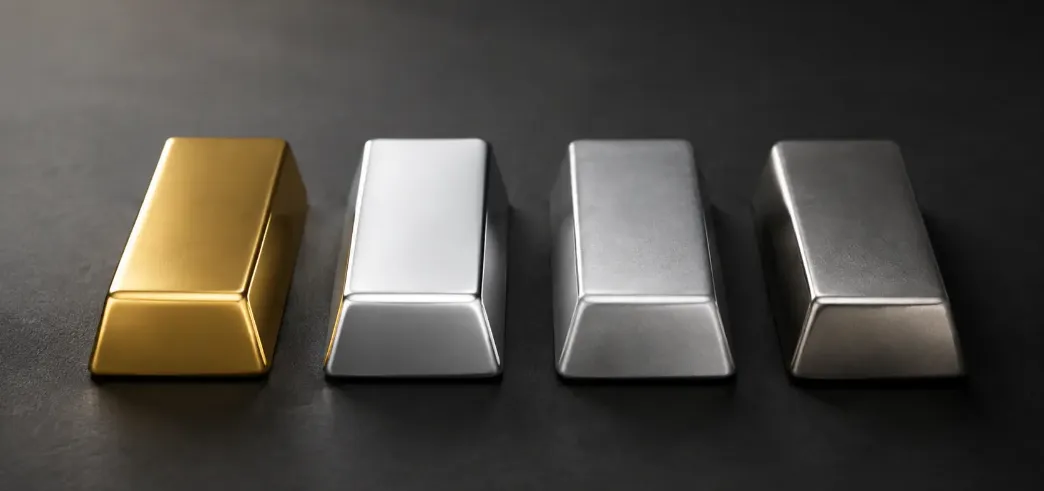
Gold, silver, platinum and palladium are all four precious metals, but they do not serve the same purpose. The core difference is that gold has the strongest monetary role and is driven mainly by investor demand and purchases by central banks, whereas demand for silver, platinum and palladium is much more directly linked to industrial production. As a result, the four metals each respond differently to interest rates, economic growth, technology and geopolitics.
In this article we compare the four metals head to head on demand, price, volatility, VAT and tradability, and on the question of which metal suits which purpose.
If you first want to know what a precious metal precisely is and which properties they share, read our article about what precious metals are.
Gold, silver, platinum and palladium share the same noble properties, but differ on the points that matter to an investor. The table below compares the key points side by side.
| Characteristic | Gold | Silver | Platinum | Palladium |
|---|---|---|---|---|
| Role for investors | Stable base, store of value | Affordable entry metal | Niche investment | Strong industrial investment |
| Demand mainly driven by | Investors, central banks | Industry and investors | Automotive industry, chemicals, technology | Automotive industry |
| Price per gram (relative) | Highest | Lowest | Variable | Highly variable |
| Volatility | Relatively stable | More volatile | Volatile | Very volatile |
| Main uses | Investment, reserves, jewelry | Electronics, solar panels, jewelry | Catalysts, hydrogen, jewelry | Catalytic converters for gasoline cars |
| VAT (NL, private individuals) | Investment gold exempt* | 21% (coins: margin scheme) | 21% | 21% |
| Tradability | Very high | High | Lower | Lowest of the four |
| Physical | Heavy, highly corrosion-resistant | Lightest, can tarnish | Heaviest, high melting point | Lighter than platinum |
*Provided the legal criteria for investment gold are met. Relative price relationships change over time and you can find current prices on our price pages.
The main difference between gold and silver is that silver is much more dependent on industrial demand, causing the silver price to fluctuate more. Gold is hardly used industrially and acts as a store of value. Silver is widely used in electronics, solar panels and batteries. If industrial demand declines, it affects the silver price more than the gold price.
Silver is also called “the gold of the small investor” because the price per gram is lower and the entry barrier is lower. There is a fiscal drawback: you pay 21% VAT on silver bars, while silver coins fall under the margin scheme and are therefore more advantageous. Gold remains, under conditions, exempt from VAT as investment gold.
A practical point is storage. Silver has a lower density than gold, so for the same value physical silver takes up considerably more space. Anyone who wants to hold larger amounts physically will notice that difference in storage and transport. Silver is attractive for those who want to start small; those who mainly seek stability are more likely to choose gold.
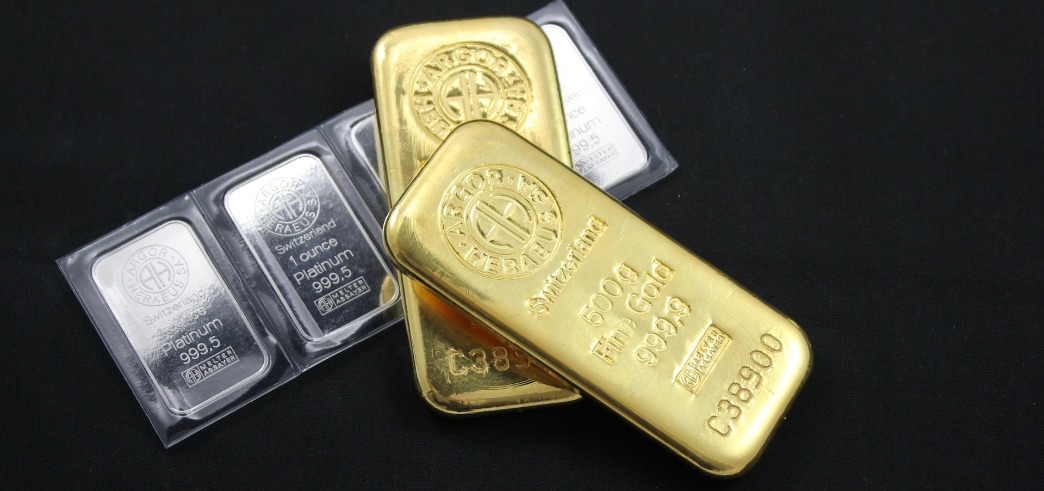
You pay VAT on silver, platinum and palladium. Investment gold is exempt under certain conditions.
Platinum is scarcer than gold, but it is less liquid and its price is more strongly determined by industry. Platinum is mainly used in catalytic converters and in hydrogen technology, causing demand to move with the automotive industry and the energy transition. Gold hardly shows that industrial sensitivity.
The price relationship changes over time: for many years the platinum price was higher than the gold price, but since the early 2010s gold has generally been more expensive. That platinum is scarcer therefore does not automatically mean it is more expensive: scarcity and market price are two different things.
In addition, you pay 21% VAT on platinum. A more detailed comparison can be found in our article on the price of platinum versus gold. If you are considering investing in platinum, take the lower tradability into account.
Platinum and palladium belong to the same metal group and are very similar, but palladium is more dependent on one end market: the catalytic converters of gasoline cars. As a result, the palladium price can move violently when demand from the automotive industry shifts, for example due to the rise of electric driving. Platinum has a broader range of applications, including hydrogen technology, and is denser than palladium.
An interesting feature is that platinum and palladium can partially substitute for each other in certain catalytic converters. With a large price difference, industry can partly switch, which links the demand for both metals.
Those who want to understand the differences in detail can read our article about what palladium is. If you are considering buying palladium, factor in those strong price swings.
Prices move differently because each metal has its own mix of buyers, applications and supply risks. Four factors weigh most heavily.
Gold is driven mainly by monetary and investment demand: central banks, investors and physical reserves. Silver also has that investment demand, but industrial demand is larger, with electronics and solar energy as drivers. Platinum and palladium are strongly tied to the automotive industry.
Supply also matters: where and how concentrated a metal is mined, and whether it comes from a mine as a primary product or a by-product, determines how quickly supply can respond.
Finally, substitution plays a role: with large price differences, manufacturers can partially swap platinum and palladium for each other in catalytic converters.
The current price alone therefore says little about scarcity or suitability. A high price can stem from strong demand, a temporary shortage or market unrest.
Gold is generally the most stable and the easiest to trade, palladium the most volatile and the least liquid. These two characteristics are linked to industrial dependence. The larger the industry's share of demand, the more strongly the price reacts to economic ups and downs.
For gold, demand comes from a broad mix of investors, central banks and jewelry, which keeps the price relatively stable. Silver follows the economic cycle more closely. Platinum and palladium are largely tied to the automotive industry, so a shift in demand or supply can already lead to significant price swings.
Liquidity also differs: you can sell gold and silver almost anywhere, whereas the market for platinum and palladium is smaller.
The biggest practical difference when buying is VAT. Only investment gold is exempt; the other three metals are taxable. That makes tax treatment a real factor in your choice, separate from the market price. The table below summarizes this.
| Metal | Bars | Coins |
|---|---|---|
| Gold (investment gold) | Exempt from VAT* | Exempt from VAT* |
| Silver | 21% VAT | Margin scheme (VAT only on the margin) |
| Platinum | 21% VAT | 21% VAT |
| Palladium | 21% VAT | 21% VAT |
*Provided the legal criteria for investment gold are met.
Because of these differences, the net entry cost for silver, platinum and palladium is higher than the bare metal value suggests. For silver and platinum, private individuals therefore often choose coins instead of bars.
Silver, platinum and palladium are subject to 21% VAT. If you store the metal directly in a customs warehouse through Edelmetaal Beheer Nederland, the VAT is suspended as long as it remains stored.
Besides VAT, the premium also differs by metal. The premium is the amount you pay above the bare metal value for production, packaging and tradability, and it is generally higher for silver, platinum and palladium than for gold. For silver this is partly due to the lower value per gram; for platinum and palladium it is due to the smaller, less liquid market.
The same applies to the spread, the difference between the buy and sell price at the same moment. The smaller and more volatile the market, the wider that spread usually is. For gold the spread is typically the narrowest, for platinum and palladium the widest.
When comparing the four precious metals, it is therefore wise not only to look at the spot price and VAT, but also at the premium and the spread. These also determine what you pay at purchase and what you receive when selling.
There is no precious metal that is “the best” for everyone; the appropriate choice depends on your goal, investment horizon and how much price volatility you accept. The table below provides a first indication, not specific advice.
| Your goal | Often suitable | Why |
|---|---|---|
| Stable base and store of value | Gold | Low industrial dependence, stable, very liquid |
| Small entry amount or diversification | Silver (coins) | Low price per gram; coins are more advantageous under the margin scheme |
| Deliberate niche diversification, accepting more risk | Platinum | Scarce, different demand dynamics, more volatile than gold |
| Strong industrial focus, high risk appetite | Palladium | Highly dependent on the automotive industry, large swings |
Many investors do not choose a single metal, but combine gold as a stable core with a smaller portion of silver, platinum or palladium for diversification. A combination reduces dependence on a single metal, but also adds different risks. If you are unsure which allocation suits you, then our Choice Guide can help you on your way.
Note: The Silver Mountain does not provide individual investment advice.
Anyone who compares gold, silver, platinum and palladium only by price misses the most important difference. Gold has a strong monetary function, while the other three are much more directly linked to industrial production. As a result, they each respond differently to interest rates, growth, technology and geopolitics. The right comparison therefore does not start with the question of which metal is best, but with the role it must play within your objective.
Daan Wesdorp - Inkoop Edelmetaal expertAt The Silver Mountain you can buy gold, silver, platinum and palladium in the form of coins and bars at the current market price. The Silver Mountain has specialised in physical precious metals since 2008 and is listed in the AFM register under licence number 12048860 for offering investment objects. This ensures that you buy your precious metals from a reliable and regulated party.
The gold and silver bars we sell are from producers accredited by the LBMA. The LBMA Good Delivery List relates to recognised refineries and to the large bars that meet the professional Good Delivery standard. Think of brands such as Umicore, C Hafner, Heraeus and PAMP Suisse.
The prices on our website are updated automatically based on the current market rate. You can have your order delivered insured via our own delivery service or pick it up by appointment in Baarn and The Hague, and, if you wish, have your precious metals stored insured via Edelmetaal Beheer Nederland. You can sell later again via sister company Inkoop Edelmetaal.
Compare the full range on the pages buy gold, buy silver, buy platinum and buy palladium.
Gold, silver, platinum and palladium belong to the same group of precious metals, but each has a different economic role. Gold stands out for its monetary role and use as a store of value. Silver combines an investment market with broad industrial demand. Platinum is scarce and strongly industrially driven, and palladium is mainly tied to the automotive industry.
The question is therefore not which metal is best, but which metal or combination fits your goal, time horizon and risk tolerance. Consider not only the current price, but also the origin of demand, volatility, VAT, storage and future selling options.
The Silver Mountain does not provide investment advice and this article should therefore not be considered as such. Past results do not guarantee future performance. The price of precious metals can both rise and fall.
The four metals mainly differ in the origin of demand and in volatility. Gold is driven by investors and central banks and is stable; silver is affordable but more volatile; platinum is scarce and strongly industrial; palladium is mostly tied to the automotive industry and is the most volatile. They do share the same noble properties.
That depends on your goal and risk tolerance; neither is generally better. Gold is more stable and serves as a store of value, but costs more per gram and takes up less storage space. Silver is more affordable and offers an accessible entry point, but its price fluctuates more strongly due to substantial industrial demand.
No, scarcity alone does not determine which metal is more expensive. The price is formed by the combination of demand, supply, stocks, production and market expectations. Gold has a large monetary and investment demand, while demand for platinum is more closely linked to industry. The relative price relationship therefore changes over time.
Both belong to the same group and resemble each other, but palladium is more dependent on the catalysts used in petrol cars and is therefore more volatile. Platinum is heavier and has broader uses, including in hydrogen technology. In certain catalysts the two metals can partially replace each other, which links their demand.
Yes, in the Netherlands you pay 21% VAT on silver, platinum and palladium, while investment gold is exempt under certain conditions. For silver coins the margin scheme applies, where you only pay VAT on the margin. Check the current tax treatment per metal and coin type before purchase.
Gold is generally the least volatile precious metal. Because demand comes from a broad mix of investors, central banks and the jewellery industry and the metal is hardly consumed industrially, the gold price reacts less sharply to economic fluctuations than silver, platinum and palladium.
Palladium can fluctuate strongly because both demand and supply are concentrated. A large part of demand comes from the automotive industry, while production and stocks cannot quickly respond to changes. Geopolitics, recycling and partial substitution by platinum also influence the price.
Diversification can reduce dependence on a single metal, but it also adds new risks, because the four metals respond to different developments. Whether a combination suits you depends on your goal, horizon, risk tolerance and storage options. That remains a personal consideration; The Silver Mountain does not provide advice on this.
Daan Wesdorp is Purchasing Manager at Inkoop Edelmetaal, part of The Silver Mountain, and a specialist in trading physical precious metals. With a background in economics and years of experience in the financial markets, Daan possesses in-depth knowledge of stocks, cryptocurrencies, and precious metals. His broad market insight makes him a reliable source for investors looking to diversify and protect their assets. In his articles, Daan combines up-to-date market information with practical insights for both new and experienced investors.

Be the first to discover the latest products and the latest news about precious metals.


 Daan Wesdorp
 Nederlands