
 Buy gold bars
 Buy gold coins
 Series
 Buy silver coins
 Buy silver bars
 Series
 Buy silver collectible coins
 Silver collectible coin series
 Buy gold collectible series
 Gold collectible coin series
 Author:
  Date: 23 December 2024
Why is it important to test platinum for authenticity?
 Rolf van Zanten
24 December 2024
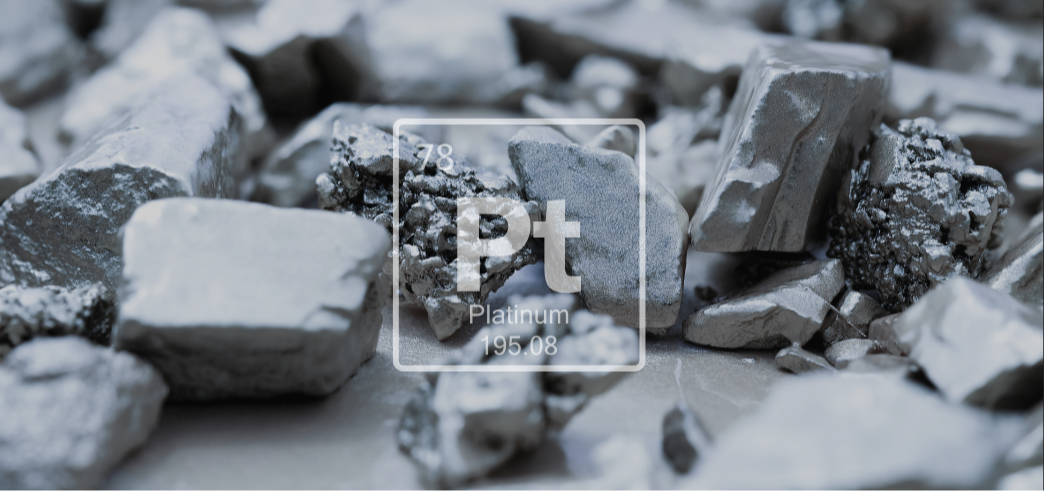
Platinum is a very rare and silver-colored precious metal, known worldwide for its strength and impressive durability. The material is primarily used in the automotive industry for the production of catalytic converters and plays a major role within the medical sector.
In addition, it is a popular material for luxury jewelry and is rapidly growing in popularity as a tangible financial investment. Platinum is no less than 30 times rarer than gold and is available in coins and bars for investors.
In this article, you will read exactly what platinum is, what it is used for, how it is mined, and why this precious metal has garnered significant interest in recent years.
| Property | Value |
|---|---|
| Chemical symbol | Pt |
| Atomic number | 78 |
| Color | Silver-white / grayish white |
| Melting point | 1,768 °C |
| Density | 21.45 g/cm³ (heavier than gold) |
| Purity of investment products | 999.5/1000 (99.95%) |
| Rarity | Approximately 30x rarer than gold |
Platinum belongs to the platinum group metals (PGMs), along with palladium, rhodium, iridium, osmium, and ruthenium. These metals are primarily known for their catalytic properties: they accelerate chemical reactions without being consumed themselves.
In addition, platinum is corrosion-resistant (it does not rust or oxidize) and hypoallergenic, making it suitable for people with sensitive skin. Due to its high density, platinum feels remarkably heavy; it is even “heavier” than gold.
This makes platinum more than just a luxury precious metal. It is a strategic raw material for industry, technology, and the energy transition. This also makes its pricing structure different from that of gold: whereas gold primarily serves as a monetary store of value, the price of platinum is driven more strongly by industrial supply and demand.
Platina and platinum are the exact same precious metal. Platinum is the English designation, while platina is the correct Dutch term. Because international product names such as the Platinum Eagle and Platinum Maple Leaf use the English term, both words are frequently used interchangeably in practice.
When it comes to jewelry, do take note: a product sold as “platinum” is not always pure platinum, but may be an alloy instead. Investment platinum, such as coins and bars, always carries a guaranteed purity of 99.95%.
The name platina originates from Spanish and literally means “little silver”. In the sixteenth century, Spanish explorers initially viewed the metal as an inferior byproduct of gold mining. Given its current value, that turned out to be a historic misunderstanding.
The history of platinum is remarkable: the metal that ranks among the most precious metals today was discarded as a worthless byproduct for centuries.
Platinum was in use long before its European discovery. The La Tolita culture in present-day Ecuador and Colombia processed the metal into jewelry and ceremonial objects around the beginning of our era. This was an impressive feat, considering platinum only melts at 1,768 °C, a temperature that was entirely unachievable at the time.
When Spanish explorers searched for gold in South American rivers during the sixteenth century, they regarded the heavy, silver-colored grains as immature silver. They mockingly called it platina, meaning “little silver”. The metal was frequently thrown back into the river or misused to counterfeit gold coins.
Scientific recognition followed in the eighteenth century. Antonio de Ulloa brought platinum to the attention of European science in 1748, and in 1751, the Swedish chemist Henrik Scheffer demonstrated that it was a distinct precious metal. Not long after, platinum captured the interest of European royal houses; goldsmith Marc-Étienne Janety created platinum objects for King Louis XVI in 1786.
The modern platinum era began in 1924, when geologist Hans Merensky discovered the Bushveld Complex in South Africa, which remains the largest platinum reserve in the world to this day. The mandatory catalytic converter in the United States (1974) subsequently turned the automotive industry into the largest consumer, and with investment coins like the Platinum Maple Leaf (1988) and Platinum Eagle (1997), platinum became widely accessible to investors.
| Period | Event |
|---|---|
| C. 100 BC | La Tolita culture processes platinum into jewelry |
| 16th century | Spaniards discover „platina“ (little silver) in Colombia |
| 1748–1751 | Scientific recognition as a distinct precious metal |
| 1786 | Platinum objects for King Louis XVI |
| 1824 | Discovery of platinum deposits in the Russian Ural Mountains |
| 1924 | Merensky discovers the Bushveld Complex in South Africa |
| 1974 | Mandatory catalytic converters in the US boost industrial demand |
| 1983–1997 | Introduction of platinum investment coins (Noble, Maple Leaf, Eagle) |
| 2025–2026 | Record prices due to supply shortages and hydrogen demand |
Platinum is used in catalytic converters, hydrogen technology, medical equipment, the chemical industry, electronics, jewelry, and as a physical investment product. The combination of catalytic activity, corrosion resistance, and heat resistance makes the metal virtually irreplaceable for many of these applications.
These are the primary applications of platinum:
The wide diversification of applications is of great significance to the platinum market. Unlike gold, which primarily serves as a store of value, platinum is deeply intertwined with industry and technology.
This means that the demand for platinum moves alongside economic developments, environmental legislation, and technological innovation. New applications, such as the emerging hydrogen economy, can structurally expand demand.
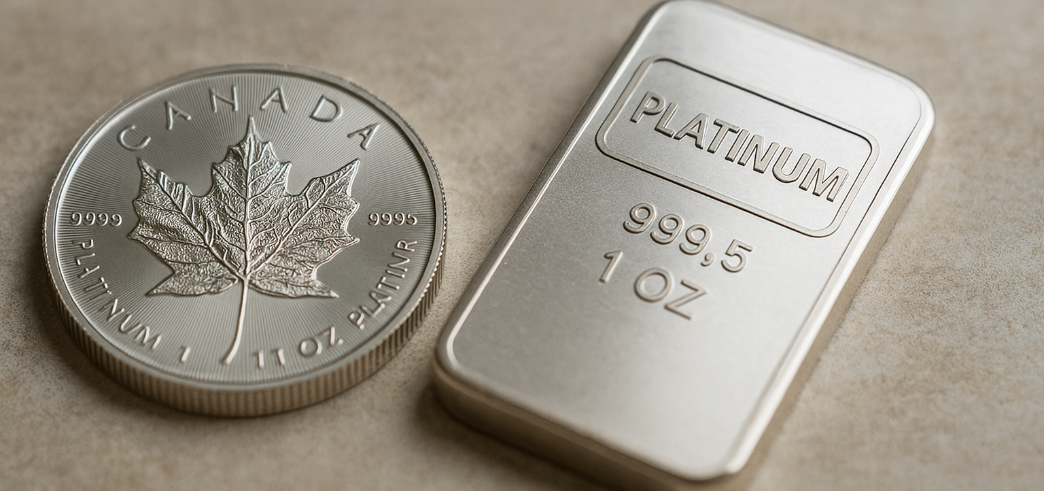
Platina (or platinum) is a rare precious metal with symbol Pt and atomnumber 78. It's about 30 times rarer than gold.
At first glance, platinum and white gold look very similar: both have a silver-white appearance and are widely used for wedding bands and exclusive jewelry. Yet, they are two fundamentally different materials.
The most important difference lies in the composition. Platinum is a pure precious metal that is processed almost entirely in its pure form: jewelry typically consists of 95% platinum, recognizable by the “Pt 950” hallmark.
White gold, on the other hand, is not a natural metal, but an alloy of gold combined with white metals such as palladium or silver. Because this alloy naturally retains a yellowish undertone, white gold is almost always plated with a thin layer of rhodium to achieve its bright white color.
| Feature | Platinum | White gold |
|---|---|---|
| Composition | Virtually pure (usually 95%) | Alloy of gold with other metals (approximately 75% gold) |
| Color | Naturally silver-white | Naturally more yellowish; receives a rhodium plating |
| Maintenance | Retains color without treatment; develops a characteristic patina over time | Rhodium layer wears off and must be periodically replated |
| Weight | Heavier and denser | Lighter |
This difference in composition affects its maintenance. The rhodium plating on white gold wears off over time, meaning the jewelry must be periodically replated. Platinum retains its color without any treatment and, at most, develops a soft patina, which is highly appreciated by many enthusiasts.
The metals also behave differently when subjected to wear: when platinum scratches, the material merely shifts and virtually nothing is lost. With white gold, the material actually wears away. Partly because of this, platinum jewelry typically lasts a lifetime.
Platinum is approximately 30 times rarer than gold: for every 30 grams of gold mined worldwide, only about 1 gram of platinum is found. Furthermore, its extraction is highly concentrated: the majority comes from South Africa, specifically from the Bushveld Complex, followed by Russia and Zimbabwe.
Platinum occurs in very low concentrations in the earth's crust and is often extracted as a byproduct of nickel and copper refining, or from minerals such as cooperite. After mining, the ore is concentrated and chemically refined, using acids and electrolysis among other methods, to a purity of 99.95%.
Due to this intensive process, the supply is less flexible than that of many other raw materials: production cannot be scaled up quickly when demand increases.
In the Netherlands, the Guarantee Act (Waarborgwet) also applies: platinum jewelry that meets the legal requirements carries a hallmark indicating the purity (850, 900, or 950 thousandths, often engraved as “Pt 950”, for example).
The platinum price is quoted internationally in US dollars per troy ounce (31.1 grams). Unlike gold, the price is primarily driven by industrial supply and demand.
Furthermore, the concentrated mining makes the market sensitive to disruptions: strikes, power issues, or geopolitical tensions in producing countries like South Africa have a direct impact on the price. Because platinum is traded in dollars, exchange rate fluctuations also influence the price in euros.
In 2008, platinum reached a peak of approximately $2,100 per troy ounce, driven by strong demand from the automotive industry. Following the financial crisis, the price dropped sharply and moved between $800 and $1,100 for years. This was a period in which platinum was remarkably cheaper than gold.
The tide turned from 2024 onward. A structural supply deficit, growing demand from the hydrogen industry, and renewed interest from investors pushed the price upward. Platinum was the best-performing precious metal in 2025: the price rose by over 90% that year and broke through the barrier of $2,000 per troy ounce in December 2025. In early 2026, the price set new records, peaking at nearly 2,200 dollars per oz.
The World Platinum Investment Council also expects another market deficit for 2026 and signals a growing demand for platinum bars and coins. Would you like to follow the current price? On our page with the current platinum price, you can view the live price in euros and dollars, per gram, troy ounce, and kilo.
For years, platinum has remained undervalued compared to gold, while the supply is structurally tight and industrial demand is growing. The developments of recent years show how quickly that perception can shift.
Rolf van Zanten, June 2026Platinum can be an interesting addition to a diversified precious metals portfolio, but it carries a different risk profile than gold. Whether platinum suits you depends on your investment goals, horizon, and risk appetite.
The main difference with gold lies in its pricing structure. Gold primarily serves as a monetary store of value and is seen as a safe haven during uncertain times. In contrast, the price of platinum is driven more strongly by industrial demand: developments in the automotive industry, the hydrogen economy, and mining have a direct impact on the price. This generally makes platinum more volatile than gold, with larger price fluctuations, but it also creates opportunities when industrial demand grows while supply remains tight.
On the other hand, it has a strong fundamental base: platinum is approximately 30 times rarer than gold, its supply is concentrated and difficult to scale up, and the rise of hydrogen technology is creating a structurally new source of demand.
Physical platinum is available in coins and bars with a purity of 99.95%, from accredited producers such as Valcambi. Please note that unlike investment gold, platinum is subject to 21% VAT in the Netherlands. This difference affects the total cost of your purchase and is therefore important to know beforehand.
Would you like to know which products are available, how to safely store platinum, and what to look out for when buying and selling? Then read our complete guide to investing in platinum.
The Silver Mountain has specialized in physical precious metals since 2008 and holds an AFM license. Within the knowledge center, founder and owner Rolf van Zanten shares his experience with gold, silver, and platinum. This practical experience is relevant, because platinum is not just a chemical element, but also a physical investment product with its own specific considerations regarding price, VAT, storage, liquidity, and marketability.
Platinum is a rare, silver-white precious metal that is indispensable in modern industry: from catalytic converters and hydrogen technology to medical equipment and jewelry. It is approximately 30 times rarer than gold, while its supply is concentrated and difficult to scale up.
This combination of scarcity and growing demand makes platinum increasingly interesting for investors as well. Would you like to add physical platinum to your portfolio? Then view our range of platinum coins and bars or follow the current platinum price.
The Silver Mountain does not provide investment advice. This article is for educational purposes only. Past performance is not indicative of future results.
Platinum is a rare, silvery white precious metal with the chemical symbol Pt and atomic number 78. It is corrosion-resistant, hypoallergenic and approximately 30 times rarer than gold. Platinum is used in industry, in jewellery and as a physical investment product in coins and bars.
Yes, platina and platinum are the same precious metal. Platinum is the English name, while platina is the Dutch term. International product names such as the Platinum Eagle and Platinum Maple Leaf use the English term, which is why both words are often used interchangeably in practice.
Platinum is most used in catalytic converters, which convert harmful exhaust gases into less harmful substances. Other important applications include hydrogen technology, medical equipment, the chemical industry, electronics and jewellery. In addition, platinum is available as coins and bars for investors.
Platinum occurs in very low concentrations in the Earth's crust and is mined in only a few countries, mainly South Africa, Russia and Zimbabwe. For every 30 grams of gold mined worldwide, only about 1 gram of platinum is found.
No, at the moment gold is more expensive per gram than platinum, despite platinum's greater rarity. Historically, platinum was often more expensive. The ratio changes because the platinum price responds more strongly to industrial demand, while gold mainly serves as a safe haven.
You can recognise real platinum by its hallmark (in the Netherlands 850, 900 or 950 thousandths, often stamped as "Pt 950"), its high weight and its lasting silvery white lustre. With investment products, the producer guarantees a purity of 99.95%. Read more about testing platinum for authenticity.
Rolf van Zanten is the founder and owner of The Silver Mountain, a specialist in physical precious metals since 2008. With nearly twenty years of experience in the precious metals trade, Rolf shares his expertise on investing in gold, silver, and platinum in an accessible and reliable way. His knowledge of the international gold and silver markets helps investors make well-informed decisions. In his role as an expert, he strives to ensure that transparency, security, and trust are at the heart of every purchase.

Be the first to discover the latest products and the latest news about precious metals.



 Nederlands