
 Buy gold bars
 Buy gold coins
 Series
 Buy silver coins
 Buy silver bars
 Series
 Buy silver collectible coins
 Silver collectible coin series
 Buy gold collectible series
 Gold collectible coin series
 Author:
  Date: 13 August 2026
Why buy physical gold rather than gold mining shares
 Rolf van Zanten
12 March 2025
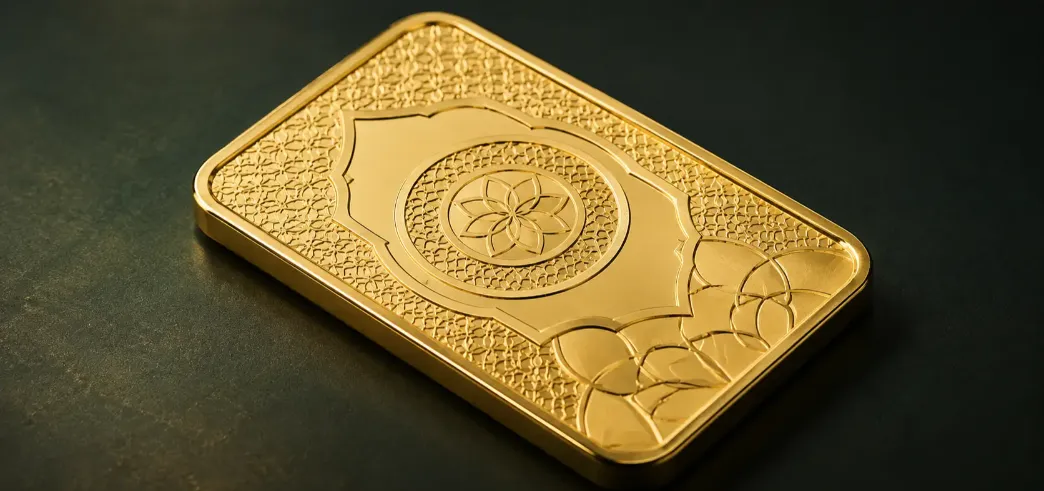
Buying gold can be halal according to commonly used Islamic principles, provided the payment and transfer of ownership take place immediately and you actually become the owner of identifiable gold. Not only the product matters: the method of payment, the delivery and the storage also determine whether a purchase meets the conditions. "Halal gold" is therefore not a separate type of gold or a certification, but gold that is bought and held within the correct structure.
In this knowledge centre article we explain which rules Islam sets for buying gold, what the international sharia standard says about it, and which forms of gold do and do not fit.
This article is intended for information only and does not constitute a fatwa or religious ruling. For a binding answer regarding your situation consult a qualified Islamic scholar.
Yes, investing in gold can be halal when the purchase and possession comply with Islamic rules for the trade in gold. The precise assessment differs by scholar and school of thought, but immediate payment, actual ownership and avoiding interest and delay form the core.
Within Islamic jurisprudence gold is considered a ribawi item. Special trading rules apply to it, which among other things must prevent the emergence of riba. Therefore, when purchasing with euros or another currency, payment and transfer should take place within the same transaction.
In 2016 the Accounting and Auditing Organization for Islamic Financial Institutions (AAOIFI), together with the World Gold Council, published the Shariah Standard on Gold. That standard deals with physical gold, gold storage and modern gold products, and confirms that investing in gold is permitted when the relevant rules are met.
For more background see the World Gold Council's commentary on the launch of the AAOIFI Shariah Standard on Gold and the page about shariah gold. Our article is intended as a general explanation; for a judgment about your own situation consult a qualified scholar or sharia adviser.
Special rules apply to gold because it has historically had a monetary function in Islam and is treated as a ribawi item. As a result, not every structure that exposes someone to the gold price is automatically permitted. Three concepts are central here.
| Concept | Meaning | Implication for buying gold |
|---|---|---|
| Riba | Interest or an unequal, deferred exchange | No interest-bearing arrangement; payment and transfer without delay |
| Gharar | Excessive uncertainty in a contract | Clarity about product, weight, purity, price and delivery |
| Maysir | Gambling or pure speculation | No speculative products without an underlying asset |
A central principle is qabd: the taking of possession. In the exchange of gold for money that transfer must take place immediately, without either party postponing payment or delivery. The buyer should therefore not receive a future promise or an unsecured claim, but an actual purchase in which the money is paid and the gold comes into possession physically or constructively.
Buying halal gold in practice revolves around five factors, based on the main principles of the AAOIFI standard: immediate settlement, actual ownership, full allocation, free disposal and transparent terms.
When buying gold against currency, payment and transfer should take place within the same transaction. In modern trade this does not have to be literally hand-to-hand; an immediately executed payment with a transfer of ownership on the same trading day (T+0) can also be acceptable.
You must actually become the owner of the purchased gold, not merely receive a general claim against a seller or custodian. With home delivery that is clear, but with off-site storage documentation is needed showing which gold is yours and from what moment.
Physical possession means that you receive the gold yourself; constructive possession means it is held on your behalf. Both can be acceptable, provided the constructive possession is concrete enough. A delay due to insured delivery is not the same as deferred transfer of ownership: if the gold has already been allocated to you after payment, physical delivery may follow later.
Fully allocated gold is specifically assigned to you and does not appear as a general gold liability on the provider's balance sheet. Unallocated gold, where you only have a claim to an amount of gold, generally does not meet the ownership requirement.
You should, in principle, be able to have the gold delivered, stored, or sold. The conditions for that should be clear in advance. Uncertainty about whether delivery is possible is a warning sign.
At our sister company Edelmetaal Beheer Nederland your gold is kept fully allocated. You are the immediate owner of the physical gold, which is documented in your name and remains deliverable.
Physical gold bars and gold coins with direct ownership offer the clearest starting point. Paper holdings and derivative products are harder to reconcile with the principles of buying halal gold.
The table below gives an overview of how the different forms are generally assessed. Assessments vary by scholar and school of thought, so this overview is informative and not a religious ruling.
| Form | Common assessment | Main consideration |
|---|---|---|
| Physical gold bar or coin with direct ownership | Generally permissible | Immediate payment and ownership; delivery possible |
| Physical gold via a bullion or coin webshop | Generally permissible | Ensure you are buying true physical ownership, with clear transfer of title |
| Fully allocated storage (in your name) | Generally permissible | T+0 allocation, proof of ownership, delivery possible |
| Physically backed, allocated gold ETF | Opinions vary | Some scholars permit it, others are cautious; have it reviewed |
| Gold or mining shares | Opinions vary | You buy a share, not gold; requires separate screening, including for debt |
| Unallocated gold account | Generally problematic | You own a claim, not assigned gold |
| Gold on installment or with deferred payment | Generally problematic | Deferral conflicts with the requirement for immediate settlement |
| Futures and options | Generally not permitted | Deferral, leverage and no direct ownership; a minority rules otherwise |
| CFDs, spread betting and other derivatives | Generally not permitted | Speculation without underlying ownership |
Physical gold bars and gold coins can both be bought halal, because it is not the form but the entire transaction that is decisive. Pre-owned gold is subject to the same rules: a bar or coin having had a previous owner does not change the metal or the core conditions.
Opinions differ about physically backed ETFs and gold stocks. Conservative scholars emphasize the lack of direct ownership, while others accept a fully allocated, physically backed structure under conditions. Always have such a product assessed separately.
Buying gold on installment is generally not appropriate when the price and the sale are already fixed while part of the payment is deferred. In a gold-for-currency transaction, both obligations must be settled within the same transaction, and that prohibition on deferral is separate from interest.
A rent-free staged payment does not automatically resolve this: the absence of interest is relevant, but the requirement that payment and transfer not be deferred also applies. A periodic savings plan can be different when each individual contribution is immediately used for a new, fully paid and directly allocated purchase.
The specific contract terms remain decisive, so have a staggered payment arrangement reviewed in advance.
The same quality requirements apply to halal gold as to ordinary investment gold. They must be recognizable products from recognized producers. Our gold bars come from refineries on the LBMA Good Delivery List, the international benchmark for quality and reliability, and our coins from recognized mints.
That LBMA recognition says something about the refinery and the origin, but is not a halal certification.
A reputable producer like PAMP Suisse makes physical gold bars that, depending on payment, transfer of ownership and storage, can fit within a halal purchase. PAMP also issues bars with cultural and religious designs, including an Eid Mubarak edition.
Such a design makes a bar attractive as a gift around Eid, but does not in itself constitute religious approval of the purchase, and collectibles usually carry a higher premium than standard bars.
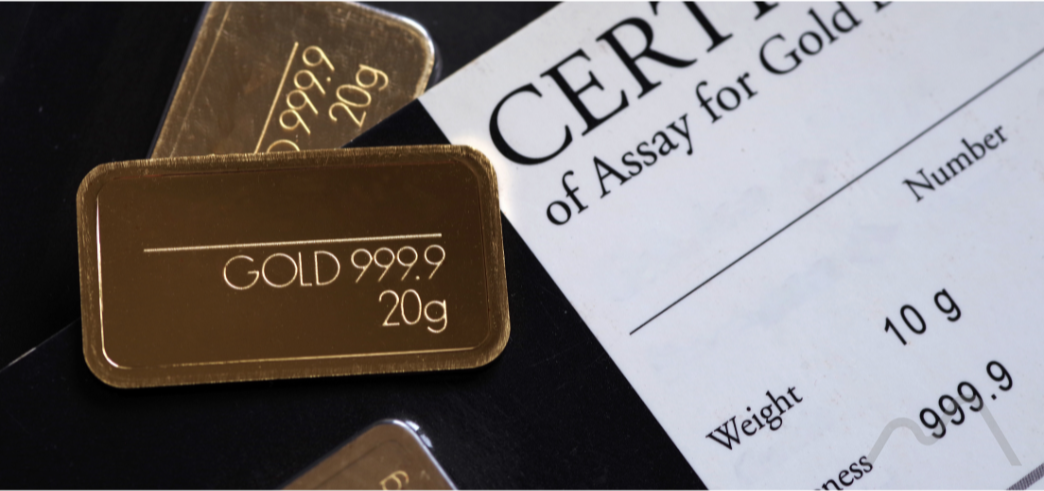
Buying physical gold can be halal if payment is made immediately and you instantly become the full owner.
Professionally stored gold can comply with Islamic requirements when it is fully allocated and remains the legal property of the buyer. The mere presence of gold in a vault is not sufficient; ownership must be established and the gold must be deliverable.
When stored via Edelmetaal Beheer Nederland, your gold is held fully allocated. You are the direct owner of the physical gold, which is documented in your name and kept off the storage provider's balance sheet. On request you can have it delivered. This arrangement is substantively consistent with the principle of constructive possession.
Whether that is considered halal in your specific case is a religious determination to be referred to a scholar. You can have the storage and ownership documentation reviewed for this purpose.
A practical check starts with the question of whether, after payment, you can precisely identify what you own. A nice bar or convincing marketing copy is not enough when payment, ownership or custody remain unclear. Use this checklist before purchase.
| Checklist item | Question to the provider |
|---|---|
| Product | Which specific gold bar or coin am I buying? |
| Price | Is the full purchase price fixed? |
| Payment | Is the full amount paid immediately? |
| Ownership | At what point do I become the legal owner? |
| Allocation | Is my gold specifically allocated to me on T+0? |
| Proof | Which document confirms my ownership? |
| Storage | Is the gold held off the storage provider's balance sheet? |
| Delivery | Can I have my gold physically delivered? |
| Sale | Can I sell it without an additional financial arrangement? |
| Certification | Who assessed any halal claim, and what exactly was assessed? |
Zakat may be due on gold when the applicable religious conditions are met. The calculation depends, among other things, on the amount of gold, the period of ownership, the intention with which you hold it, and the interpretation followed.
Because the nisab threshold, the valuation moment, the ownership period (hawl) and the treatment of jewelry can be interpreted differently, The Silver Mountain does not provide individual calculations on this. Discuss it with a scholar or a specialized advisor, and for valuation use the current gold price.
Anyone who wants to buy gold according to Islamic principles must look beyond the logo on the packaging. The most important questions are when you pay, when you become the owner, and whether the gold is truly allocated to you. We make those steps as transparent as possible, because physical gold lends itself to that: weight, purity, ownership and storage can be recorded concretely. At the same time humility is appropriate, because the religious ruling lies with a scholar, not with the gold dealer.
Rolf van Zanten - founder The Silver MountainAt The Silver Mountain you buy physical gold with transparent product information, immediate payment and a T+0 transfer of ownership. We have specialized in physical precious metals since 2008 and, as an AFM license holder, are accustomed to working carefully and transparently. You pay for your purchase in full and immediately, and receive the gold via our own delivery service or by appointment in Baarn or The Hague.
If you want the gold stored, this can be done fully allocated and in your name via Edelmetaal Beheer Nederland, whereby you are the direct owner of the physical gold. And if you wish to sell later, sister company Inkoop Edelmetaal will buy your gold back.
This way you arrange purchase, storage and sale in one place. View our full range on the page buy gold. The AFM license denotes supervision of our financial services and is not a religious approval.
Why choose for The Silver Mountain:
Buying halal gold is not about a separate type of gold, but about a purchase in which payment, ownership and possession are clear. Physical gold bars, gold coins and fully allocated storage can fit within those conditions, with immediate payment and immediate transfer as the starting point.
Unallocated storage, deferred payments and derivative products without direct gold ownership require extra caution and are often not appropriate.
Therefore check not only which gold you are buying, but also when you become the owner, what proof you receive and whether delivery is possible. If there is religious doubt, have the arrangement assessed by a qualified sharia advisor.
The Silver Mountain does not provide religious advice, tax advice or individual investment advice, and does not issue fatwas. This article is solely general information about commonly used principles within Islamic finance; interpretations may differ. Past results offer no guarantees for the future. The gold price can both rise and fall.
Yes, buying gold can be halal when payment and transfer of ownership occur immediately and you obtain physical or constructive possession. With constructive possession, the gold must be fully allocated to you and you must be able to dispose of it. The precise assessment depends on the Islamic interpretation followed.
Yes, since the AAOIFI Shariah Standard on Gold of 2016 there has been a widely used framework within which gold is permitted as an investment. The condition is real ownership without interest or speculation. Physical gold generally fits well here, while speculative paper products remain controversial.
Yes, buying gold online can be acceptable when you pay in full during the transaction and immediately become the owner of concrete or fully allocated gold. A later insured delivery is not a problem if ownership has already been transferred. Keep the order confirmation, the invoice and the proof of ownership, and avoid financing with interest.
PAMP Suisse produces physical gold bars that can fit within a properly arranged purchase. However, the brand name, an authenticity certificate or an Eid design does not automatically make a product halal; the transaction is decisive. For a formal halal or sharia approval, additional substantiation is needed and must be determined per product.
Yes, professional storage can be acceptable when the gold is fully allocated and remains the legal property of the customer. With storage via Edelmetaal Beheer Nederland you are the direct owner of the gold documented in your name, which you can have delivered. A general claim on a non-segregated stock is generally insufficient.
Generally not when the price is fixed but payment is deferred. For gold against currency, payment and transfer should take place within the same transaction, and even without interest, deferral remains problematic. A savings plan in which each contribution immediately results in a full, assigned purchase may be different; have this assessed.
Not automatically, and scholars differ on this. Check whether the product is fully backed by assigned physical gold, what ownership rights you receive, when settlement takes place and whether derivatives or interest are used. Some allocated structures may be acceptable; "physically backed" alone is insufficient without reviewing the legal documentation.
Zakat may be applicable if your gold holdings meet the religious conditions. The calculation depends on the amount, the period of ownership, the valuation method and the school of Islamic law followed. Ask a qualified advisor for a personal calculation and use a current gold price for the valuation.
Rolf van Zanten is the founder and owner of The Silver Mountain, a specialist in physical precious metals since 2008. With nearly twenty years of experience in the precious metals trade, Rolf shares his expertise on investing in gold, silver, and platinum in an accessible and reliable way. His knowledge of the international gold and silver markets helps investors make well-informed decisions. In his role as an expert, he strives to ensure that transparency, security, and trust are at the heart of every purchase.

Be the first to discover the latest products and the latest news about precious metals.


 Daan Wesdorp
 Nederlands