
 Buy gold bars
 Buy gold coins
 Series
 Buy silver coins
 Buy silver bars
 Series
 Buy silver collectible coins
 Silver collectible coin series
 Buy gold collectible series
 Gold collectible coin series
 Author:
  Date: 9 December 2024
Gold Price Development: The Influence of Interest Rates, Inflation, and Geopolitics
 Rolf van Zanten
5 February 2026

Anyone who wants to protect wealth often looks first at the savings interest. That makes sense: saving is clear, directly available, and feels safe. Yet savings interest is only part of the story. The question that weighs more heavily for many savers and investors is how much purchasing power actually remains over time.
That is exactly why the comparison between savings interest and gold has become more relevant. A savings account makes your balance grow in euros, but that does not automatically mean that your money also becomes more valuable. When prices rise faster than the interest you receive, your purchasing power decreases.
Gold works differently: it pays no interest, but is used by many investors as a tangible asset for diversification and long-term value retention.
In this article, we compare savings interest and gold. What does a savings account actually yield for you? And what happens to your purchasing power if you choose physical precious metals as an alternative to saving?
When we analyze the current savings interest, it is important to look beyond just the percentage the bank promises you. The real picture only becomes clear when you compare the nominal interest against inflation.
The nominal interest is simply the compensation shown on your bank statement. Over the past ten years, this interest has had an erratic course. Between 2016 and 2021, savers faced the notorious zero interest and even negative rates. In the years that followed, the compensation on the savings account recovered slightly.
Yet this is only half the story. To determine whether you are truly advancing financially, you must calculate with the real interest rate. This is the nominal interest reduced by the percentage of currency devaluation.
As soon as inflation turns out to be higher than the interest compensation on your bank account, you unnoticeably lose wealth. Your balance in euros nominally remains the same or rises a little bit, but your actual purchasing power drops. You can simply buy fewer goods or services for the exact same hundred euros.
To make the impact of this clear, below you will find an overview of the relationship between saving and inflation over the past decade:
| Period | Average nominal savings interest | Average inflation | Impact on purchasing power |
|---|---|---|---|
| 2016 to 2021 | Around zero or lower | 1.5% to 2.5% | Creeping loss |
| 2022 to 2024 | 0.5% to 1.5% | 6.0% to over 10.0% | Sharp drop in value |
| 2025 to 2026 | 1.5% to 2.0% | 2.5% to 3.5% | Persistent erosion |
Official historical inflation figures from Statistics Netherlands (CBS) show that the average currency devaluation, particularly in the period between 2022 and 2024, was historically high. This consumer price index clearly demonstrates that a slightly rising savings interest rate is absolutely insufficient to compensate for the loss of purchasing power.
With saving, it is important to distinguish between nominal and real return. The nominal return is the interest you receive on your savings account. The real return shows what remains of that after inflation is taken into account.
If your savings balance increases by 2%, while prices rise by an average of 3%, your wealth only grows on paper. In practice, you can buy less with that money. Your balance therefore rises nominally, but your purchasing power falls.
To make the theory surrounding savings interest and inflation concrete, we look at a true and tangible scenario. Suppose you had an amount of € 10,000 available in the spring of 2016.
You faced a choice: leave this amount in a regular savings account or invest in physical precious metals. What are the actual differences in return over a period of exactly ten years?
If we look at the average savings interest in the Netherlands over the past decade, we see a historic low. For years, the compensation on savings was practically zero percent or savers even faced negative interest rates. Only in the last few years did the savings interest begin to rise slightly again.
Due to the sum of these low percentages, your initial investment of € 10,000 nominally grew to approximately € 11,763 in 2026. That seems like a modest profit on paper. In reality, however, your purchasing power has been hit hard by skyrocketing inflation, especially in the peak period between 2022 and 2024.
In practice, you can buy significantly less today with that € 11,763 than with your € 10,000 ten years ago.
If we look at the precious metals market in the spring of 2016, the gold price was around € 35,300 per kilo. For your investment of € 10,000 you bought approximately 283 grams of pure gold at the time.
Today, in 2026, the current gold price fluctuates around € 143,000 per kilo. That means that your 283 grams of gold has now reached a market value of over € 40,000.
In this scenario, you have not only effortlessly compensated for the creeping inflation, but your absolute purchasing power has increased significantly. Gold proves to be a superior alternative to traditional saving in this period.
Below you can clearly see the tangible differences between both choices side by side:
| Scenario | Starting amount | Nominal end value | Nominal growth | End value in purchasing power of starting year |
|---|---|---|---|---|
| Saving | €10,000 | €11,763.49 | +17.63% | €9,027.31 |
| Physical gold | €10,000 | €21,098.84 | +110.99% | €16,191.27 |
At first glance, saving seems to yield a solid result in this example. After all, the amount grows from €10,000 to €11,763.49. Yet that picture changes as soon as inflation is included. Corrected for purchasing power, the real value of this amount turns out to be approximately €9,027.
In other words: the savings balance has risen in euros, but purchasing power has decreased on balance.
With gold, the picture is different. Gold pays no interest and is not a replacement for a liquid buffer, but in this example the value rises from €10,000 to over €21,098. After correcting for inflation, a purchasing power of approximately €16,191 remains.
That underlines the role investment gold can play for many investors as part of a strategy aimed at wealth preservation and diversification.
This example does not mean that gold always performs better than saving. The gold price can fluctuate in the short term, while savings are specifically intended for certainty and direct availability.
The comparison does make it clear that anyone who wants to protect wealth for a longer period of time must look beyond just the interest rate on a savings account.
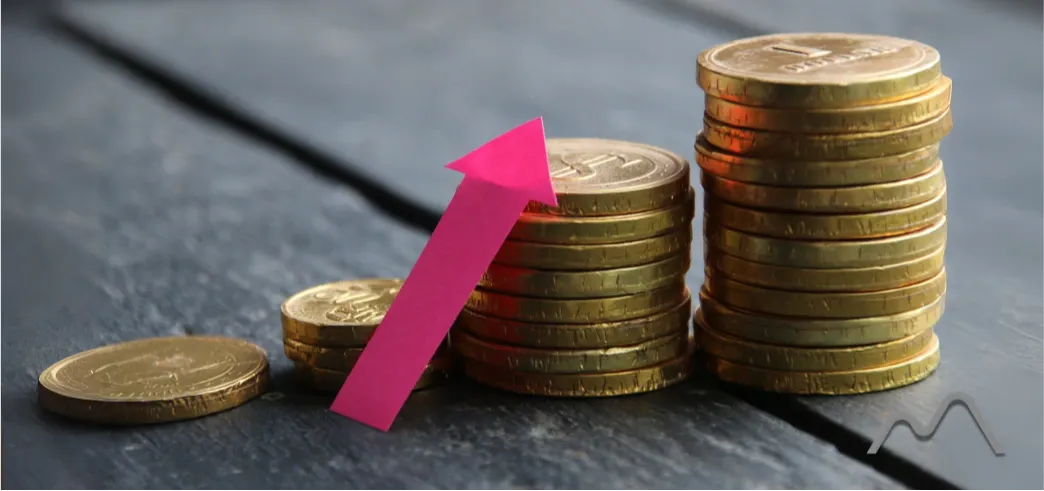
Because of it's natural scarcity, physical gold historically maintains his real value.
The earlier calculation examples expose a fundamental economic reality. Where regular currencies such as the euro or the dollar inevitably lose value in the long term due to money creation and inflation, gold historically retains its actual purchasing power.
This makes the precious metal an important instrument for structural wealth preservation.
When central banks pump new money into the economy, the relative value of every euro already in circulation drops. This monetary process translates directly into higher prices for everyday goods and services.
When we look at the development of consumer prices, we see that everyday goods and services are becoming structurally more expensive. Statistics Netherlands (CBS) measures these rising costs accurately using a fixed basket of groceries.
While your saved euro can buy fewer and fewer of these goods over the years, a physical gram of gold does retain its relative purchasing power against these daily expenses.
The global amount of physical gold is limited and only grows slowly through intensive mining. This physical and natural scarcity forms the scientific and economic basis beneath the robust value retention of the precious metal.
A look at the past confirms the unique role of gold as an inflation shield. A fixed weight of pure gold today still buys a similar amount of goods as fifty or even a hundred years ago.
The absolute price expressed in euros has risen enormously in those decades, but the underlying purchasing power has remained extremely stable.
Below you will find a clear overview of the fundamental differences between fiat money and physical gold:
| Characteristic | Fiat money (euro / dollar) | Physical gold |
|---|---|---|
| Supply | Unlimited (can easily be printed) | Limited by natural scarcity and difficult extraction |
| Intrinsic value | Based on trust in the government | Physical asset with ancient, universal acceptance |
| Long-term purchasing power | Drops structurally due to persistent inflation | Remains preserved for decades historically |
By converting a part of your savings into physical precious metals, you build a solid buffer against the whims of the banking and monetary system. You are less dependent on current interest rate policies and effectively defend yourself against the creeping erosion of your capital. Gold thus acts as a financial insurance.
The choice between saving and investing in gold is rarely black and white in practice. Both financial instruments fulfill a completely different role within a healthy and well-diversified portfolio.
It is therefore mainly about finding the right balance that suits your personal financial goals and your time horizon.
Saving remains an indispensable foundation for your daily financial peace of mind. Money in an instantly accessible savings account is specifically intended for the short term. You primarily choose the bank in the following situations:
As soon as your basic financial buffer is in order, long-term wealth preservation comes into the picture. Here, physical precious metal excels compared to the savings account. Gold is strategic capital and you choose it for the following reasons:
By smartly combining saving and investing, you benefit from the daily flexibility of your bank account and the robust, long-term security of physical precious metals.
Before making the final decision to convert a portion of your savings into precious metals, it is important to have a sharp picture of all the characteristics. After all, every financial choice brings specific opportunities and risks.
Saving excels in nominal certainty and direct accessibility. You know exactly how many euros are in your account at any time of the day.
Physical precious metals, on the other hand, offer unique and tangible protection against the invisible decline in value called inflation. It is a foundation for your wealth in the long term.
To help you make a well-considered and balanced choice, we have clearly listed the main advantages and disadvantages of both options for you.
| Financial choice | Main advantages | Main disadvantages and risks |
|---|---|---|
| Savings account |
|
|
| Physical gold |
|
|
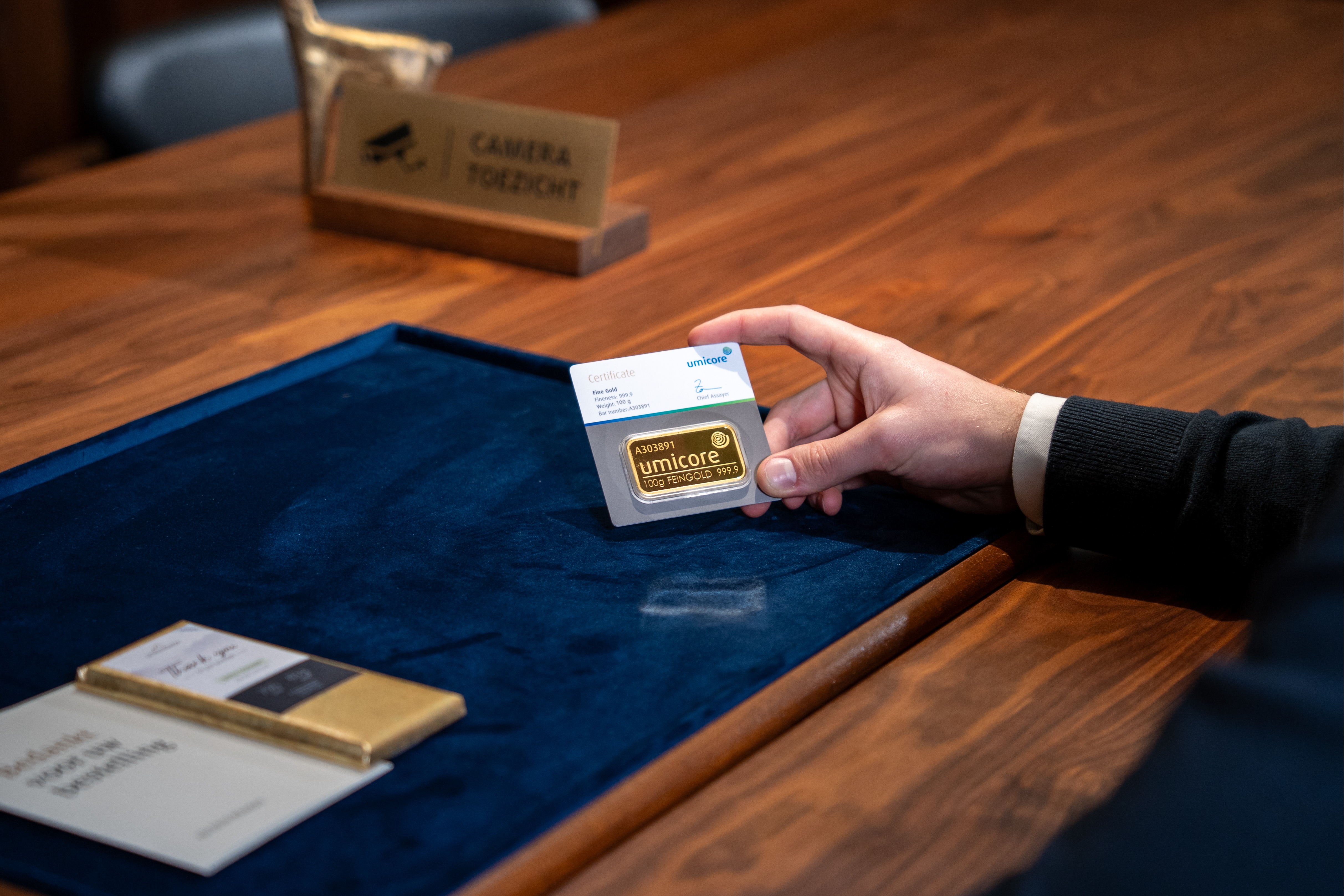
Your savings account gives more certainty, but investing in gold usually has a higher return of investment.
It is a common misconception that you have to choose between the bank or the vault. In reality, a black and white approach is rarely the best financial strategy. For most investors, it actually makes much more sense to smartly combine traditional saving and physical precious metals.
By including both elements in your portfolio, you create an ironclad financial foundation. You benefit from the unique advantages of both worlds, while effectively covering the vulnerabilities of your capital.
What does such a balanced strategy look like? Although this depends on your personal situation, the basis almost always consists of the following three steps:
With this combined approach, you don't have to lose sleep over a fluctuating economy or rising inflation. Your daily life and short-term expenses are secured by your bank account.
At the same time, the purchasing power of your accumulated capital is firmly anchored for the future by the historically proven stability of gold. This way you are prepared for any economic scenario.
When you are considering moving part of your wealth from the bank to the vault, it is important to understand the fundamental differences. Saving and investing in precious metals both operate according to a completely different economic dynamic. Below we explain the four main differences in detail.
The most obvious difference is the way in which return is built up. Savings provide you with periodic interest. With physical gold, you do not receive a monthly dividend or annual interest compensation.
On the other hand, gold possesses a unique intrinsic value. Investors buy precious metal precisely because of its natural scarcity and global tradability. The return on gold comes from price development and its historical role as the ultimate store of value.
Savings are extremely stable in nominal terms. An amount of one thousand euros will always remain one thousand euros on your screen. This makes saving financially very calm and clear for the short term.
Gold, on the other hand, moves in price daily. The price continuously reacts to geopolitical developments and inflation figures. Because of this volatility, precious metals are less suitable for money you need tomorrow, but exceptionally a tool for the longer time horizon.
Another important aspect is the direct availability of your wealth. Savings are extremely liquid. You can log into your bank at any time and transfer or withdraw the money that same minute for an unexpected expense.
Physical gold is highly tradable worldwide, but not as directly usable as digital money in a checking account. You must first sell the physical precious metal before you have the euros at your disposal again.
Savings in a European bank account are legally protected. Should your bank unexpectedly run into trouble, the deposit guarantee scheme guarantees your balance up to an amount of € 100,000 per person per bank.
Physical gold does not have this specific government guarantee. This is offset by an enormous fundamental advantage. Gold under your own management or in a professional vault is not on the balance sheet of a financial institution. As a result, you run zero counterparty risk with physical precious metals.
Traditional saving offers peace of mind in the short term, but insufficiently protects your wealth against creeping inflation. Physical gold, however, has amply proven that it flawlessly maintains your purchasing power.
For a financially healthy future, a smart combination of both strategies is therefore the absolute best choice. Use your bank account for daily liquidity and anchor the rest of your capital safely in precious metals.
Ready to structurally protect your wealth against rising inflation? At The Silver Mountain, we are happy to help you with that. As one of the market leaders in the Netherlands, we guarantee fair prices, discrete handling, and the highest security standards.
Whether you are buying precious metals for the first time or want to expand your existing portfolio, we always offer a suitable solution. Spread your risks and discover our range of internationally tradable gold coins or invest in gold bars from LBMA-recognized producers.
The Silver Mountain does not provide individual investment advice. This article is intended for information purposes only. Expectations, scenarios, market developments, and past results offer no guarantee for future results.
Gold is an excellent alternative because it historically retains your purchasing power. While savings often go down in value unnoticeably due to inflation, physical precious metal acts as a reliable shield. You are also not dependent on interest rate policies or a bank, which ensures maximum financial independence.
The nominal interest is the fixed percentage that your bank actually pays out. The real interest is this percentage minus current inflation. Because inflation is often higher than the compensation on your savings account, your real return structurally turns out negative in practice.
The biggest risk of gold is price volatility in the short term. Where your savings balance always remains nominally stable, the gold price can fluctuate daily. In addition, you do not receive periodic interest on your precious metal and you must arrange for safe and well-insured storage yourself.
Unlike regular money, which governments and central banks can print unlimitedly, the global amount of physical gold is very limited. This natural scarcity ensures that the precious metal retains its economic value when prices rise. You can successfully secure your purchasing power over decades.
It is financially unwise to convert all your savings into precious metals. Always ensure an instantly accessible financial buffer in your bank account for unexpected expenses first. Only invest your excess capital in gold for the long term to protect your ultimate purchasing power.
No, physical gold is not covered by the deposit guarantee scheme. This scheme exclusively protects bank savings up to a maximum of one hundred thousand euros. However, gold under your own management has no counterparty risk. In the unexpected event of a bank bankruptcy, your physical precious metal always remains completely unaffected.
Rolf van Zanten is the founder and owner of The Silver Mountain, a specialist in physical precious metals since 2008. With nearly twenty years of experience in the precious metals trade, Rolf shares his expertise on investing in gold, silver, and platinum in an accessible and reliable way. His knowledge of the international gold and silver markets helps investors make well-informed decisions. In his role as an expert, he strives to ensure that transparency, security, and trust are at the heart of every purchase.

Be the first to discover the latest products and the latest news about precious metals.



 Nederlands