
 Buy gold bars
 Buy gold coins
 Series
 Buy silver coins
 Buy silver bars
 Series
 Buy silver collectible coins
 Silver collectible coin series
 Buy gold collectible series
 Gold collectible coin series
 Author:
  Date: 23 July 2026
 About
About Palladium Price Prediction: market outlook and price forecast
 Rolf van Zanten
25 February 2025
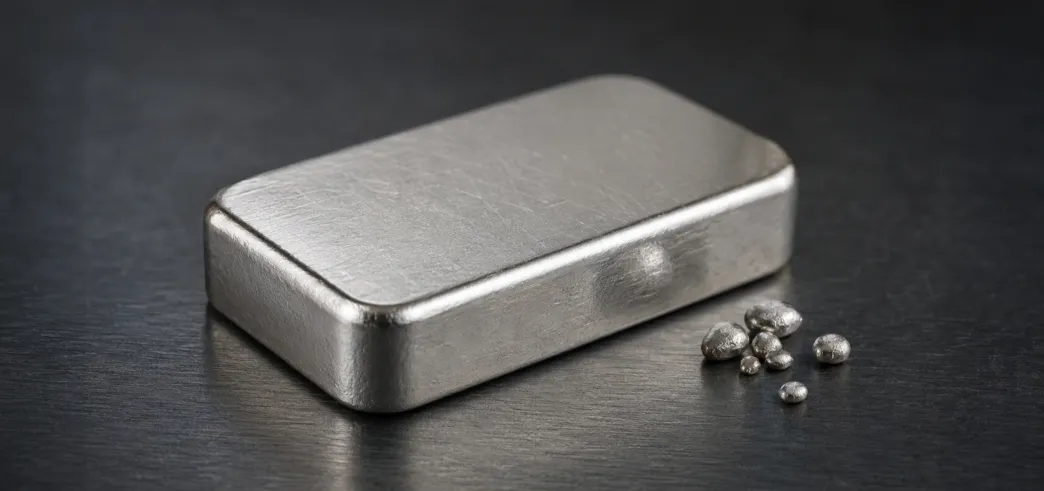
Palladium is so volatile because concentrated demand and an inflexible supply reinforce each other: about 80% of demand comes from one sector, the auto industry, while about 80% of mine production comes from just two countries, Russia and South Africa. Because neither can adjust quickly when demand or supply shifts, the price must absorb the shock, causing palladium to move more sharply than more broadly held precious metals like gold or silver.
In this article we explain the mechanisms behind those price fluctuations: the concentration on the demand side, the particular way palladium is mined, the geographic concentration of supply, the delayed role of recycling, the transition to electric vehicles and the interplay with platinum.
This is an explanatory article about the causes; for current price levels and expectations we refer to our palladium price outlook.
Volatility means that the price can rise or fall sharply in a short time, and for palladium that volatility is exceptionally large. Whereas gold and silver have a broad group of buyers and uses, the value of palladium depends on a narrow base of supply and demand. As a result, relatively small changes, such as disappointing car sales figures or a production disruption at a single mine, have a disproportionately large effect on the price.
It is important to realize that volatility only says something about the degree of movement, not about the direction. A volatile metal can both rise sharply and fall sharply, so the volatility itself is neither a prediction nor a buy signal.
To understand why palladium is so volatile, you need to look at the structure of the market: where the demand comes from, how the metal is mined, and where it is produced. Those factors reinforce each other, and that is what makes palladium more volatile than most other precious metals.
The main cause of the volatility is that demand for palladium depends heavily on a single buyer: the automotive industry. About 80% of all palladium is used in catalytic converters for gasoline and hybrid vehicles, where the metal converts harmful exhaust gases into less harmful substances.
The remaining demand comes from electronics, the chemical industry, dentistry, jewelry and hydrogen technology, but those applications are too small to compensate for the dominant role of the automotive industry.
This dependence makes the palladium price particularly sensitive to anything that affects car production. An economic downturn that slows car sales, a shortage of chips that halts production, or a shift in the type of cars being built all feed through almost directly into demand. Whereas demand for gold is spread across numerous countries, sectors and investors, the demand for palladium rises or falls with the health of a single industry.
In addition to the number of cars produced, the amount of palladium per catalytic converter also plays a role, the so-called loading factor. Stricter emissions standards can lead manufacturers to use more precious metal per exhaust system to meet the requirements. As a result, palladium demand can in theory increase even in a year when car sales stagnate.
The effect is, however, not unambiguous: manufacturers may at the same time seek technical savings or adjust the metal mix, which actually dampens demand. Those opposing forces make demand harder to predict, which increases volatility.
A second, less well-known cause is that palladium is rarely mined on its own. It almost always occurs as a by-product of nickel or platinum mining, and that has major consequences for how supply responds to price. For a normal product, a higher price leads to more production; for palladium that mechanism hardly works.
The reason is that a mining company bases its production decision on the primary metal, not the by-product. A nickel mine keeps producing the same amount of nickel regardless of whether the palladium price doubles or halves; the amount of palladium released in the process therefore hardly changes. This is called an inelastic supply: production does not or barely adjust when the price changes.
That explains why a spike in demand can hit the price so hard. If demand rises, supply cannot simply grow with it, because there are hardly any mines that mine palladium as a primary product. The result is that the price absorbs the shock instead of production. The same rigidity works the other way too: with falling demand supply stays at its level, which puts additional downward pressure on the price.
The third factor is the strong geographical concentration of production. Russia and South Africa together account for about 80% of the world’s mined palladium production, each with a roughly 40% share. The rest mainly comes from Canada, the United States and Zimbabwe.
For comparison: gold is mined in dozens of countries across multiple continents, so a disruption in one country matters much less.
With palladium it is different. A strike, a power outage, an export restriction or a geopolitical conflict in one of the two dominant countries can directly affect a significant part of the world supply. Moreover, most Russian production comes from a single region, around Norilsk, which further increases the concentration.
Because the supply is so concentrated, geopolitical tensions have an amplified effect on the palladium price. Around the war in Ukraine investors and car manufacturers speculated about a shortage of Russian palladium, which temporarily drove the price up. When that expected shortage failed to materialize, the price corrected again. This pattern is typical: the market often reacts to the fear of a disruption before it occurs. Buyers who, out of caution, purchase extra can temporarily make a tight market even tighter.
If the disruption turns out to be less severe, that same material is released again and the price falls. That gap between expected and actual supply is a recurring source of volatility that plays much less of a role with more widely distributed metals.
A fourth factor is that the secondary supply, palladium from recycled catalysts, cannot respond quickly to price. A large part of the palladium on the market comes from reuse, especially from the catalysts of scrapped cars. In theory that should be a stabilizing buffer, but in practice recycling actually works with a delay.
The reason is that a car is only scrapped many years after production. The palladium that is processed into new cars today therefore only becomes available for reuse after a long period.
Moreover, recycling is sensitive to the price itself: at a low palladium price collectors sometimes hold onto catalysts awaiting better prices, while a high price draws material to the market. As a result recycling sometimes amplifies price movements instead of dampening them: precisely when there is scarcity, the extra supply does not come on stream quickly enough.
On top of the existing volatility, the rise of the electric car adds structural uncertainty. Because palladium is mainly used in the catalysts of petrol and hybrid vehicles, and fully electric cars do not have that catalyst, any acceleration or delay of electrification means a shift in long-term demand.
The pace of that shift is itself uncertain and it is that uncertainty that feeds volatility. If electric car sales grow faster than expected, demand for palladium will decline faster; if the transition is slower, for example because hybrids remain popular longer, demand will remain stronger for longer.
It is important to make a distinction here: a fully electric car has no exhaust catalyst, but a hybrid still has an internal combustion engine and therefore needs palladium. The growth of hybrids therefore does not mean that demand will fall at the same rate as the sale of ordinary petrol cars. Investors and manufacturers continuously adjust their expectations about this pace and every adjustment can move the price.
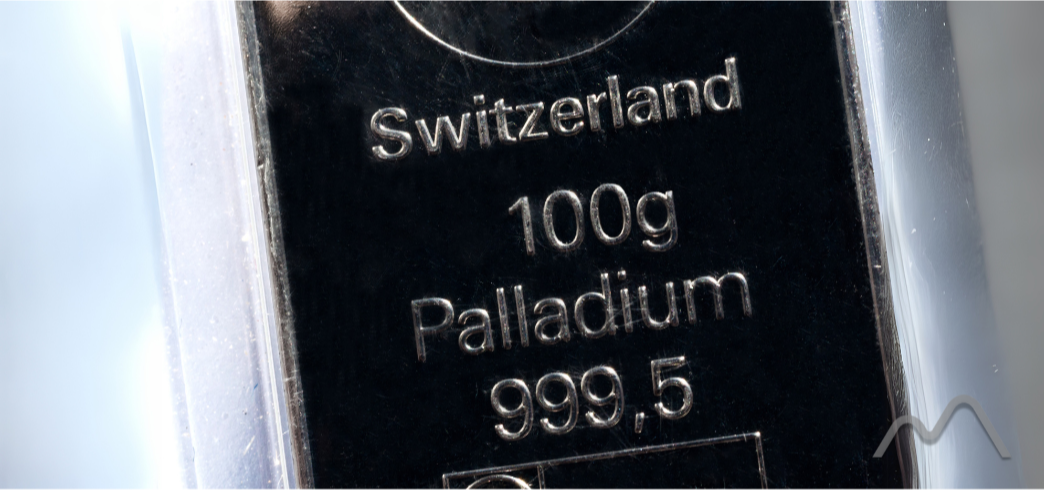
The shift to electric cars is a structural uncertainty for long-term demand.
A sixth factor that influences price movements is the possibility of replacing palladium with platinum. In catalysts, manufacturers can substitute the two metals to a certain extent, and that choice is mainly determined by price. If palladium becomes much more expensive than platinum, the incentive to switch to the cheaper platinum increases, which dampens demand for palladium.
However, that substitution does not happen overnight. Adjusting a catalyst system requires redesign, testing and recertification, which takes time. The brake therefore operates with a delay. Conversely, a low palladium price can later lead to switching back.
This interplay between the two metals adds an extra layer of volatility and partly explains why the price ratio between palladium and platinum itself can fluctuate significantly.
We elaborate on the differences between the two metals in our article on the differences between palladium and platinum.
Palladium is more volatile than gold because it is predominantly an industrial metal, while gold mainly serves a monetary and defensive function. The value of gold is supported by central banks, investors, the jewelry industry and a global spread of buyers. That broad base dampens fluctuations, and in the case of gold uncertainty often pushes the price up because it is sought as a safe haven.
That dampening effect is largely absent for palladium. The metal has no significant role as a monetary reserve and demand is narrow and cyclical rather than broad and defensive. In an economic downturn palladium can come under pressure because fewer cars are being built.
The table below summarizes why palladium is structurally more volatile.
| Characteristic | Palladium | Gold |
|---|---|---|
| Main demand | Automotive industry (around 80%) | Investors, central banks, jewelry |
| Demand distribution | Narrow, one dominant sector | Broad, many sectors and countries |
| Supply | By-product, hardly responsive to price | Primarily mined in dozens of countries |
| Production concentration | About 80% from two countries | Globally distributed |
| Reaction to uncertainty | Often falling (industrial) | Often rising (safe haven) |
| Portfolio behavior | Cyclical, industrial | Defensive, stores value |
This structure makes palladium more of an industry-driven niche metal than a classic defensive precious metal. Anyone who wants to read about the metal's properties and applications can find them in our article on what palladium is.
For anyone considering to buy palladium, this volatility means the metal carries higher risk and a different character than gold or silver. The price can rise sharply in a relatively short time, but it can just as easily fall significantly. Those movements are difficult to predict because they depend on industrial and geopolitical factors that play out outside the precious metals market.
A strong price move is therefore not in itself a reason to buy or sell. Palladium is less suitable as a calm, defensive core holding and more as a deliberate, well-understood choice within a diversified portfolio.
It is also good to know that palladium is treated differently in the Netherlands for tax purposes than investment gold: where gold can be VAT-free under certain conditions, palladium is generally subject to the regular VAT rate. That difference affects the actual cost of a purchase.
Palladium is a fascinating metal, but investors often underestimate how differently it behaves compared with gold. The price is tied to the auto industry and to two producing countries, and therefore moves with shocks you rarely see with gold. Anyone considering palladium should understand and accept that volatility. See it as a deliberate choice, not as a safe foundation for your assets.
Daan Wesdorp - manager Inkoop EdelmetaalPalladium's volatility stems from a combination of factors that reinforce each other. On the demand side the metal is tied to one sector, the auto industry; on the supply side it is produced as a by-product in only two dominant countries, while recycling only picks up after a delay of years.
On top of that, the shift to electric driving and the possibility of substitution by platinum introduce continuous uncertainty. Together these mechanisms make palladium one of the most volatile precious metals, with a pronounced industrial character.
Those considering investing in the metal would do well to understand this dynamic and view palladium as a deliberate choice within a broader diversified portfolio. Do not see it as a calm safe haven, and remember that volatility itself says nothing about the direction of the price.
The Silver Mountain does not provide investment advice and this article should not therefore be regarded as such. Past results offer no guarantees for the future.
Palladium is volatile because concentrated demand and rigid supply coincide. About 80% of demand comes from the auto industry and roughly 80% of production comes from two countries. Because supply hardly responds to price, price fluctuations must absorb shocks, which leads to strong swings.
Because palladium is mainly produced as a by-product of nickel and platinum mining. Mining companies base their production on the primary metal, not on palladium. A higher palladium price therefore does not lead to increased production, as there are hardly any mines that produce palladium as the main product. This inelastic supply amplifies the price swings.
Gold has a broad base of investors, central banks and jewelry demand, spread across many countries, which dampens fluctuations. Palladium is tied to one sector and two producing countries. In times of uncertainty gold often rises as a safe haven, whereas palladium can fall because it is an industrial metal.
Fully electric cars have no catalytic converter and therefore do not use palladium. Because about 80% of palladium demand comes from cars, the shift to electric driving represents a structural downward pressure on long-term demand. Hybrids do retain an internal combustion engine and palladium, which can slow that decline. The uncertain pace makes the price especially volatile.
Recycling of end-of-life car catalytic converters supplements supply, but it responds with years of delay because cars are only scrapped long after production. Moreover, collectors sometimes hold onto material when prices are low. As a result, additional supply often does not emerge at the moment of scarcity, which can amplify price swings.
Russia and South Africa together supply about 80% of palladium, each roughly 40%. Because of that concentration a strike, power outage, export restriction or geopolitical conflict in one country can affect a large share of the world supply. That makes the price sensitive to events in just two producing countries.
Yes, in catalytic converters manufacturers can substitute palladium and platinum to some extent. That choice mainly depends on price: if palladium becomes much more expensive than platinum, the incentive to switch increases. The adjustment does take time due to redesign and re-certification, so substitution works through with a delay.
Not necessarily. A high price can stem from a real shortage, but just as well from expectations, geopolitical concerns or extra precautionary stock purchases. If the feared disruption does not occur, the price can fall again. Volatility therefore indicates the amount of movement, not the direction of the price.
Daan Wesdorp is Purchasing Manager at Inkoop Edelmetaal, part of The Silver Mountain, and a specialist in trading physical precious metals. With a background in economics and years of experience in the financial markets, Daan possesses in-depth knowledge of stocks, cryptocurrencies, and precious metals. His broad market insight makes him a reliable source for investors looking to diversify and protect their assets. In his articles, Daan combines up-to-date market information with practical insights for both new and experienced investors.

Be the first to discover the latest products and the latest news about precious metals.



 Nederlands