
 Buy gold bars
 Buy gold coins
 Series
 Buy silver coins
 Buy silver bars
 Series
 Buy silver collectible coins
 Silver collectible coin series
 Buy gold collectible series
 Gold collectible coin series
 Price alert

image and year as an indication


-
 Securily packaged
-
Buy back guarantee
-
Tradable world wide
-
Customer rating: 9.7
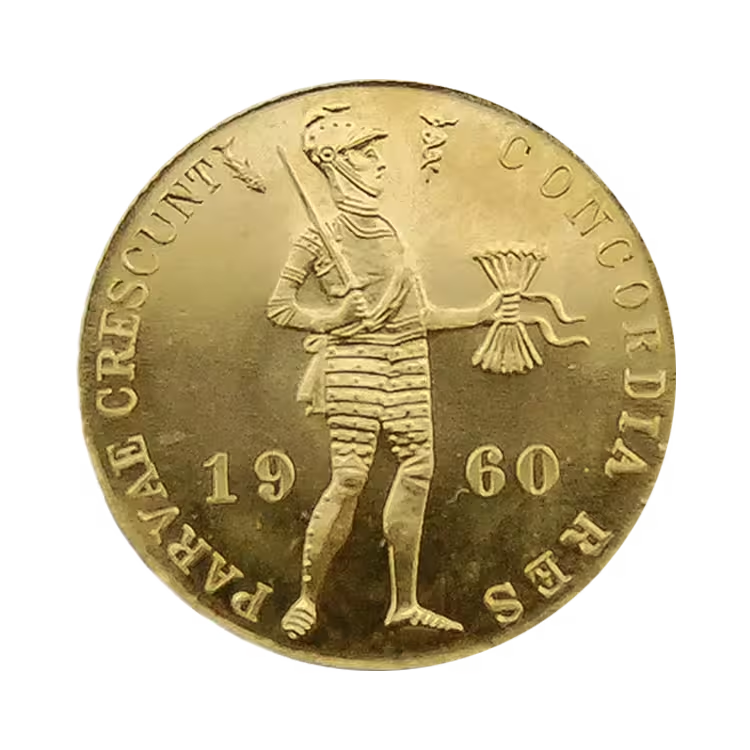
Gold Ducat coin with 3,43 gram fine gold. We offer gold Ducat coins from various years. The golden ducat has a total weight of 3,494 gram.
Related products
- Pre-owned
- Bestseller

- Pre-owned
- Bestseller


- Mint condition

- Pre-owned
- Bestseller


Specifications

Physical properties
Net weight

The net weight is determined by multiplying the gross weight with with the purity. |
3,43 gram |
| Purity and metal type | 98,3% | Gold |
| Gross weight | 3,49 gram |
Origin
| Country of origin | Netherlands |
| Mint | Koninklijke Nederlandse Munt |
| Year of issue | Mixed years |
Price properties
| Selling price | € 420,00 |
| Metal worth | € 395,63 |
|
Price per gram
The price per gram is determined by dividing the sales price by the net weight. |
€ 122,45 |
|
Premium
The premium is determined by substracting the metal worth and possible taxes from the sales price. |
€ 24,37 |
| Investment score | B-label |
| VAT-rate | Investment gold |
Other specifications
| Pick up possible | Yes |
| Storage possible | Yes |
| Availability | Delivery time: 3 weeks |
Information
Buy the Gold Ducat
The Royal Dutch Mint annually issues Golden Ducats. This particular proof-quality gold coin is minted in 98.3% pure gold, weighs 3.494 grams and has a diameter of 21 mm.
The Golden Ducat has remained unchanged for nearly 400 years, with the exception of minor changes in details. For example, minor changes have been made to the knight's equipment over time, and the decorations on the reverse have also been somewhat subject to "fashion" over the centuries.
Design Golden Ducat

Obverse
The front of the Golden Ducat depicts a knight. This knight with distinctive buttons has a sword and bundle of arrows in his hands. Along the edge is the motto: "Concordia Res Parvae Crescunt." This is Latin for "Unity makes small things great. The year of issue is also clearly shown in two parts. The front is finished with a border of dots.

Reverse
The back of the Golden Ducat always has the Latin text in the middle: "Mo. Aur. Reg. Belgii Ad Legem Imperii.", translated: Golden coin of the Kingdom of the Netherlands according to the law of the Empire. Around this text are beautiful (leaf) decorations with an acanthus motif and shells.
History of the Golden Ducat
Since August 4, 1586, the Golden Dukaat has been in the Dutch Mint Act in the capacity of a commercial currency. The Golden Dukaat originated in the Republic of Venice and was later minted in the Netherlands. The Golden Dukaat has always been a strong currency; for centuries these coins were an important means of payment in international trade. They had a good reputation for their reliable weight and content.
They were readily accepted in Scandinavia, Poland and Russia, and the Gouden Dukaat was also frequently used in trade with Asia. As a result, the Dutch Golden Ducat grew to become one of the most important trade coins in the world. The Royal Dutch Mint annually mints Double and Single Golden Ducats by order of the Ministry of Finance to keep the memory of the Netherlands' rich trading past alive.
The Gouden Dukaat is not legal tender but is a popular investment and collector coin. This is because the coins are assured of their content and weight. Also, the circulation of each year varies, making years with low circulation very popular with collectors.
Featured
- Dutch Trade coin with a rich history
- Struck in 3.494 grams of gold (98.3%)
- Yearly changing circulation
The images are indicative only. We supply Gold Ducats from various years.
Price chart
Koninklijke Nederlandse Munt
The Royal Dutch Mint (KNM) is a Dutch company responsible for minting coins. The company is located in Houten and has a rich history dating back to 1567, when the Mint of Utrecht was established. In 1807, the Royal Dutch Mint was founded, and in 1912 the company was granted the "Royal" designation.

 Investment score
A B-rating indicates products that are still widely recognized and tradable worldwide, often issued by reputable mints or refiners. However, the price per gram or spread is generally slightly higher compared to A-rated products. While still suitable for investment purposes, they are not the most cost-efficient option available.
Label information A-label
Read more
Less information
A-label
Read more
Less information
Products with an A-rating are among the most commonly traded and liquid options available. These coins and bars offer a strong balance between a competitive price per gram and a low spread, making them well-suited for investors who want to acquire physical gold or silver efficiently. Due to their global recognition, they are typically easy to buy and sell.
B-label
Read more
Less information
Een B-label staat voor producten die wereldwijd goed verhandelbaar zijn en afkomstig zijn van erkende munthuizen of raffinaderijen. De prijs per gram of de spread ligt echter doorgaans iets hoger dan bij A-label producten. Daarmee zijn ze nog steeds geschikt als belegging, maar minder optimaal voor wie puur kijkt naar kostenefficiëntie.
 C-label
Read more
Less information
C-label
Read more
Less information
Products with a C-rating are primarily valued for their collectible characteristics. This may include limited editions, unique designs, or historical significance. As a result, their price is often less closely tied to the underlying metal value. These products are typically chosen by collectors rather than investors focused on efficiency.


 Nederlands