
 Buy gold bars
 Buy gold coins
 Series
 Buy silver coins
 Buy silver bars
 Series
 Buy silver collectible coins
 Silver collectible coin series
 Buy gold collectible series
 Gold collectible coin series
 Delivery
 Delivery service - From Friday delivered

 Pick up


-
 Securily packaged
-
Buy back guarantee
-
Tradable world wide
-
Customer rating: 9.7
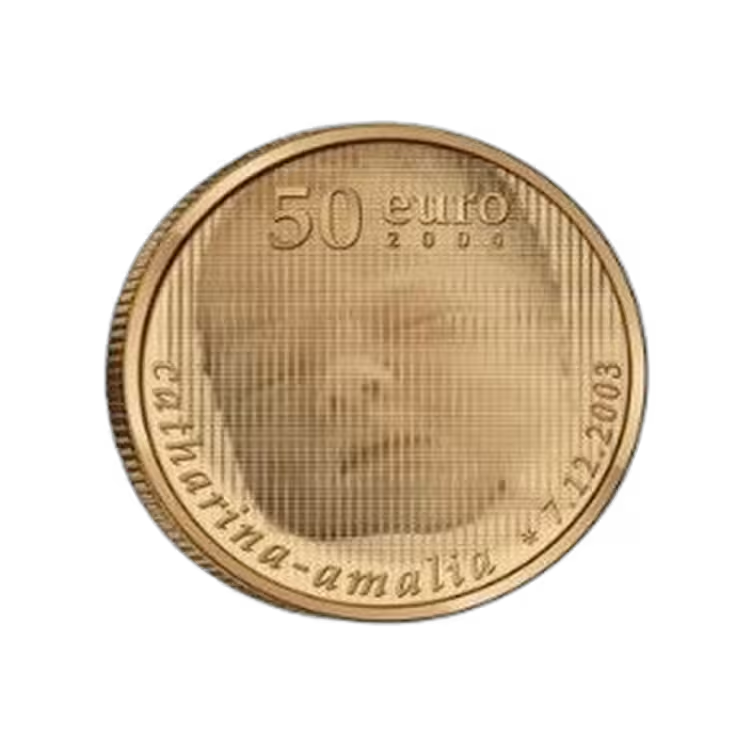
The Gold €50 Princess Amalia 2004 coin was issued by the Royal Dutch Mint to commemorate the birth of Princess Catharina-Amalia. The coin is struck in 90% gold, weighs 13.44 grams and contains approximately 12.1 grams of pure gold. This Dutch commemorative coin combines intrinsic gold value with a royal and historical theme.
Related products
- Almost sold out

- Almost sold out
- Pre-owned

- Discount
- Pre-owned

- Pre-owned
- Bestseller

- Mint condition

- Pre-owned
- Bestseller

Specifications

Physical properties
Net weight


The net weight is determined by multiplying the gross weight with with the purity. |
12,1 gram |
| Purity and metal type | 90% | Gold |
| Gross weight | 13,44 gram |
| Condition |
As good as new
In good condition with possible superficial scratches or stains, without affecting the value or buyback guarantee. |
Origin
| Country of origin | Netherlands |
| Mint | Koninklijke Nederlandse Munt |
| Year of issue | 2004 |
Price properties
| Selling price | € 1.586,00 |
| Metal worth | € 1.467,54 |
|
Price per gram
The price per gram is determined by dividing the sales price by the net weight. |
€ 131,07 |
|
Premium
The premium is determined by substracting the metal worth and possible taxes from the sales price. |
€ 118,46 |
| Investment score | C-label |
| VAT-rate | Investment gold |
Other specifications
| Pick up possible | Yes |
| Storage possible | Yes |
| Availability | In stock |
Information
Gold €50 Princess Amalia 2004 Coin
The Gold €50 Princess Amalia coin was issued in 2004 to commemorate the birth of Princess Catharina-Amalia on 7 December 2003. As the eldest daughter of King Willem-Alexander and Queen Máxima, she is first in the line of succession to the Dutch throne. The coin is struck in 90% gold, weighs 13.44 grams and contains approximately 12.1 grams of pure gold.
The Princess Amalia €50 coin design
The design is dedicated to the birth of Princess Amalia and refers to the young princess and her position within the Dutch Royal Family. With a face value of €50, the coin is an official Dutch legal tender commemorative issue.
Its royal theme and substantial gold content make the coin interesting to both collectors of Dutch commemorative coins and buyers of physical gold.
Buy the Gold €50 Princess Amalia 2004 Coin
The Gold Princess Amalia €50 coin contains approximately 12.1 grams of pure gold in the form of a Dutch commemorative coin. Its combination of intrinsic gold value, royal theme and historical significance gives it a distinctive character compared with regular gold bullion coins.
Price chart
Koninklijke Nederlandse Munt
The Royal Dutch Mint (KNM) is a Dutch company responsible for minting coins. The company is located in Houten and has a rich history dating back to 1567, when the Mint of Utrecht was established. In 1807, the Royal Dutch Mint was founded, and in 1912 the company was granted the "Royal" designation.

 Investment score
Products with a C-rating are primarily valued for their collectible characteristics. This may include limited editions, unique designs, or historical significance. As a result, their price is often less closely tied to the underlying metal value. These products are typically chosen by collectors rather than investors focused on efficiency.
Label information A-label
Read more
Less information
A-label
Read more
Less information
Products with an A-rating are among the most commonly traded and liquid options available. These coins and bars offer a strong balance between a competitive price per gram and a low spread, making them well-suited for investors who want to acquire physical gold or silver efficiently. Due to their global recognition, they are typically easy to buy and sell.
 B-label
Read more
Less information
B-label
Read more
Less information
Een B-label staat voor producten die wereldwijd goed verhandelbaar zijn en afkomstig zijn van erkende munthuizen of raffinaderijen. De prijs per gram of de spread ligt echter doorgaans iets hoger dan bij A-label producten. Daarmee zijn ze nog steeds geschikt als belegging, maar minder optimaal voor wie puur kijkt naar kostenefficiëntie.
C-label
Read more
Less information
Products with a C-rating are primarily valued for their collectible characteristics. This may include limited editions, unique designs, or historical significance. As a result, their price is often less closely tied to the underlying metal value. These products are typically chosen by collectors rather than investors focused on efficiency.


 Nederlands