
 Buy gold bars
 Buy gold coins
 Series
 Buy silver coins
 Buy silver bars
 Series
 Buy silver collectible coins
 Silver collectible coin series
 Buy gold collectible series
 Gold collectible coin series
 Author:
  Date: 18 March 2026
Why does the gold price rise or fall? The influence of interest rates, inflation, and geopolitics
 Rolf van Zanten
5 February 2026

The European Central Bank (ECB) firmly holds the reins of our economy. With every adjustment of the interest rate, they directly influence the return on your savings account and the value of your money. For investors in precious metals, this interest rate policy is an important factor.
A rising interest rate seems favorable for savers, but often does not outweigh inflation. Is the interest rate falling or is your euro silently losing purchasing power? Then gold (or another precious metal) shines as a safe investment.
In this article, you will discover exactly how the decisions of the ECB steer the price of precious metals and how you can optimally protect your wealth.
The European Central Bank (ECB) is the official central bank for all countries within the European Union that use the euro as legal tender.
From its headquarters in Frankfurt, this institution manages the common currency and determines the monetary policy for the entire eurozone. This policy is mostly based on fiat money.
The primary main goal of the ECB is clearly defined: maintaining price stability. In practice, this means that the central bank aims for an inflation rate of exactly two percent over the medium term.
This specific percentage is seen by economists as the ideal level to facilitate economic growth, without your euro losing its purchasing power at too rapid a pace.
As the European Union itself describes, guarding this stability is of crucial importance for the financial confidence of all European citizens, savers, and companies.
To keep inflation around this target of two percent, the ECB uses the interest rate as its main steering mechanism. The mechanism behind this directly determines the financial climate:
For a detailed look at this steering mechanism, De Nederlandsche Bank (DNB) offers clear explanations about monetary policy. As the national central bank, DNB works closely with the ECB to implement this European policy in the Netherlands.
By understanding how the ECB turns these interest rate dials, you can better estimate which economic phase we are in. This insight helps you make objective and rational choices for the structure of your own portfolio, fitting your personal horizon and goals.
The policymakers of the European Central Bank meet regularly at the headquarters in Frankfurt to assess the economic situation in the eurozone. These important monetary meetings typically take place every six weeks.
During these meetings, the governing council decides whether the main interest rates will be raised, lowered, or maintained.
At this moment, in the spring of 2026, the ECB is maintaining a stable policy. The deposit facility rate currently stands at 2.0 percent. The central bank is consciously choosing this calm course because inflation is slowly but surely cooling down towards the desired target of exactly two percent.
At the same time, the European economy is proving to be relatively resilient, despite various ongoing global uncertainties.
By holding the interest rate at this level for the time being, the ECB is trying to find a perfect balance. They want to definitively suppress inflation, without unnecessarily slowing down economic growth in Europe with overly expensive loans for consumers and businesses.
For investors and savers, it is wise to keep an eye on the central bank's agenda. Every slight change in the bank's tone can immediately set the financial markets in motion.
The next monetary policy meetings of the ECB are scheduled for March 19, 2026, and April 30, 2026. During the subsequent press conferences, financial markets worldwide analyze every word in search of new signals about the future interest rate path. After all, these decisions directly dictate the conditions for your wealth accumulation in the coming months.
The Governing Council of the ECB meets several times a year, but not every meeting is about interest rates. The monetary policy meetings are the moments when the market pays the most attention to possible interest rate adjustments and the explanation from the ECB President.
For 2026, monetary policy meetings are scheduled for, among others, March 18 and 19, April 29 and 30, June 10 and 11, July 22 and 23, September 9 and 10, October 28 and 29, and December 16 and 17.
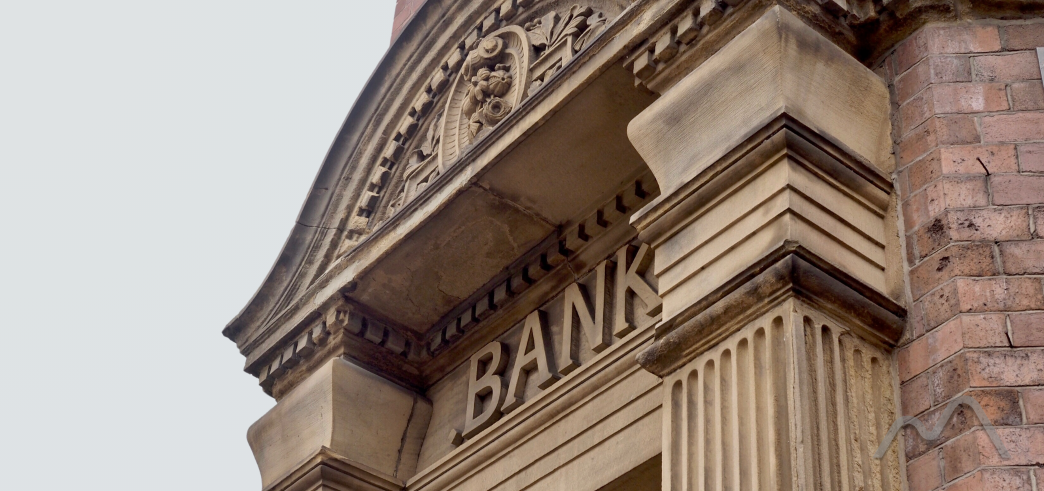
A low interest rate or high inflation, makes investing in physical gold very interesting.
For you as an investor, the ECB's interest rate policy is an important factor to monitor. There is a strong historical correlation between interest rates, inflation, and the attractiveness of precious metals.
Although the gold price often plays the leading role in the media, the decisions in Frankfurt also have a significant impact on the prices of silver and platinum.
When the European Central Bank raises the interest rate, the returns on alternatives such as savings accounts and European government bonds increase. Physical precious metals do not pay a monthly dividend or annual interest.
A rising interest rate therefore means that holding precious metals becomes relatively more expensive, because you miss out on safe interest. Economists call this opportunity costs. When interest rates rise, large institutional investors often choose to sell a portion of their precious metals. This typically puts a temporary brake on prices.
As soon as the ECB lowers the interest rate, or when inflation is structurally higher than the interest return on your bank account, this mechanism turns resolutely around. Your savings lose actual purchasing power in that scenario.
When this real interest rate becomes negative, precious metals shine as the ultimate safe investment. Investors flock massively to this physical capital to protect the value of their wealth. This strongly drives up global demand and prices.
Although the market for precious metals often moves in the same direction, the specific metals react slightly differently to the central bank's policy. This has everything to do with the unique properties and industrial applications of each individual metal.
Below you can see exactly how the different precious metals react to the macroeconomic steering of the ECB:
| Precious metal | Primary driver | Reaction to ECB policy |
|---|---|---|
| Gold | Monetary and safe haven | Responds most strongly to pure interest rates and inflation expectations. Gold benefits maximally when the ECB lowers interest rates or when inflation erodes purchasing power. |
| Silver | Monetary and industrial | Has a dual role. Benefits from low interest rates as a safe haven, but also increases extra in value if the ECB successfully stimulates the economy (more industrial demand for solar panels and electronics). |
| Platinum | Largely industrial | Highly sensitive to economic growth. If the ECB stimulates European industry (such as the automotive and hydrogen sectors) with its policy, the demand for platinum increases immediately. |
By understanding these nuances, you can structure your portfolio strategically. An interest rate cut by the ECB can, for example, be an excellent moment for silver, while gold forms the stable foundation during periods of persistent inflation.
The theory behind interest rates and precious metals is clear, but financial history provides the real evidence. When we look at recent moments of economic crisis, we see in practice exactly how the emergency policy of the European Central Bank influences the value of physical gold.
During major global shocks, the ECB is almost always forced to drastically lower interest rates. They do this to stimulate a faltering economy with cheap money. For savers, this monetary easing is disadvantageous, but for investors in precious metals, this is precisely the phase in which gold maximally proves its purchasing power.
Below we highlight two defining periods from recent financial history to provide insight into the reaction of the gold price:
| Period and event | Monetary policy of the ECB | Reaction of the gold price (in euros) |
|---|---|---|
| Financial Crisis (2008 to 2011) | Significant interest rate cuts from over 4% to 1% to save the financial system. | The gold price rose by over 80% during this extremely uncertain period. |
| COVID-19 pandemic (2020) | Maintaining zero interest rates and introducing massive financial stimulus packages. | The gold price reached new records at the time and rose by over 14% in 2020 alone. |
This historical data illustrates a fundamental economic law. As soon as confidence in the financial system drops and central banks open the money taps with low interest rates, capital worldwide flees to tangible security.
In such periods, physical gold consistently reacts as the most robust and independent investment for your accumulated capital.
Although the European Central Bank steers the financial markets with interest rate decisions and digital money, the institution itself leans heavily on the age-old certainty of physical precious metals.
The ECB and the affiliated national central banks of the Eurosystem are collectively even among the largest gold owners in the world.
The hard numbers speak for themselves. The ECB itself currently owns more than 506 tonnes of pure gold. If we look at the broader picture and add the gold reserves of all affiliated national banks (such as De Nederlandsche Bank), the total strategic gold reserve of the eurozone amounts to over 10,000 tonnes.
Interesting? Check out our article with an overview of the 10 countries with the highest gold reserves.
This enormous gold holding fulfills a fundamental function within our monetary system. The precious metal serves as the absolute emergency reserve and a tangible anchor of trust.
Unlike currency reserves or government bonds, physical gold has no counterparty risk. It cannot go bankrupt, and its value does not depend on the promise of a specific government or financial institution. For central banks, this gold reserve forms an extremely reliable buffer.
Should an unprecedented global crisis occur in which confidence in the financial system completely collapses, gold will always retain its universal purchasing power and exchangeability.
The fact that the highest monetary authorities in the world hold so strongly to their precious metal sends a crystal-clear signal. If the institutions that create our money and determine the interest rates themselves use physical gold as their safe investment, this emphasizes the unparalleled power of precious metals as a protector of wealth.
For many private investors, this policy of the central banks is an important confirmation to similarly anchor their own portfolio partly with gold.
Yes, the European Central Bank owns and buys physical precious metals. Together with all affiliated national central banks, they form one of the largest gold owners worldwide. They view gold as a monetary buffer and an important foundation for trust in our financial system.
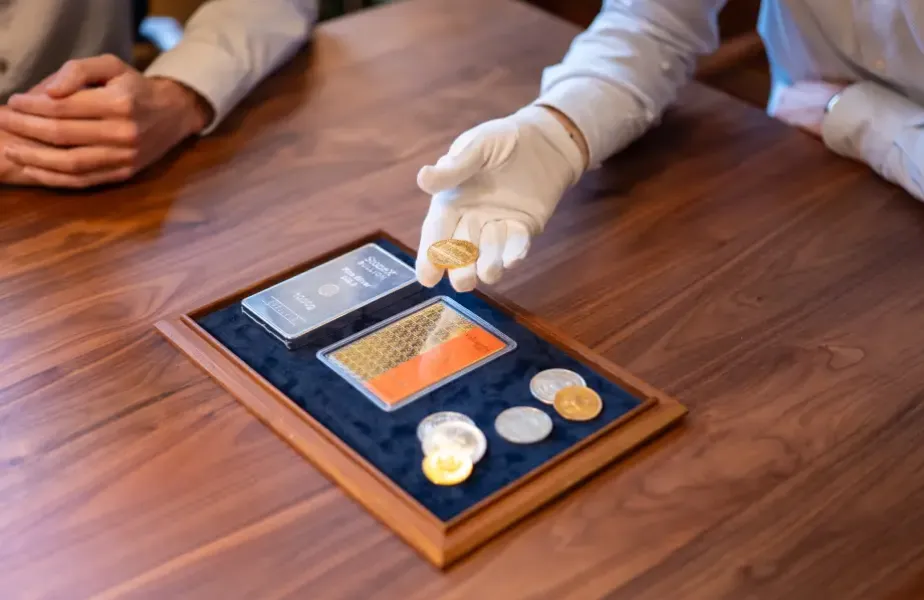
The European Central Banks together own more than 10.000 tonnes of gold.
Although the European Central Bank determines your savings in Europe, the American central bank should absolutely not be overlooked. The Federal Reserve (often simply called the FED) has an equally significant influence on the global precious metals market. This is because the international gold price is basically always expressed and traded in US dollars.
The monetary policy in Washington therefore has a direct effect on the purchasing power of European gold buyers. The interaction on the financial markets usually works through the two scenarios below:
| Economic situation in the US | Action by the FED | Impact on the US Dollar | Consequence for gold (European buyer) |
|---|---|---|---|
| Rising inflation | Raises interest rates firmly | Dollar becomes stronger | Gold becomes relatively more expensive, causing temporary price pressure. |
| Contraction or deflation | Lowers interest rates drastically | Dollar becomes weaker | Gold becomes cheaper and global demand rises enormously. |
Just like the European Central Bank, the American FED is currently maintaining an extremely cautious course. During the most recent policy meeting in March 2026, the central bank decided to keep the main policy rate stable.
The policymakers in America base this wait-and-see pause on the following current points:
The decisions of the European Central Bank and the American FED have a direct impact on current interest rates and inflation. Although your savings benefit in the short term from a higher interest return, the real interest rate often remains negative in practice. As a result, your money in the bank still silently loses its purchasing power.
Physical gold has proven itself through the decades as the ultimate shield against this currency devaluation. Even the highest central banks massively rely on precious metals as their most important, tangible reserve.
Do you want to secure your purchasing power in the long term and be less dependent on the fickle interest rate policies of governments? Discover your options today and buy physical gold or buy silver safely and securely at The Silver Mountain.
The Silver Mountain does not provide individual investment advice. This article is intended for information purposes only. Expectations, scenarios, market developments, and past results offer no guarantee for future results.
In the spring of 2026, the European Central Bank is keeping the main interest rates stable. The deposit facility rate currently stands at exactly 2.0 percent. The bank is opting for this pause because inflation in the eurozone is slowly but surely cooling down towards the established target of two percent.
Historically, a lower interest rate is highly favorable for the gold price. Because physical precious metal pays no interest, it becomes more attractive as soon as the returns on savings accounts drop. Investors move their capital massively into gold to protect their purchasing power, which directly drives up global demand and prices.
The European Central Bank itself currently owns over 506 tonnes of physical gold. When we add the strategic gold reserves of all affiliated national banks within the Eurosystem to this, the total gold holding amounts to over 10,000 tonnes. This metal functions as an independent emergency reserve and ultimate anchor of trust.
The American Federal Reserve has an enormous influence because the international gold price is always traded in dollars. When the FED raises interest rates, the dollar strengthens and gold becomes relatively more expensive for European buyers. With an interest rate cut, the dollar weakens and gold prices generally rise significantly.
Gold reacts primarily to interest rates and inflation expectations as the ultimate safe haven. Silver, however, fulfills a dual role. In addition to its monetary function, silver is also widely used industrially. As a result, the silver price often rises exceptionally fast when the ECB successfully stimulates the European economy and industry with low interest rates.
The policymakers of the European Central Bank meet every six weeks in Frankfurt for their important monetary meetings. The next dates on which they may present new interest rate decisions are currently scheduled for March 19, 2026, and April 30, 2026. Financial markets always follow these press conferences closely.
The real interest rate is the interest return on your savings account minus current inflation. Because inflation often turns out to be higher than the savings interest, this real return is frequently negative in practice. This invisible loss of purchasing power is the main reason for many investors to convert their wealth into precious metals.
Yes, although platinum is primarily driven by industrial demand, interest rates play a major role. A low interest rate stimulates the European economy, which creates more industrial production in, for example, the hydrogen sector and the automotive industry. This directly further fuels the industrial demand and the price of platinum.
Rolf van Zanten is the founder and owner of The Silver Mountain, a specialist in physical precious metals since 2008. With nearly twenty years of experience in the precious metals trade, Rolf shares his expertise on investing in gold, silver, and platinum in an accessible and reliable way. His knowledge of the international gold and silver markets helps investors make well-informed decisions. In his role as an expert, he strives to ensure that transparency, security, and trust are at the heart of every purchase.

Be the first to discover the latest products and the latest news about precious metals.



 Nederlands