
 Buy gold bars
 Buy gold coins
 Series
 Buy silver coins
 Buy silver bars
 Series
 Buy silver collectible coins
 Silver collectible coin series
 Buy gold collectible series
 Gold collectible coin series
 Author:
  Date: 22 March 2026
The influence of the ECB on interest rates: what does this mean for investors in precious metals?
 Rolf van Zanten
18 March 2026
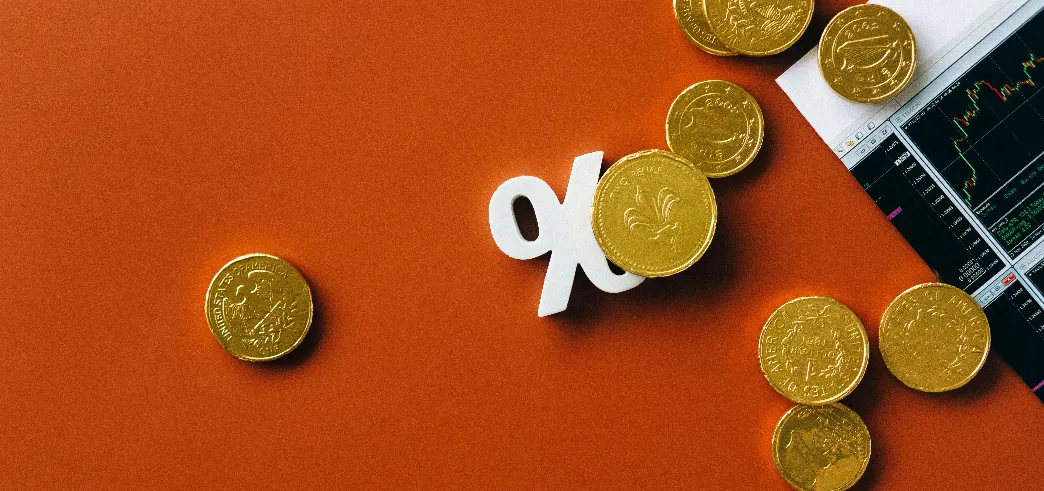
What happens to €10,000 if you let it yield returns for twenty years through compound interest? And what happens if you allocate that same amount to physical gold as a protection of purchasing power? That question touches the core of wealth management: do you primarily choose growth, preservation or a combination of both?
Compound interest revolves around wealth growth by reinvesting returns. Physical gold has a different role. It does not pay interest or dividends, but is often used as a tangible buffer against inflation, currency risk and economic uncertainty.
In this article, we compare both approaches and you will read which strategy best suits your financial goals. Will you choose compound interest or gold?
Compound interest is the financial principle where you earn a return on your initial investment plus the previously earned profits. Financial experts often describe this phenomenon as the most powerful engine behind structural wealth growth.
The difference between simple and compound interest is fundamental. With simple interest, you only receive compensation on your starting capital. This capital basically always remains the same. With compound interest, you consciously choose to proactively reinvest your returns.
As a result, your total wealth does not grow linearly, but exponentially. The effect is comparable to a small snowball rolling down a steep mountain, increasing in size faster and faster.
For the investor who wants to understand exponential growth exactly, financial professionals use a fixed formula to calculate compound interest:
A = P(1 + r/n)^(nt)
To perform this calculation yourself, use the following fixed variables:
Suppose you invest €10,000 at an average annual return of 7%. After 10 years, this amount will grow to approximately €19,672. After 20 years, this is approximately €38,697. If the return is continuously reinvested, the snowball effect arises that makes compound interest so powerful.
This calculation also immediately shows the difference with physical gold. Gold can increase in value, but it does not pay out any interest or dividend itself. Therefore, there is no automatic return-on-return effect with gold, unless increases in value are actively realized and reinvested.
This formula shows that while the theory is beautiful, in practice, this growth engine only works optimally when three crucial factors converge in your investment strategy:
Within traditional wealth management, compound interest is almost always linked to broadly diversified stock portfolios. This path requires patience and the stomach to accept interim market fluctuations.
For precious metal investors, it is important to understand this mechanism. It directly explains why physical gold fulfills a substantially different, stabilizing function within your total portfolio.
While compound interest revolves around the continuous reinvestment of earned profits, physical gold takes a fundamentally different approach to wealth management. Gold is an inanimate, tangible element and does not produce cash flow on its own.
You receive no monthly dividend and no annual interest compensation. Therefore, the well-known snowball effect of exponential growth is not directly applicable here.
Why then do investors and central banks choose this precious metal en masse? The power of physical gold lies not in increasing your nominal wealth, but in protecting your existing purchasing power.
This unique wealth preservation is driven by three fundamental properties of the metal:
Regular fiat money (such as the euro or the dollar) can theoretically be created by central banks in unlimited quantities. This continuous expansion of the money supply lowers the value of your savings.
Physical gold, however, cannot be printed. The global supply is physically limited and grows only marginally through complex and costly mining.
Precisely because of this indisputable scarcity, gold retains its intrinsic value over long periods. When regular money falls in purchasing power due to persistent inflation, the gold price in that same currency almost always rises historically.
In practice, the precious metal acts as a reliable mirror for the devaluation of our money.
Physical gold under your own management or in secure storage has no counterparty risk. Your investment is not dependent on the profit figures or policy of a listed company, the stability of a commercial bank, or the political choices of a government. It is an asset with a universally accepted value.
The primary goal of investing in gold is therefore not to double your capital rapidly on paper. It is a strategic defensive choice. You invest in precious metals to build in the certainty that your wealth will be able to purchase exactly the same amount of goods and services in twenty years as it can today.
Within a well-thought-out investment portfolio, gold forms the perfect, stabilizing counterweight to your more high-risk growth stocks.

Compound interest enables exponential wealth grow.
Let's contrast these two theories with the harsh reality of the financial markets. For the compound interest approach, we look at the MSCI World. This is a broadly diversified stock index that follows the performance of the largest listed companies from developed countries.
For the purchasing power strategy, we look purely at the historical price development of physical gold in euros.
Looking at the data over a period of more than 47 years (from December 1978 to early 2026), we see a clear difference in average growth. The MSCI World achieved an average compounded annual growth rate (CAGR) of 10.43 percent. Physical gold recorded an average value increase of 7.12 percent per year over the same period.
What this mechanism of interest on interest and these historical averages mean concretely for a one-time starting capital of €10,000 is shown in the overview below:
| Duration | Physical Gold Result (at 7.12% average) | MSCI World Result (at 10.43% average) |
|---|---|---|
| After 10 years | € 19,893 | € 26,969 |
| After 20 years | € 39,574 | € 72,735 |
(Note: These are historical gross averages. Past performance is no guarantee of future results, and any storage or management costs are not included here).
The table above shows the impressive growth power of stocks over several decades. Yet this only tells half the story. Stock markets are volatile and rarely rise in a straight line.
Investors in the global stock market have faced a so-called 'maximum drawdown' in the past. This is the maximum value decrease measured from a historical peak. For the MSCI World index, that decline at its heaviest point was no less than 33.91 percent.
Successfully building wealth through compound interest therefore requires a long-term perspective and a strong stomach.
Precisely at times when the financial system is under heavy pressure and stock markets correct sharply, gold proves its unique value as a stabilizer in your portfolio. Historical data shows that gold excels when economic uncertainty increases:
This exactly underscores the fundamental difference between the two strategies. Stocks and the associated compound interest historically form the strongest engine for wealth growth during periods of economic prosperity.
Physical gold, on the other hand, is historically proven better in protecting your accumulated capital when the financial system shows cracks.
The choice between compound interest through stocks and protecting your purchasing power via physical gold is rarely an absolute one in practice. Professional wealth managers know that these two worlds complement each other perfectly.
How much you tip the scales in one direction or the other depends on your personal financial life phase, your time horizon, and your risk profile. We roughly distinguish two profiles:
You primarily choose compound interest through stocks or index funds when you are at the beginning or middle of your financial journey. This strategy fits perfectly if you:
You strategically choose a heavier weighting in physical gold when your priorities shift from aggressive growth to defensive certainty. You choose precious metals when you:
| Strategy | Main Advantages | Main Disadvantages |
|---|---|---|
| Compound Interest (Stocks / ETFs) | 1. Ensures exponential wealth growth in the long term. 2. Often generates passive income via structural dividend payments. 3. Historically yields the highest percentage return. |
1. Very high volatility and potential for significant interim price drops. 2. Fully dependent on the financial system (counterparty risk). 3. Requires a very long time horizon and a lot of discipline. |
| Physical Gold (Purchasing Power) | 1. Structurally protects your accumulated purchasing power against inflation. 2. Zero counterparty risk or dependence on banks. 3. Acts as a safe and stable-value haven during severe crises. |
1. Does not pay out passive income (like dividends or interest). 2. The engine of exponential growth (return on return) is missing. 3. Requires an external solution for safe and insured storage. |
However, gold can lag behind stock markets for longer periods, especially in periods of economic growth, rising corporate profits and relatively stable inflation.
For most successful investors, the ultimate truth lies in the middle. You use the stock market to grow your wealth and you use physical precious metals to protect that same wealth.
Within a well-diversified and mature investment portfolio, experts often maintain a strategic allocation of five to ten percent in physical gold or silver. These precious metals form a solid and stress-free foundation under your portfolio.
They provide the necessary financial peace of mind and stability, regardless of the whims of the global economy or the volatility of the day on the stock exchange.
In the long term, stocks historically often yield higher returns than gold, mainly due to price growth, dividends and the return-on-return effect. Gold pays no interest or dividends, but can preserve value in periods of inflation or uncertainty. Therefore, gold fits mainly as a defensive addition within a portfolio.
Compound interest and investing in physical precious metals are not mutually exclusive. In fact, within a mature and well-thought-out investment portfolio, they complement each other seamlessly.
Where compound interest through the stock market acts as the most powerful engine for your future wealth growth, physical gold works as a reliable insurance of your current purchasing power.
By smartly combining these two fundamentally different strategies, you build robust wealth that is resistant to both economic heydays and unexpected global crises.
Do you want to immediately lower the risks within your current portfolio and take the logical step towards tangible wealth preservation? Discover our extensive range of coins and bars and choose to buy physical gold or silver safely and securely at The Silver Mountain.
The Silver Mountain does not provide investment advice. This article is for educational purposes only. Past performance is not indicative of future results.
Compound interest is the principle where you earn a return on your initial investment and on all previously earned profits. By structurally reinvesting returns, a snowball effect is created, allowing your total invested capital to grow exponentially over the long term
You calculate compound interest by multiplying your starting capital by the expected return plus one, to the power of the number of years. The mathematical formula is A = P(1 + r/n)^(nt). There are countless handy online calculation tools that solve this complex and exponential math problem for you instantly.
No, physical gold does not pay out regular dividends or monthly interest. Therefore, you do not benefit from the exponential return-on-return effect with precious metals. The primary financial advantage of gold lies in its historical price increases and the absolute and structural protection of your purchasing power.
Stocks are high-risk investments primarily aimed at exponential wealth growth through compound interest. Physical gold, however, is a defensive asset without counterparty risk, specifically designed for safe wealth preservation. An optimal and balanced portfolio typically combines stocks for growth and physical precious metals for stability.
Yes, physical gold is globally known as the ultimate inflation shield. Because precious metal is naturally scarce and cannot be printed limitlessly by central banks, it retains its intrinsic value. Historically, the gold price almost always rises in line with real inflation and currency devaluation.
Physical gold held personally or in vault storage has zero counterparty risk. Your asset is not dependent on the profit figures of listed companies or the stability of commercial banks. This makes precious metal a safe, independent, and universally accepted safe haven when the regular financial system is under pressure.
Absolutely, these two totally different strategies complement each other perfectly. Financial experts use stocks or index funds as the powerful engine for future wealth growth. Additionally, they advise a fixed weighting of five to ten percent in physical gold as a reliable and robust insurance of purchasing power.
The main disadvantage is the high degree of volatility. To fully benefit from compound interest on the stock market, a very long time horizon is required. Furthermore, you must be emotionally and financially able to withstand significant interim price drops and temporary economic setbacks without panicking.
Rolf van Zanten is the founder and owner of The Silver Mountain, a specialist in physical precious metals since 2008. With nearly twenty years of experience in the precious metals trade, Rolf shares his expertise on investing in gold, silver, and platinum in an accessible and reliable way. His knowledge of the international gold and silver markets helps investors make well-informed decisions. In his role as an expert, he strives to ensure that transparency, security, and trust are at the heart of every purchase.

Be the first to discover the latest products and the latest news about precious metals.



 Nederlands